
For over a decade, Dr. Fundaro, armed with a PhD in Human Nutrition and vast experience, had relied on macro counting to maintain her physique and performance through six powerlifting competitions. However, the initial utility of this precise dietary management eventually gave way to a pervasive sense of rigidity and anxiety. The constant calculation and adherence to external targets began to erode her innate confidence in her food choices. She yearned for the freedom to enjoy meals without the omnipresent worry that her health or physique would falter if her macros weren’t perfectly balanced. This internal conflict, a paradox for someone so knowledgeable in the field, highlighted a common struggle for many individuals immersed in fitness and nutrition culture. The fear of "losing all my muscle" or "gaining fat" without the guardrails of tracking became a significant psychological barrier, even for an expert.
The Search for a Sustainable Alternative
Dr. Fundaro’s growing discontent with macro tracking propelled her to seek an alternative that could reconcile her nutritional goals with a sense of peace and autonomy around food. Traditional calorie counting was immediately dismissed as equally, if not more, restrictive. Intuitive eating, while promoting internal cues, also presented challenges. After years of prioritizing external metrics, Dr. Fundaro felt her internal compass for hunger and fullness was muted, leaving her desiring a more structured framework than intuitive eating typically offered. This highlighted a critical gap: the need for a method that bridged the gap between rigid external control and unstructured internal listening.
Coincidentally, during this period, Dr. Fundaro was integrating the Rate of Perceived Exertion (RPE) scale into her powerlifting training. Developed by Gunnar Borg in the 1960s, RPE provides a subjective yet quantifiable measure of effort during physical activity, typically ranging from 0 (no exertion) to 10 (maximum effort). Athletes use it to autoregulate their training, ensuring they work effectively without overtraining, aligning intensity with their daily readiness. Dr. Fundaro observed that this blend of self-assessment and structured guidance allowed her to train more effectively and recover better. It was this successful application of structured intuition in her physical training that sparked a profound realization: if RPE could optimize her workouts, couldn’t a similar principle guide her eating habits?
Introducing the RPE-Eating Scale
This pivotal insight led to the creation of the RPE-Eating Scale. By adapting the core principles of RPE to hunger and fullness cues, Dr. Fundaro developed a framework designed to help individuals, including herself and her clients, cultivate greater confidence and self-trust around food, enhance nutritional awareness, and ultimately liberate themselves from the confines of continuous food tracking. This method moves beyond the binary of "on-track" or "off-track" eating, fostering a more nuanced and sustainable relationship with nourishment. It offers a structured path for those who feel lost without tracking but aren’t yet comfortable relying solely on unguided intuition.
The original RPE scale, often seen in fitness, uses a 0-10 range to categorize perceived exertion levels:
- 0: No exertion, at rest
- 1: Very light
- 2-3: Light
- 4-5: Moderate, somewhat hard
- 6-7: High, vigorous
- 8-9: Very hard
- 10: Maximum effort, highest possible
This scale, initially used in physiotherapy, gained widespread acceptance in sports science and fitness for its ability to personalize training intensity. Its strength lies in acknowledging the subjective nature of human experience; while a coach provides guidance, the individual ultimately interprets what a "7/10" effort feels like for their body on that specific day. Dr. Fundaro applied this same philosophy to eating, creating a parallel 1-10 scale for hunger and fullness. The goal is to empower individuals to discern their own needs without external validation, fostering a profound sense of autonomy.
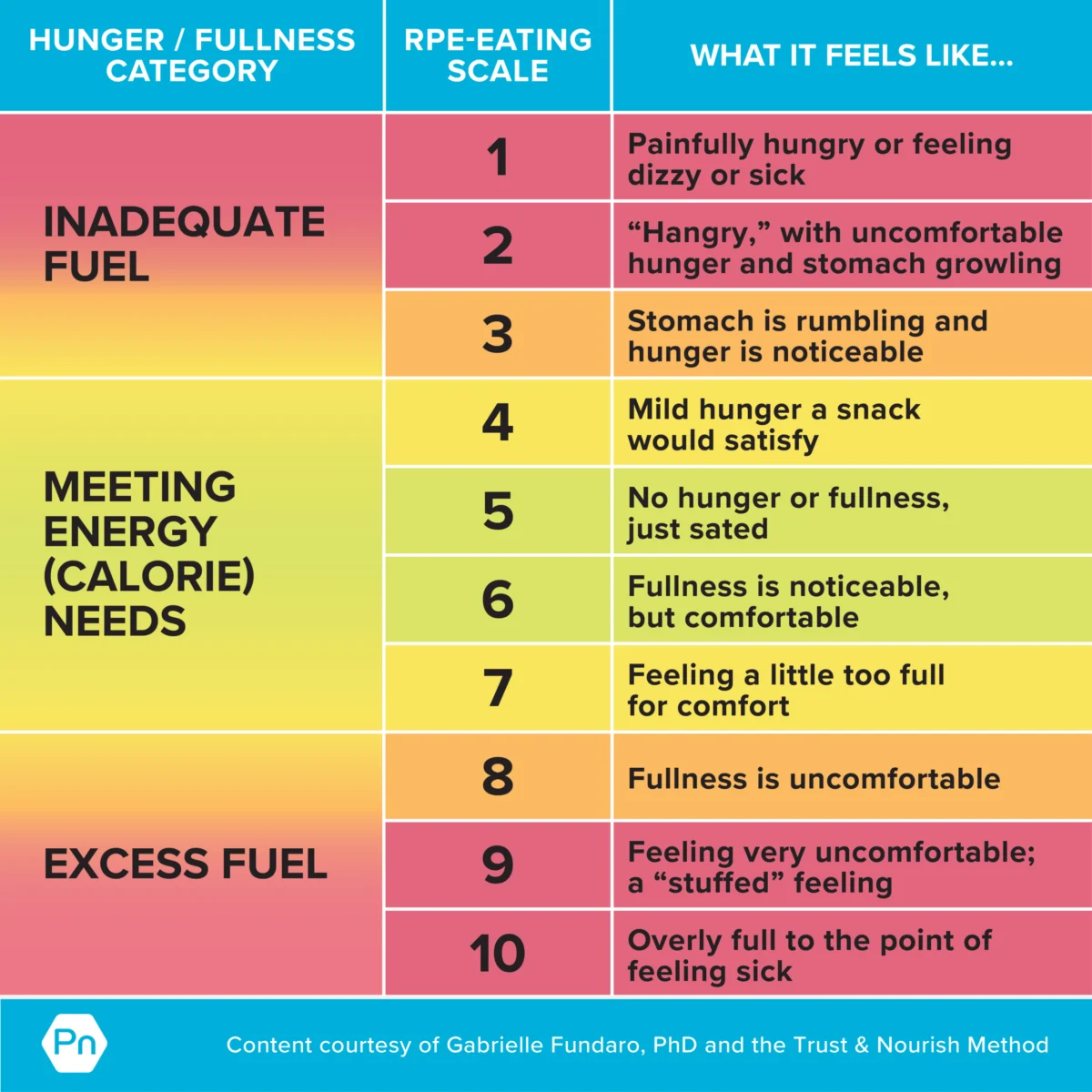
The RPE-Eating Scale, as envisioned by Dr. Fundaro, provides a gradient for internal food cues:
- 1: Painfully hungry, dizzy, or sick
- 2: "Hangry," uncomfortable hunger, stomach growling
- 3: Hunger noticeable, stomach rumbling
- 4: Mild hunger, a snack would satisfy
- 5: No hunger or fullness, just sated
- 6: Noticeable fullness, but comfortable
- 7: A little too full for comfort
- 8: Uncomfortable fullness
- 9: Very uncomfortable or "stuffed"
- 10: Overly full to the point of feeling sick
This scale provides a language for internal sensations, a crucial step for individuals who have become disconnected from their bodies due to prolonged external tracking. It’s not about perfection but about building a skill set in interoceptive awareness – the ability to perceive and understand internal bodily signals. Research consistently highlights the importance of interoceptive awareness for self-regulation, emotional well-being, and making informed health decisions. By systematically categorizing hunger and fullness, RPE-Eating helps re-establish this vital connection.
Practical Application of RPE-Eating
Implementing RPE-Eating, much like RPE-training, requires consistent practice and patience. It acknowledges that reconnecting with internal cues takes time, especially after years of relying on external metrics.
Step 1: Clarify Your Goals.
Dr. Fundaro emphasizes that RPE-Eating is not merely another diet focused on body transformation or strict control. Instead, its primary aim is to foster inner trust and confidence in one’s ability to provide appropriate nourishment. This philosophical distinction is critical. While it can be adapted for physique goals, its core value lies in building a healthier, more intuitive relationship with food. In a society often fixated on specific body ideals and quick fixes, RPE-Eating offers a refreshing counter-narrative, prioritizing well-being and psychological freedom over rigid adherence to external body metrics. This goal clarification helps set realistic expectations and prevent the approach from being misused as another restrictive diet.
Step 2: Practice Identifying Hunger Cues.
This step involves distinguishing between true physiological hunger and psychological appetite. Hunger is driven by physical sensations (e.g., stomach emptiness, lightheadedness) signaling the body’s need for energy. Appetite, conversely, is the desire to eat, often influenced by sensory appeal, emotional states, or social cues, and can persist even after hunger is satisfied. Studies in nutritional psychology show that chronic dieting can disrupt the body’s natural hunger-satiety signaling, making this distinction challenging.

To practice, individuals are encouraged to use the RPE-Eating scale before, during, and after meals. Before eating, one assesses their hunger level. During the meal, ideally eaten mindfully without distractions, another check-in helps gauge evolving hunger. Finally, upon completion, a final rating helps internalize the feeling of comfortable fullness. This iterative process, repeated consistently, gradually recalibrates the body’s internal feedback system, making individuals more attuned to their actual needs rather than external triggers.
Step 3: Recognize Non-Hunger Triggers.
Life’s stresses, emotions, and environmental cues often drive eating behaviors unrelated to physiological hunger. This "emotional eating" is a common human experience, with research indicating that stress, boredom, sadness, or even happiness can trigger a desire for food. The RPE-Eating framework encourages individuals to become aware of these non-hunger triggers through a process of "Notice and Name." This involves pausing to identify the underlying emotion or situation preceding compulsive eating.
Once identified, the next crucial step is to explore alternative coping mechanisms. Instead of automatically turning to food for comfort, individuals are prompted to consider what they truly need: perhaps a brief walk, a moment of deep breathing, connecting with a friend, or engaging in a hobby. Diversifying coping strategies reduces reliance on food as the sole emotional regulator, leading to more intentional and less reactive eating patterns. This process aligns with principles of mindfulness and cognitive behavioral therapy, which are widely recognized for their efficacy in managing emotional eating.
Step 4: Embrace Satiety and Satisfaction.
Effective eating, according to RPE-Eating, extends beyond mere physical satiety—the feeling of being physically full and having met caloric needs. It also encompasses satisfaction, a more holistic sense of contentment and pleasure derived from the meal. Many restrictive diets may lead to satiety but leave individuals feeling emotionally deprived, often leading to cravings and eventual overeating or binging. This concept is supported by psychological research demonstrating that perceived restriction can increase desire for "forbidden" foods, creating a cyclical pattern of deprivation and indulgence.
Satisfaction integrates the sensory experience, cultural significance, and emotional enjoyment of food. RPE-Eating advocates for including genuinely enjoyed foods in one’s diet, even those previously deemed "off-limits." By practicing the scale with a variety of meals, including indulgent ones, individuals learn that they can adequately fuel themselves while also experiencing pleasure, without the need for strict external policing. This approach fosters flexibility, spontaneity, and a healthier psychological relationship with food, moving away from the restrictive mindset that often characterizes traditional dieting.
Is RPE-Eating Right for You? Broader Implications and Considerations
RPE-Eating offers a valuable tool for specific populations. It is particularly beneficial for those who feel overly dependent on food tracking but wish to disengage, individuals experiencing anxiety or a loss of control when attempting to stop tracking, or those seeking a structured guidance system without the rigidity of macro counting. Critically, it is also recommended for individuals with elevated risk factors for developing eating disorders, such as a history of yo-yo dieting, disordered eating patterns, high body dissatisfaction, or participation in weight-class sports. For these individuals, the constant focus on external metrics like macros can exacerbate existing vulnerabilities, making a shift towards internal awareness a safer and more therapeutic approach. However, Dr. Fundaro and other experts emphasize that RPE-Eating is not a substitute for professional medical or psychological help for diagnosed eating disorders.
Regarding weight modification, Dr. Fundaro advocates for RPE-Eating primarily in a weight-neutral context, focusing on internal well-being rather than external numbers. She acknowledges that while it can be adapted for weight management, it should not be treated as a direct replacement for highly precise, outcome-driven methods like macro tracking for extreme physique goals (e.g., bodybuilding competition prep). For modest weight gain, individuals might aim to consistently eat within the 7-8 range on the RPE-Eating scale (noticeable fullness). Conversely, for gradual weight loss, aiming for the 4-5 range (mild hunger to comfortably sated) could be appropriate. This provides a gentle, self-regulated approach, contrasting with the often aggressive and potentially risky strategies associated with extreme weight manipulation.
Addressing Skepticism: "Feelings Over Facts?"
The concept of RPE-Eating, relying on subjective internal sensations, might initially draw skepticism, much like RPE in fitness once did. However, just as RPE is now a widely accepted and scientifically validated method for training autoregulation, RPE-Eating grounds itself in the science of interoceptive awareness. Studies consistently demonstrate that developing this awareness enhances an individual’s ability to make informed decisions about their body’s needs.
The perceived "subjectivity" is, in fact, its strength, allowing for a personalized approach that external metrics often miss. While blood glucose monitors offer objective data, the constant monitoring can be impractical and may overshadow the body’s natural hunger signals. RPE-Eating provides a more accessible and convenient way to tap into these physiological cues, such as stomach rumbling or general hunger pangs, which correlate with fluctuating blood sugar levels. This skill-building approach, though imperfect and requiring practice, fosters a deeper, more sustainable connection between mind and body than mere data tracking.
Potential Downsides and Conclusion
Despite its benefits, RPE-Eating is not a universal solution. It demands significant attention and reflection on one’s physical and emotional states, which can be challenging for individuals with demanding schedules, such as parents of young children or those with jobs requiring constant on-the-go eating. For these individuals, Dr. Fundaro suggests selective application—using the method during quieter meals or focusing on isolated steps, such as simply identifying hunger and fullness cues, without attempting to overhaul their entire eating routine.
Ultimately, RPE-Eating serves as a vital "off-ramp" for those seeking to transition away from rigid and potentially psychologically taxing macro tracking. While macro tracking can be an invaluable educational tool, few aspire to maintain it lifelong. The fear of abandoning this external structure often traps individuals in a cycle of dependence. RPE-Eating provides a structured yet flexible bridge, offering language and a framework to navigate this transition with less fear and greater confidence. It helps individuals move beyond external directives—whether macro targets or the ingrained habit of "cleaning one’s plate"—towards an empowered understanding of their body’s true needs. Dr. Fundaro’s core message remains: genuine nourishment comes from within, not from a food tracker. This approach represents a significant step towards fostering greater food freedom and self-trust in the broader landscape of health and wellness.