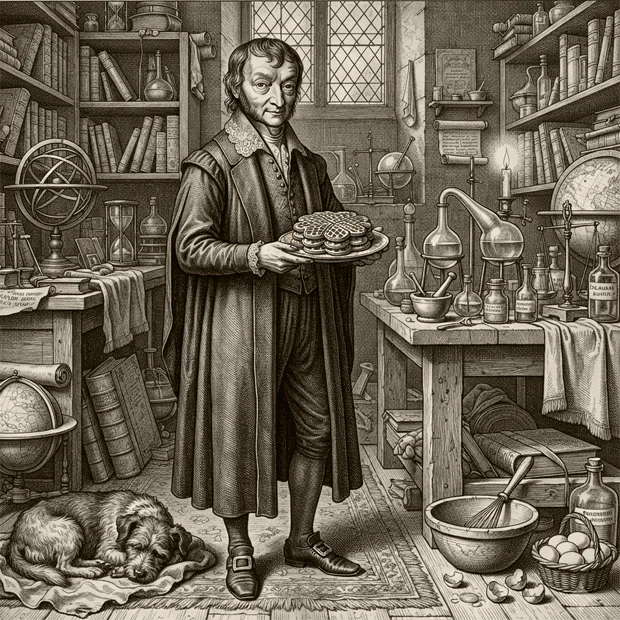

The intersection of quantitative chemistry and domestic gastronomy has reached a new milestone with the public release of a sophisticated web application designed to mathematically model, evaluate, and generate bespoke waffle batters. Unveiled on August 9, 2026—coinciding precisely with the global celebrations marking the 250th birth anniversary of Italian physicist and chemist Amedeo Avogadro—the tool, appropriately titled Avogadro, bridges the gap between historical baking intuition and modern algorithmic food science. Developed by the culinary informatics platform Khymos, the parametric recipe generator allows users to manipulate a vast array of ingredient inputs and sensory sliders to formulate mathematically sound waffle batters in real time.
The Launch of a Decade-Long Project
The debut of the Avogadro generator represents the culmination of a project that originated more than a decade ago. Initially conceived in 2014, the foundational concept began as a series of static interface mockups supported by a rudimentary spreadsheet model. For years, the project remained dormant as technical constraints and competing priorities sidelined its development. However, the convergence of advanced web technologies and a milestone historical anniversary provided the impetus needed to bring the concept to full fruition.
The tool operates fundamentally differently from traditional culinary websites or digital recipe databases. Rather than retrieving pre-existing, static recipes from a repository, the generator functions algorithmically. Users select specific classes of foundational ingredients—including liquids, dairy components, fats, eggs, starches, and sweeteners—and adjust a series of dynamic control sliders that govern sensory characteristics such as sweetness, richness, and tanginess.
Once parameters are established, the software calculates an optimized batter composition instantly. Proportions are displayed precisely in grams and scaled automatically according to the user-specified quantity of eggs. A specialized diagnostic feature, termed the waffle heart quality indicator, provides immediate visual feedback. This metric evaluates the structural viability of the generated batter and compares its ingredient ratios against an extensive corpus of historical and commercial waffle formulations to determine its proximity to established culinary norms.
Navigating Complexity: Standard Versus Expert Modes
To accommodate varying levels of culinary experience and technical engagement, the platform features two distinct user environments: Standard Mode and Expert Mode.
Standard Mode is designed for accessibility, offering a streamlined interface with a curated subset of ingredients and a limited number of control sliders. This environment is engineered to provide a frictionless user experience, guaranteeing that any combination of inputs will yield a chemically and structurally viable batter.

In contrast, Expert Mode is tailored for advanced practitioners, culinary professionals, and food scientists. It grants unrestricted access to the complete inventory of available ingredients, all eight parametric sliders, and a broader selection of preset configurations. This advanced tier removes computational guardrails, enabling users to explore uncharted culinary territory that extends far beyond the confines of conventional cookbooks.
The Historical Archive and the Definition of a Waffle
The development of the algorithm was informed by rigorous empirical research into historical baking traditions. The creator amassed a comprehensive corpus of approximately 1,000 distinct waffle recipes, predominantly originating from Norway and the broader Scandinavian region.
This archival research underscored a persistent challenge in culinary history: the reliance on tacit knowledge in pre-industrial and early modern recipe writing. Historical texts frequently omitted precise measurements, relying instead on qualitative instructions such as adding flour until the batter achieved the "right consistency." This phenomenon raised fundamental questions regarding food physics: What precise physical and chemical parameters define a functional waffle batter, and at what point does a mixture cease to possess the structural characteristics required for successful baking?
By analyzing the quantitative relationships between moisture, protein, fat, and starch across hundreds of traditional recipes, the Avogadro application attempts to operationalize this once-elusive tacit knowledge, translating traditional intuition into reproducible mathematical models.
Quantifying the Culinary Universe: The Avogadro Connection
The nomenclature and launch date of the application pay direct homage to Amedeo Avogadro, whose foundational scientific contributions continue to underpin modern chemistry. Born in Turin, Italy, on August 9, 1776, Avogadro is celebrated for formulating the hypothesis that equal volumes of all gases, at the same temperature and pressure, contain the same number of molecules. This hypothesis paved the way for the establishment of Avogadro’s constant ($6.02214076 times 10^23$), which defines the number of constituent particles—such as molecules, atoms, or ions—found in one mole of a substance.
In a deliberate mathematical nod to this scientific milestone, the parametric architecture of the waffle generator yields an astronomical number of theoretical configurations. By calculating all permissible permutations of ingredient selections and slider positions, the system spans approximately $10^27$ distinct control settings. When compared against Avogadro’s number, this configuration space encompasses roughly 1,660 moles’ worth of potential waffle batters.
Food Science Implications and Practical Limitations

While the theoretical capacity of the generator reaches into the septillions of combinations, the developers emphasize important practical caveats regarding the interpretation of these figures. The vast expanse of control settings does not equate to an equivalent number of meaningfully distinct culinary products. Due to numerical rounding algorithms and the systematic pruning of trace ingredients, numerous distinct input settings ultimately resolve into identical batter compositions.
Furthermore, because the software permits unrestricted exploration in Expert Mode, a significant percentage of theoretical settings generate mixtures that fall well outside the boundaries of physical viability. These non-viable formulations are clearly identified by the absence of structural indicators within the interface’s diagnostic display.
Nevertheless, the density of the functional recipe space ensures that users can continuously discover novel formulations that have no recorded precedent in culinary literature. This characteristic transforms the application from a mere recipe calculator into an exploratory platform for experimental gastronomy.
Community Engagement and Future Iterations
Given the impossibility of physically testing $10^27$ distinct batter formulations in a laboratory setting, the creators have positioned the application as an open-ended collaborative experiment. The current iteration functions as an informed algorithmic estimation of traditional consistency standards, relying on user feedback to refine its underlying parameters.
The development team has issued an open invitation to culinary enthusiasts, bakers, and food scientists to test the limits of the software. Users who encounter structural anomalies, edge-case failures, or exceptional culinary discoveries are encouraged to submit detailed feedback alongside direct URLs to their generated recipes. This crowd-sourced refinement process is intended to improve the accuracy of the predictive models over subsequent updates.
As the international community marks the quarter-millennium anniversary of Amedeo Avogadro’s birth, the intersection of his scientific legacy with domestic baking offers a novel framework for culinary innovation. By applying the principles of parametric design to historical foodways, the Avogadro generator demonstrates how empirical analysis and digital tools can expand the boundaries of modern home economics.