
The global specialty coffee industry has long operated at the intersection of culinary arts and hard science. While millions of consumers brew daily rituals relying on intuition, modern coffee research reveals that extracting the perfect cup is governed by complex fluid dynamics, organic chemistry, and precision mechanical engineering. Recent technical analyses highlight how variables ranging from particle size distribution to thermal mass and bypass flows dictate the chemical composition of every consumed drop.
Understanding these physical laws shifts coffee preparation from a subjective morning routine into an exact engineering challenge. To comprehend the mechanics of a modern cup, industry researchers and chemical engineers must analyze the fundamental differences between percolation and immersion methods, tracing the historical evolution of extraction technology up to the contemporary landscape of specialized drippers.
The Chemical Reality of Coffee Extraction
At the core of coffee brewing is the process of solid-liquid extraction. Roasted coffee beans contain hundreds of distinct chemical compounds spanning multiple orders of magnitude in concentration. Each compound possesses a unique solubility rate and extraction threshold.
If the objective of a coffee extraction were strictly to mirror the complete soluble profile of the roasted bean, brewers would grind coffee to the finest possible consistency and steep it for extended periods, occasionally applying direct heat. This high-yield approach—resembling a traditional Turkish coffee brewed without sugar or spices—can achieve extraction yields approaching 30 percent. However, a maximum-yield extraction does not equate to an optimal sensory experience.
Instead, professional and home baristas aim for a selective extraction. From a chemical perspective, an optimal brew relies on an uneven extraction, where various flavor compounds dissolve at differential rates. The pour-over, or percolation, technique has historically served as the primary mechanism for achieving this selectivity. Percolation must be carefully distinguished from the classic convection-driven coffee percolator invented over two centuries ago, which cycles heated liquid through a central tube to repeatedly cascade over a coffee bed. In modern specialty terminology, pour-over refers strictly to gravity-fed filtration through a stationary bed of coffee grounds.
Variables and the Mechanics of Percolation
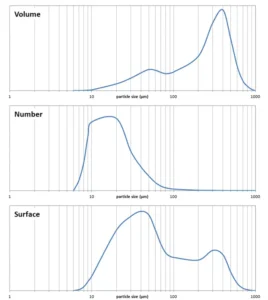
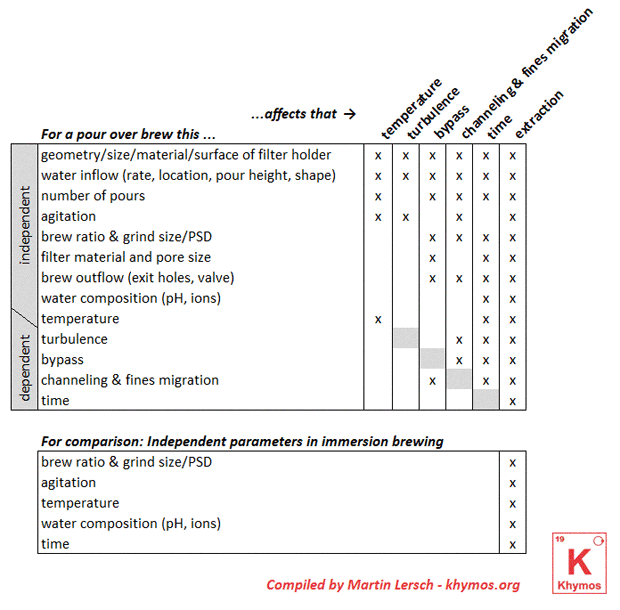
Pour-over brewing appears deceptively simple: hot water is poured over a bed of ground coffee, allowing gravity to pull the liquid through a filter. Yet, this simplicity masks an intricate web of interdependent physical parameters. As established in foundational coffee extraction studies, brew ratios, particle size distributions (PSD), water mineral composition, brewing temperature, and filter morphology drastically alter the final chemical outcome.
Furthermore, many of these operational variables are deeply correlated. Consider the role of grind size and particle size distribution. Finer particles increase the total surface area available for water interaction, thereby accelerating extraction rates. However, finer grinds also pack more densely, which restricts flow rates and increases total contact time.
This dynamic introduces the phenomenon of water bypass. Water inherently flows along the path of least resistance. When a coffee bed becomes overly dense due to fine particles or clogging, standing water above the bed may bypass the grounds entirely, slipping down the sides of the filter holder. This unextracted or under-extracted water dilutes the final beverage without contributing meaningful flavor compounds. The degree of bypass increases significantly when using filter holders with aggressive structural patterns or ridges that prevent the paper filter from maintaining uniform contact with the inner walls.
The Evolution and Engineering of Coffee Equipment
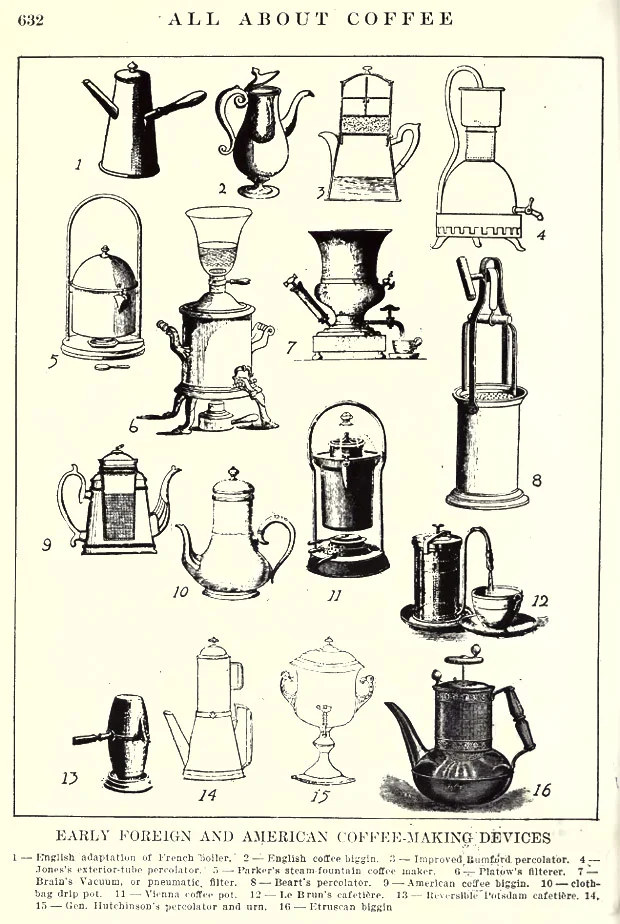
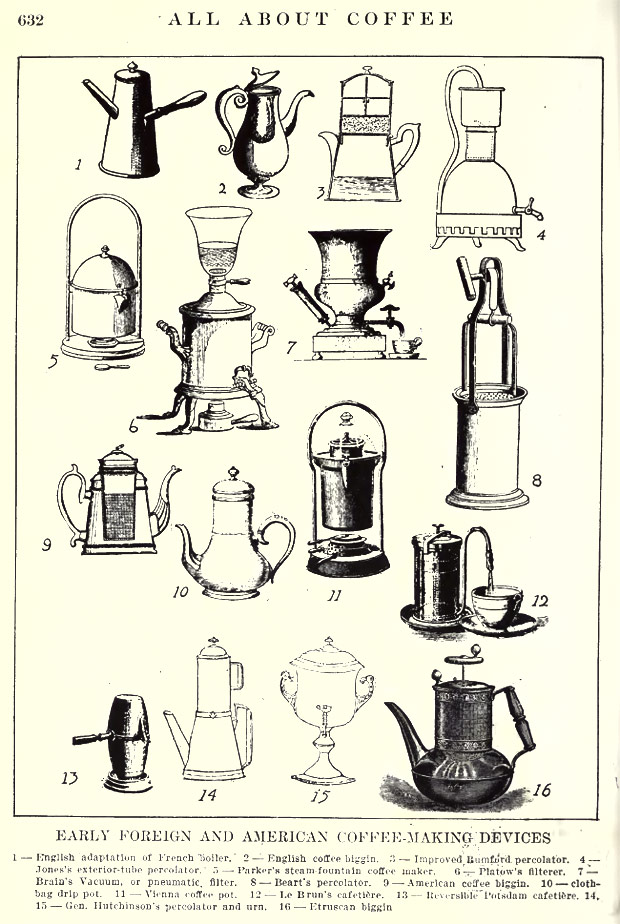
The complexity of pour-over mechanics has driven inventors for over a century to patent an astonishing array of brewing devices. Historical documentation, such as William H. Ukers’ comprehensive 1922 publication All about coffee, illustrates that mechanical innovation in drip coffee systems has been a continuous pursuit for generations. Today, the market offers dozens of distinct pour-over drippers, each engineered to address specific physical limitations of extraction.
Material Selection and Thermal Retention
Maintaining an optimal water temperature throughout the extraction cycle is critical. Metals, while durable, are highly conductive and can quickly sap thermal energy from the brewing slurry unless paired with advanced engineering. Double-walled vacuum insulation—exemplified by devices like the Stagg X/XF—effectively mitigates heat loss. While glass offers aesthetic appeal and neutrality, its fragility makes it less than ideal for high-handling environments. Consequently, food-grade plastics (such as polypropylene) and ceramics remain favored choices for balancing cost, structural sturdiness, and thermal stability.
Geometry and Bed Depth
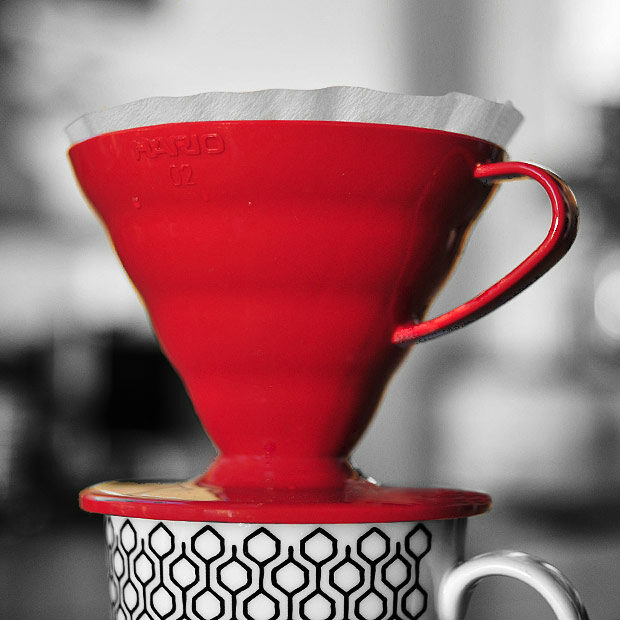
The shape of the coffee bed fundamentally alters extraction efficiency. Traditional trapezoid-shaped filters (such as Melitta designs), modern cone-shaped drippers (like the Hario V60), and flat-bottom brewers (such as the Kalita Wave) all create distinct flow dynamics. A tall, narrow cylindrical bed maximizes contact time between water and grounds but increases the risk of channeling. Conversely, a wide, flat bed promotes faster, more uniform flow but requires precise pouring techniques to prevent localized under-extraction.
Inside Wall Surface and Bypass Control
Smooth, tapered inner walls allow wet filter paper to cling tightly to the surface, effectively sealing off side-wall bypass. While this prevents unwanted water channeling around the coffee bed, it can occasionally restrict flow to a hazardous degree if fines clog the paper. To counteract this, manufacturers introduce internal ribs, ridges, or geometric patterns to maintain a micro-channel for air and liquid drainage.
Filter Types and Inflow Control
Paper filters remain the industry standard, though their porosity introduces filtration challenges when fine particles ("fines") clog the microscopic pores. Alternative designs, such as W-folded papers used in flat-bottom brewers, drastically increase surface area to maintain steady flow rates. To further stabilize extraction, modern accessories like the Melodrip or Gabi Dripmaster utilize dispersion screens. By breaking a stream of water into dozens of gentle droplets, these devices eliminate physical agitation of the coffee bed, preventing the redistribution of grounds and subsequent channeling.
Exit Holes and Flow Valves
The configuration of exit ports at the base of a dripper dictates the baseline draw-down speed. While some brewers feature a single wide-open aperture, others incorporate restrictive valves. Devices featuring a shut-off valve—such as the Clever Dripper or Hario Switch—fundamentally alter extraction mechanics by introducing an initial immersion phase prior to the final percolation draw-down. This mechanical control allows baristas to decouple grind size from contact time, offering unprecedented recipe scalability.
Comparative Analysis of Brewing Equipment
| Filter Holder | Material | Insulation | Side Shape | Structure | Filter Type | Bottom Configuration | Bypass | Inflow Control | Outflow Control |
|---|---|---|---|---|---|---|---|---|---|
| Aeropress | Plastic | Material | Straight | None | Plain | Flat (97 holes) | No | No | Pressure |
| April Pour Over | Ceramic | Material | Tapered | Ridge | Folded | Flat (Open/Ridge) | Yes | No | None |
| Bonavita Immersion | Ceramic | Material | Tapered | Ridge | Plain | Trapezoid (1 hole) | Yes | No | Stop Valve |
| Chemex | Glass | Material | Tapered | None | Plain | Cone | No | No | None |
| Clever Dripper | Plastic | Material | Tapered | Ridge | Plain | Trapezoid (1 hole) | Yes | No | Stop Valve |
| December Dripper | Metal | None | Tapered | None | Folded | Flat (12 holes) | Yes | No | Stop Valve |
| Hario V60 | Plastic/Ceramic | Material | Tapered | Ridge | Plain | Cone | Yes | No | None |
| Kalita Wave | Metal/Glass/Ceramic | Material | Tapered | None | Folded | Flat (3 holes) | Yes | No | None |
| Stagg X/XF | Metal | Vacuum | Tapered | None | Folded | Flat (10 holes) | Yes | No | None |
| Tricolate | Plastic | Material | Straight | None | Plain | Flat (51 holes) | No | Yes | None |
The Advantages of Immersion Brewing
While pour-over systems offer granular control over extraction, their complexity introduces high susceptibility to user error and random variations. This sensitivity is a primary driver behind the persistence of brewing myths and inconsistent home results.
For consumers prioritizing repeatability and operational robustness, immersion brewing offers a compelling alternative. In immersion systems—typified by the French Press or standard full-immersion steep-and-release brewers—coffee grounds are fully submerged in water for a predetermined duration.
From a chemical perspective, immersion brewing rapidly approaches an equilibrium state where the concentration of dissolved solids in the liquid balances with the remaining solubles in the coffee bed. Because all water is introduced simultaneously and extraction temperatures naturally decline over time, immersion methods are remarkably forgiving. Two different operators following the same immersion recipe will consistently yield nearly identical chemical profiles in the cup.
However, traditional immersion devices like the French Press rely on coarse metal mesh filters. These screens allow a significant quantity of micro-fines and suspended oils to pass into the final beverage. While these particles contribute heavy body and a tactile mouthfeel, they also introduce persistent sediment at the bottom of the vessel and can impart bitterness over extended contact times. Utilizing paper filtration within an immersion protocol can eliminate these suspended fines, yielding a cleaner cup profile, though some flavor compounds may remain muted compared to a well-executed pour-over.
Implications for the Future of Coffee Extraction
The ongoing evolution of coffee brewing equipment underscores a fundamental industry truth: every mechanical design choice represents a compromise between control, repeatability, and cup clarity. While pour-over methods provide the dynamic range required to highlight delicate, origin-specific flavor notes, they demand rigorous technical precision to manage fluid dynamics and bypass. Conversely, immersion techniques sacrifice dynamic extraction control in exchange for robust, repeatable performance.
As researchers, engineers, and specialty coffee professionals continue to analyze the thermodynamics of extraction, the boundary between laboratory science and daily brewing continues to narrow. Future innovations will likely focus on eliminating the uncontrolled variables of manual percolation, moving the industry closer to universally reproducible extraction standards without sacrificing the nuance that defines specialty coffee.