
For years, Dr. Gabrielle Fundaro, a highly credentialed expert in human nutrition with a PhD, over a decade of coaching experience, and a formidable track record in powerlifting, found herself grappling with a profound paradox: despite her extensive knowledge and disciplined lifestyle, she felt anything but confident in her food choices. Her daily routine was dictated by meticulous macro tracking, a method she had long employed to maintain her physique and "stay on track" with her eating. Yet, this very system, which had once served her, had become a source of profound fatigue and anxiety. The constant calculation, the inability to spontaneously enjoy a meal without concern for its macro breakdown, and the mental burden of perpetual vigilance had rendered the process unsustainable.
The Pervasive Influence of Macro Tracking and Its Unforeseen Toll
Macro tracking, or macronutrient tracking, has surged in popularity over the past two decades, propelled by the rise of fitness culture, diet apps, and the scientific understanding of protein, carbohydrates, and fats in body composition. For many, it offers an initial gateway to nutritional literacy, providing concrete data on food intake and helping individuals achieve specific body composition goals, such as muscle gain or fat loss. It quantifies eating, offering a sense of control and predictability that can be appealing in a world saturated with often-conflicting dietary advice. Data from market research indicates that the global health and fitness app market, heavily featuring food tracking tools, is projected to grow significantly, reflecting a widespread reliance on digital solutions for dietary management.
However, as Dr. Fundaro’s personal experience underscores, the long-term adherence to such a rigid system can carry significant psychological costs. The incessant focus on external metrics—numbers, percentages, and targets—can gradually erode an individual’s ability to tune into their body’s intrinsic hunger and fullness signals. This reliance on external validation can foster a strained relationship with food, where eating becomes a chore driven by data rather than an intuitive act of nourishment and enjoyment. Mental fatigue, anxiety around meals, social isolation due to dietary restrictions, and even the development of disordered eating patterns are well-documented consequences of prolonged and rigid tracking. Studies published in journals like Eating Behaviors have highlighted the correlation between frequent food tracking and increased body dissatisfaction or symptoms of disordered eating in vulnerable populations. The initial sense of control can morph into an overwhelming fear of losing it, making the thought of cessation terrifying. Dr. Fundaro articulated these fears candidly: "What if I don’t eat enough protein, and lose all my muscle? What if I overeat and gain fat? What if I have no idea how to fuel myself without tracking macros? And what does that say about me as an expert in the field of nutrition?" These questions reveal the deep-seated anxieties that can arise when an individual’s self-worth and professional identity become intertwined with their adherence to a specific dietary regimen.
The Search for a Sustainable Alternative and the Genesis of RPE-Eating
Driven by this internal conflict, Dr. Fundaro embarked on a quest for an alternative—a method that could harmonize her nutritional goals with a renewed sense of freedom and peace around food. She quickly dismissed calorie counting, recognizing it as merely a different form of restriction, potentially even more stringent than macro tracking. Intuitive eating, while appealing in its philosophy of listening to internal cues, presented its own challenges. Years of prioritizing external macro targets had dulled her interoceptive awareness, making her distrustful of her body’s natural signals. She desired structure, a framework that could guide her without imposing the rigid numerical constraints she sought to escape.
A pivotal moment arrived not in a lecture hall or a research paper, but in the gym. As a powerlifter, Dr. Fundaro had embraced the Rate of Perceived Exertion (RPE) scale in her training. Developed by Swedish researcher Gunnar Borg in the 1960s, the RPE scale revolutionized exercise prescription by acknowledging the subjective experience of effort. Instead of relying solely on objective measures like heart rate or weight lifted, RPE empowers athletes to gauge their exertion on a scale (typically 0-10 or 6-20), enabling them to train safely and effectively, adapting to daily fluctuations in energy and recovery. Borg’s work, initially focused on physiological responses to work, provided a powerful psychophysical tool that found widespread application in sports science, rehabilitation, and general fitness. Dr. Fundaro observed that by incorporating RPE into her lifting, she was not only gaining strength but also experiencing improved recovery. This blend of structured guidance and personal intuition resonated deeply. It was a revelation: if RPE could optimize her physical training, could a similar principle be applied to her nutritional approach?
This profound insight led to the birth of the RPE-Eating Scale. Dr. Fundaro adapted the core principles of the RPE scale, translating the subjective assessment of physical exertion into a subjective assessment of hunger and fullness. The goal was to provide a structured yet flexible framework that would help individuals re-establish connection with their internal bodily cues, fostering self-trust and competence around food without the burden of constant external tracking.
Understanding the RPE-Eating Framework
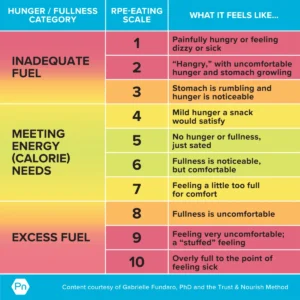
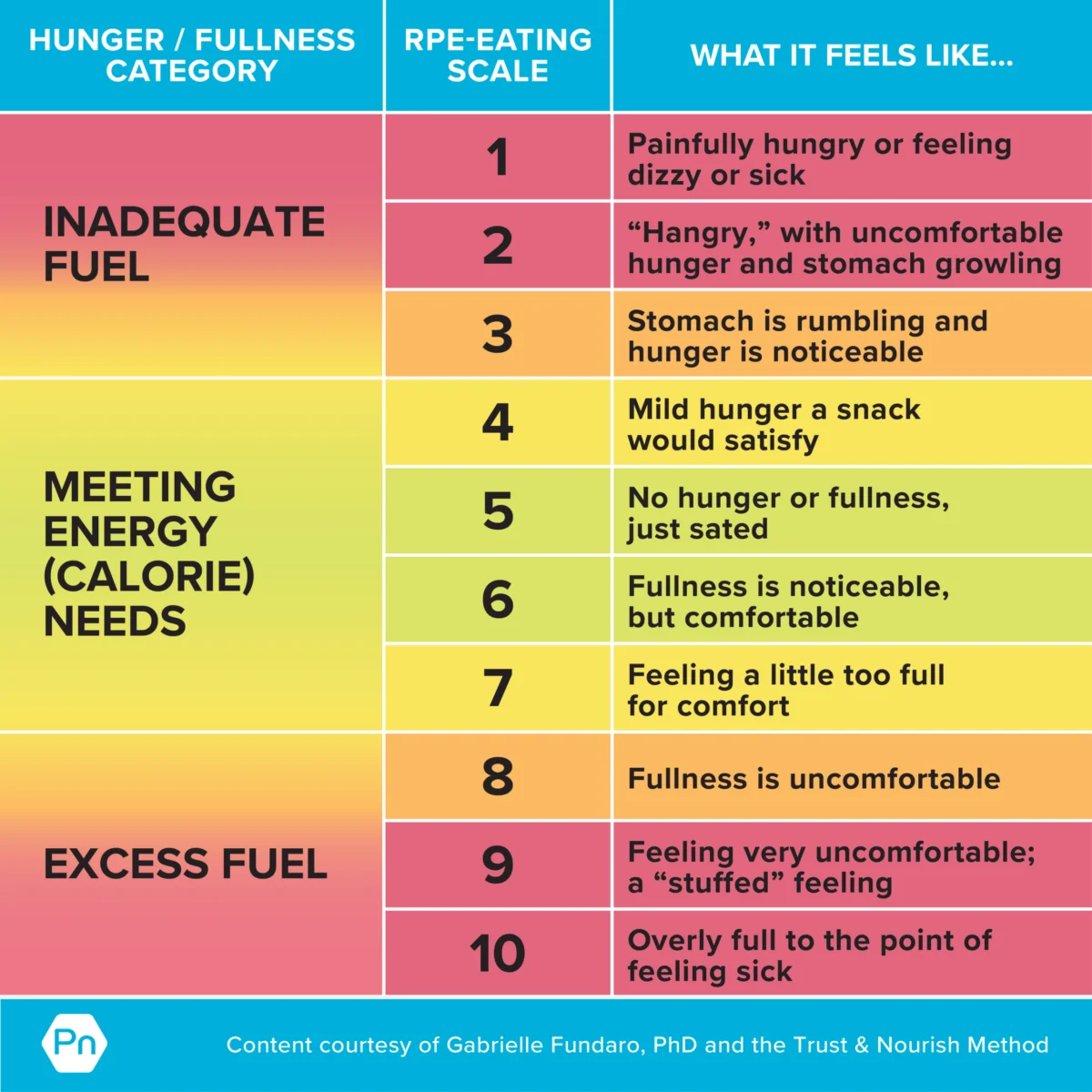
The RPE-Eating Scale maps perceived sensations of hunger and fullness to a 1-10 range. This spectrum allows individuals to continuously monitor their internal state, make conscious choices about when and how much to eat, and gradually recalibrate their perception of their body’s needs.
| Rating | Perceived Hunger/Fullness Level |
|---|---|
| 1 | Painfully hungry, dizzy or sick (Inadequate Fuel) |
| 2 | "Hangry," uncomfortable hunger, stomach growling (Inadequate Fuel) |
| 3 | Hunger noticeable, stomach rumbling (Inadequate Fuel) |
| 4 | Mild hunger, a snack would satisfy (Adequate Fuel) |
| 5 | No hunger or fullness, just sated (Adequate Fuel) |
| 6 | Noticeable fullness, but comfortable (Adequate Fuel) |
| 7 | A little too full for comfort (Adequate Fuel) |
| 8 | Uncomfortable fullness (Excess Fuel) |
| 9 | Very uncomfortable or "stuffed" (Excess Fuel) |
| 10 | Overly full to the point of feeling sick (Excess Fuel) |
The objective is to empower individuals to develop the skills necessary to determine their own sufficient intake, moving away from reliance on external metrics such as apps or rigid numerical targets.
Practical Application: Four Pillars of RPE-Eating

Implementing RPE-Eating requires a mindful, iterative approach, particularly for those accustomed to external tracking. Dr. Fundaro outlines four key steps designed to rebuild internal trust and awareness:
-
Get Clear on Your Goals: Crucially, RPE-Eating is not presented as another diet aimed at drastic body alteration or absolute control. Its primary objective is to cultivate self-trust and confidence in one’s ability to nourish the body appropriately. This involves a fundamental shift in perspective: from striving for an "optimal" diet dictated by numbers to learning to listen to and respond to one’s body. While it can be adapted for weight modification (e.g., aiming for a 7-8 range for weight gain or 4-5 for weight loss), its core value lies in fostering a sustainable and peaceful relationship with food, recognizing that physical changes might occur as a natural outcome of improved interoceptive awareness rather than a primary target. This reorientation is vital for success, as it frees individuals from the pressure of perfection and allows for genuine learning and adaptation. This aligns with a growing movement in health and wellness that prioritizes overall well-being and a positive relationship with food over strict adherence to weight-centric goals.
-
Practice Identifying Your Hunger Cues: This step differentiates between true physiological hunger and psychological appetite. Hunger is driven by physical signals—stomach rumbling, lightheadedness, a general sense of emptiness—indicating the body’s need for energy. These signals are regulated by complex hormonal interplay, involving peptides like ghrelin (the "hunger hormone") and leptin (the "satiety hormone"). Appetite, conversely, is the desire to eat, often influenced by sensory stimuli (smell, sight of food), emotional states, or social contexts, and can persist even after physical hunger is satisfied. Years of external tracking can blur this distinction. To rebuild this awareness, Dr. Fundaro recommends a structured check-in before, during, and after meals. Before eating, rate your hunger on the RPE-Eating scale. During the meal, eat mindfully, limiting distractions, and check in again halfway through. Upon finishing, record your final fullness rating. This repeated practice helps "download" and internalize the physical sensations of hunger and fullness, gradually enhancing interoceptive awareness. Scientific studies on mindful eating consistently demonstrate its effectiveness in improving satiety and reducing overconsumption by fostering this internal dialogue.
-
Get to Know Your Non-Hunger Triggers: Life is replete with situations that can override physiological hunger, prompting individuals to eat for reasons beyond nutritional need. Stress, boredom, sadness, social pressure, or even habit can trigger what is often termed "emotional eating." Dr. Fundaro emphasizes the importance of "notice and name"—a technique used in mindfulness and cognitive behavioral therapy (CBT)—to identify these triggers. When experiencing an urge to eat compulsively, individuals are encouraged to pause, identify the underlying emotion (e.g., anxiety, anger, loneliness), and pinpoint the preceding event or situation. This awareness is the first step toward developing a broader repertoire of coping mechanisms. Instead of automatically turning to food for comfort, individuals can explore non-food-related strategies, such as deep breathing, a short walk, connecting with a friend, or engaging in a hobby. This expansion of coping tools empowers individuals to address their emotional needs directly, rather than using food as a temporary, often unsatisfactory, solution. Research from institutions like the National Institute of Mental Health consistently highlights the link between stress and eating patterns, underscoring the importance of diverse coping strategies.
-
Eat for Satiety AND Satisfaction: This pillar addresses a critical dimension often overlooked in rigid dietary approaches: the psychological and hedonic aspects of eating. Satiety refers to the physical state of being full, where caloric and nutritional needs are met. Satisfaction, however, encompasses a more holistic sense of contentment and pleasure derived from the meal. It acknowledges that humans eat not just for fuel, but for enjoyment, cultural connection, novelty, and tradition. A meal might be physically satiating but emotionally unsatisfying if preferred foods are restricted or if the eating experience is devoid of pleasure. The "restriction-binge" cycle is a classic example of what happens when satisfaction is consistently neglected, often leading to feelings of guilt and shame. Dr. Fundaro advocates for incorporating genuinely enjoyable foods, even those previously deemed "off-limits," into the RPE-Eating practice. By observing hunger and fullness cues while consuming a variety of foods, individuals learn that they can adequately nourish themselves without fear, fostering a sense of flexibility and spontaneity essential for a healthy, balanced relationship with food. This approach aligns with modern nutritional psychology, which increasingly recognizes the importance of pleasure and psychological well-being in sustainable eating habits, moving away from the punitive mindset often associated with dieting.
Broader Implications and Who Benefits from RPE-Eating
RPE-Eating is particularly well-suited for individuals who feel overly reliant on food tracking but aspire to break free from its grip. It serves as a structured "off-ramp" for those who experience anxiety or a perceived loss of control when attempting to cease tracking. It offers guidance without the rigidity, providing a safety net for individuals transitioning away from external metrics. Furthermore, it can be a valuable tool for those with elevated risk factors for developing disordered eating—such as a history of yo-yo dieting, high body dissatisfaction, or participation in weight-class sports—by redirecting focus from external validation to internal awareness. This preventative aspect is increasingly recognized by public health bodies and nutrition organizations, which advocate for approaches that foster intuitive eating skills. While RPE-Eating can provide a protective framework, it is crucial to emphasize that it does not replace professional support for individuals struggling with clinical eating disorders. In such cases, consultation with a therapist, doctor, or registered dietitian specializing in eating disorders remains paramount. Nutrition coaches and healthcare providers are encouraged to assess client suitability carefully and integrate RPE-Eating as part of a broader, client-centered care plan.
Addressing the "Feelings Over Facts" Skepticism
Skeptics might dismiss RPE-Eating as merely "eating based on feelings," contrasting it with the perceived objectivity of macro tracking. However, this argument overlooks the scientific basis of interoceptive awareness. Just as the RPE scale in fitness, initially met with skepticism, is now widely accepted and scientifically validated for guiding training intensity, RPE-Eating cultivates a similar skill. Interoceptive awareness is the conscious perception of internal bodily sensations, such as hunger, thirst, and pain. It is a fundamental aspect of self-regulation and emotional intelligence, and studies show it can be significantly improved with practice. Neuroscientific research has identified specific brain regions involved in processing interoceptive signals, affirming its biological basis.
RPE-Eating trains individuals to recognize and interpret these internal signals, transforming subjective feelings into actionable insights. Observing the slowing of a barbell during a squat provides feedback on proximity to failure; similarly, noticing the absence of hunger at the end of a meal provides feedback on achieving satiety. These are not arbitrary "feelings" but biofeedback mechanisms. While macro tracking provides precise numerical data, RPE-Eating offers a more nuanced, holistic, and ultimately more convenient form of self-monitoring, leveraging the body’s innate wisdom. It bypasses the impracticality of constant glucose monitoring or biometric tracking for everyday eating, instead relying on the readily available, though often ignored, cues from within. The development of this skill allows for a more adaptive and sustainable approach to nutrition than rigid adherence to external numbers.
Nuances and Limitations
Despite its