
For ten years, the professional culinary landscape was significantly shaped by the PolyScience Classic Series Immersion Circulator. This robust piece of equipment, a staple in countless high-volume kitchens, earned its reputation as a benchmark for precision and durability in sous vide cooking. Despite its discontinuation, the Classic Series remains a touchstone for chefs and a sought-after item for those seeking proven performance, often found through secondary markets like restaurant auctions where closing establishments frequently liquidate used gear at attractive prices. The enduring influence of this model, even in its absence from current production, warrants a detailed examination of its features, its impact on professional cooking, and the evolution of sous vide technology that has since emerged.
The PolyScience Classic Series Immersion Circulator emerged during a pivotal period in the adoption of sous vide cooking within the professional culinary world. While the technique itself had roots stretching back to the mid-20th century, its widespread integration into commercial kitchens gained significant momentum in the early 2000s. This was driven by a growing appreciation for the control and consistency sous vide offered, allowing chefs to achieve unparalleled results in texture and flavor for a wide array of ingredients. PolyScience, as a manufacturer, was at the forefront of this movement, developing equipment that could withstand the rigors of daily professional use while delivering the exacting standards demanded by the industry. The Classic Series, in particular, became synonymous with this era of culinary innovation, representing the commitment to quality and performance that defined leading restaurants of the time.
A Look Back at Unrivaled Performance
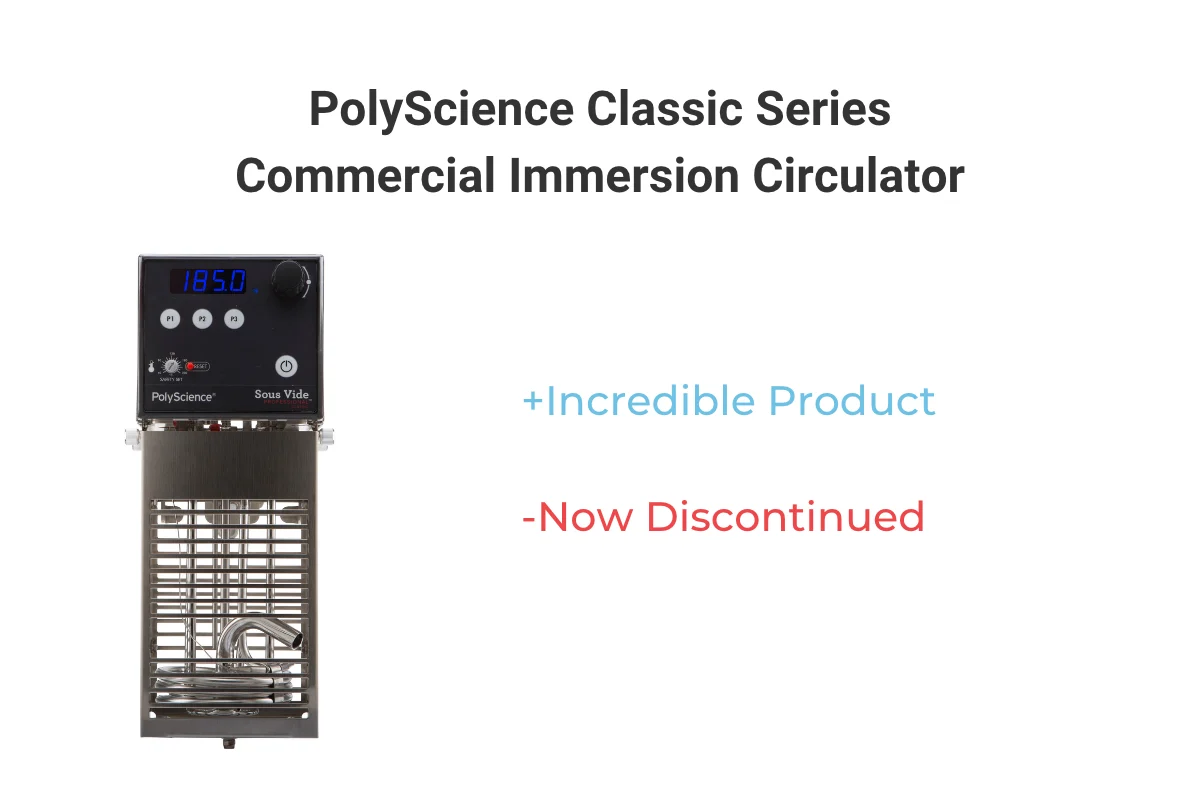
The performance specifications of the PolyScience Classic Series Immersion Circulator were, and in many respects still are, exemplary. Engineered to manage water baths of up to 8 gallons, this unit demonstrated a remarkable capacity for handling large-scale culinary operations. A key feature contributing to its reliability was the auto-restart function, a critical safeguard in busy kitchen environments where power interruptions, though infrequent, could otherwise disrupt crucial cooking processes. Furthermore, the circulator boasted a dual-speed water pump. This innovation allowed for a more nuanced control over water circulation, ensuring uniform temperature distribution throughout the bath, which is paramount for achieving consistent results across all items being cooked.
One of the most lauded aspects of the Classic Series was its exceptional temperature accuracy. The unit maintained target temperatures within an astonishing ±0.09°F, a margin that was even more precise than its successor, the Chef Series (later rebranded as the "Creative" series), which achieved ±0.1°F. While this fractional difference might seem negligible in theoretical terms, in the demanding world of professional cooking, such minute distinctions often represent the pinnacle of control and are indicative of superior engineering. This level of accuracy translated directly into reproducible outcomes, allowing chefs to confidently execute complex dishes with precise temperature requirements, time after time. The commitment to such exacting standards solidified its reputation as the gold standard for culinary professionals prioritizing absolute precision.

Industrial Design Meets Intuitive Control
The design and control interface of the PolyScience Classic Series were deliberately crafted to meet the practical demands of a professional kitchen. Its aesthetic was undeniably industrial, characterized by an open metal cage at the base. This cage not only housed the robust stainless steel heating coil and pump but also allowed for clear visual inspection of these critical components. A significant advantage of this design was its ease of maintenance; the entire cage could be swiftly detached, simplifying the cleaning process and ensuring that the unit could be kept in optimal working condition with minimal downtime. This focus on accessibility and straightforward upkeep was crucial in high-pressure kitchen environments where efficiency is paramount.
Operationally, the Classic Series featured a single, intuitive rotating knob. This minimalist control system facilitated effortless temperature setting and offered a valuable "lock-out" mode. This feature prevented accidental adjustments to the set temperature during the cooking cycle, a common concern in bustling kitchens where equipment can be inadvertently bumped or settings altered. Beyond basic temperature control, the circulator included three programmable preset functions. These allowed users to save and recall frequently used temperature settings, streamlining the workflow for repetitive tasks or signature dishes. This combination of industrial robustness and user-friendly controls made the Classic Series a workhorse that was both powerful and remarkably accessible.
The Legacy and the Evolution
The PolyScience Classic Series Immersion Circulator’s legacy is one of consistent performance and unwavering reliability. For years, it was the trusted instrument in some of the world’s most acclaimed restaurants, a testament to its superior temperature stability and overall durability. Its ability to consistently deliver precise results made it an indispensable tool for culinary innovation and execution. However, the landscape of culinary equipment manufacturing is dynamic. Following the acquisition of PolyScience’s culinary division by Breville, the production of the Classic Series was discontinued. This marked the end of an era for a model that had set such a high bar for professional sous vide equipment.
The discontinuation, while a loss for those seeking the original, has paved the way for advancements. Current production models, including those within the Breville-owned PolyScience "Creative" series, have embraced a more compact and often more cost-effective design. These newer units often incorporate enhanced power and improved user interfaces, reflecting the ongoing evolution of sous vide technology. While the Classic Series may have been larger and perhaps less aesthetically modern than its successors, its core strengths in precision and build quality remain undeniable.
For professionals and serious home cooks looking for a readily available alternative that carries the PolyScience lineage, the Breville PolyScience Creative Series immersion circulator is a recommended option. This model retains much of the brand’s renowned performance while offering a more contemporary and portable design. It represents a logical progression from the Classic Series, incorporating lessons learned and technological advancements.

The Broader Impact on Culinary Practices
The widespread adoption and reliable performance of devices like the PolyScience Classic Series Immersion Circulator played a significant role in democratizing high-level culinary techniques. Sous vide, once a niche application, became an accessible tool for achieving consistent, restaurant-quality results. This had a ripple effect across the industry, influencing menu development, ingredient preparation, and overall kitchen efficiency. The ability to precisely control cooking temperatures meant that ingredients could be cooked to their ideal state with minimal risk of over or undercooking, leading to reduced food waste and improved profitability.
Furthermore, the emphasis on temperature stability and precision inherent in the Classic Series contributed to a deeper understanding and appreciation of the science behind cooking. It encouraged chefs to experiment with different temperature and time combinations, pushing the boundaries of what was possible with traditional cooking methods. This era of sous vide proliferation, exemplified by the PolyScience Classic Series, fundamentally altered how many professional kitchens operate, embedding a culture of precision and consistency that continues to define modern gastronomy.
The Future of Sous Vide Technology
As the culinary world continues to innovate, the evolution of immersion circulators is expected to continue. We can anticipate further integration of smart technology, enhanced connectivity for remote monitoring and control, and even greater efficiency in terms of energy consumption and water heating. The demand for precision, durability, and ease of use will remain, driving manufacturers to develop equipment that meets the ever-increasing expectations of professional chefs and discerning home cooks alike. While the PolyScience Classic Series may no longer be in production, its legacy as a pioneering and highly effective piece of culinary equipment will undoubtedly continue to influence the development of future sous vide technology, serving as a benchmark against which new innovations will be measured.
For those venturing into the world of sous vide, especially for commercial applications, pairing a reliable immersion circulator with an equally robust vacuum sealer is crucial for optimal results. The precision offered by these tools ensures that food is not only cooked to perfection but also properly sealed to maintain its integrity and flavor during the sous vide process. The continued development of such specialized kitchen equipment underscores the ongoing commitment to enhancing culinary techniques and elevating the quality of food preparation across the board.