
Dr. Gabrielle Fundaro, a highly credentialed expert in human nutrition with a PhD, over a decade of coaching experience, and a background as a competitive powerlifter, has introduced a novel approach to food management: the Rate of Perceived Exertion (RPE) Eating Scale. This system emerges from her personal struggle with the rigidity of long-term macro tracking, a method she initially relied upon but ultimately found unsustainable for fostering a healthy, confident relationship with food. Her journey reflects a growing sentiment among individuals and professionals in the health and fitness community who seek alternatives to prescriptive dietary protocols.
The Pervasive Challenge of Macro Tracking
For many years, macro tracking – the meticulous accounting of macronutrients (proteins, carbohydrates, and fats) – has been lauded as an effective strategy for managing diet, achieving specific body composition goals, and enhancing athletic performance. Its popularity soared with the advent of easy-to-use mobile applications, allowing individuals to log every morsel consumed. For Dr. Fundaro, as with countless others, this method initially delivered results, providing a sense of control and a clear pathway to her physique and powerlifting objectives. The structured nature of macro tracking offered an objective framework, seemingly removing guesswork from nutritional choices.
However, the efficacy of macro tracking often comes with a hidden cost for long-term adherence and psychological well-being. Dr. Fundaro, despite her profound expertise, found herself entangled in the very system she professionally navigated. The constant vigilance, the mental arithmetic, and the pressure to achieve "perfect" macro balance began to erode her enjoyment of food and her confidence in her own bodily cues. The simple act of choosing a meal from a restaurant menu transformed into an exercise in anxiety, dominated by fears of losing her physique, under-eating protein, or overeating fat. This sentiment is not isolated; research indicates that rigid dietary control, while effective in the short term, can contribute to diet fatigue, increased stress around food, and even disordered eating patterns in susceptible individuals. The perceived loss of control when attempting to cease tracking often drives individuals back to the very habit they wish to escape, creating a cyclical dependency.
The Genesis: From Gym Autoregulation to Nutritional Intuition
Dr. Fundaro’s breakthrough originated not in the kitchen, but in the gym. As a powerlifter, she had long utilized the Rate of Perceived Exertion (RPE) scale to guide her training. Invented by Swedish psychologist Gunnar Borg in the 1960s, the RPE scale was initially developed for clinical settings to measure subjective effort during physical activity. While Borg’s original scale ranged from 6 to 20, modern adaptations typically employ a more intuitive 0-10 scale, where 0 signifies no exertion and 10 represents maximum effort. This autoregulatory tool empowers athletes to adjust their training intensity based on how they feel on a given day, rather than strictly adhering to predetermined loads or repetitions. For instance, a coach might suggest aiming for a 7/10 RPE on a set, allowing the athlete to select a weight that feels like a 7, accommodating fluctuations in recovery, stress, and energy levels.
Dr. Fundaro observed the profound benefits of RPE in her own lifting: not only was she consistently getting stronger, but her recovery improved, and she felt a greater sense of autonomy and connection with her body’s capabilities. This blend of structured guidance and intuitive responsiveness proved incredibly effective. It was this observation that sparked a profound "aha!" moment, akin to Newton’s apple: if RPE could optimize physical exertion, could a similar framework be applied to the complex act of eating? This foundational question led to the conceptualization and development of the RPE-Eating Scale.
Introducing the RPE-Eating Scale: A Hybrid Approach
The RPE-Eating Scale translates the principles of perceived exertion from physical activity to the subjective experience of hunger and fullness. It provides a structured yet flexible framework designed to help individuals re-establish trust in their internal hunger and satiety cues, improve nutritional awareness, and ultimately liberate themselves from external tracking mechanisms.
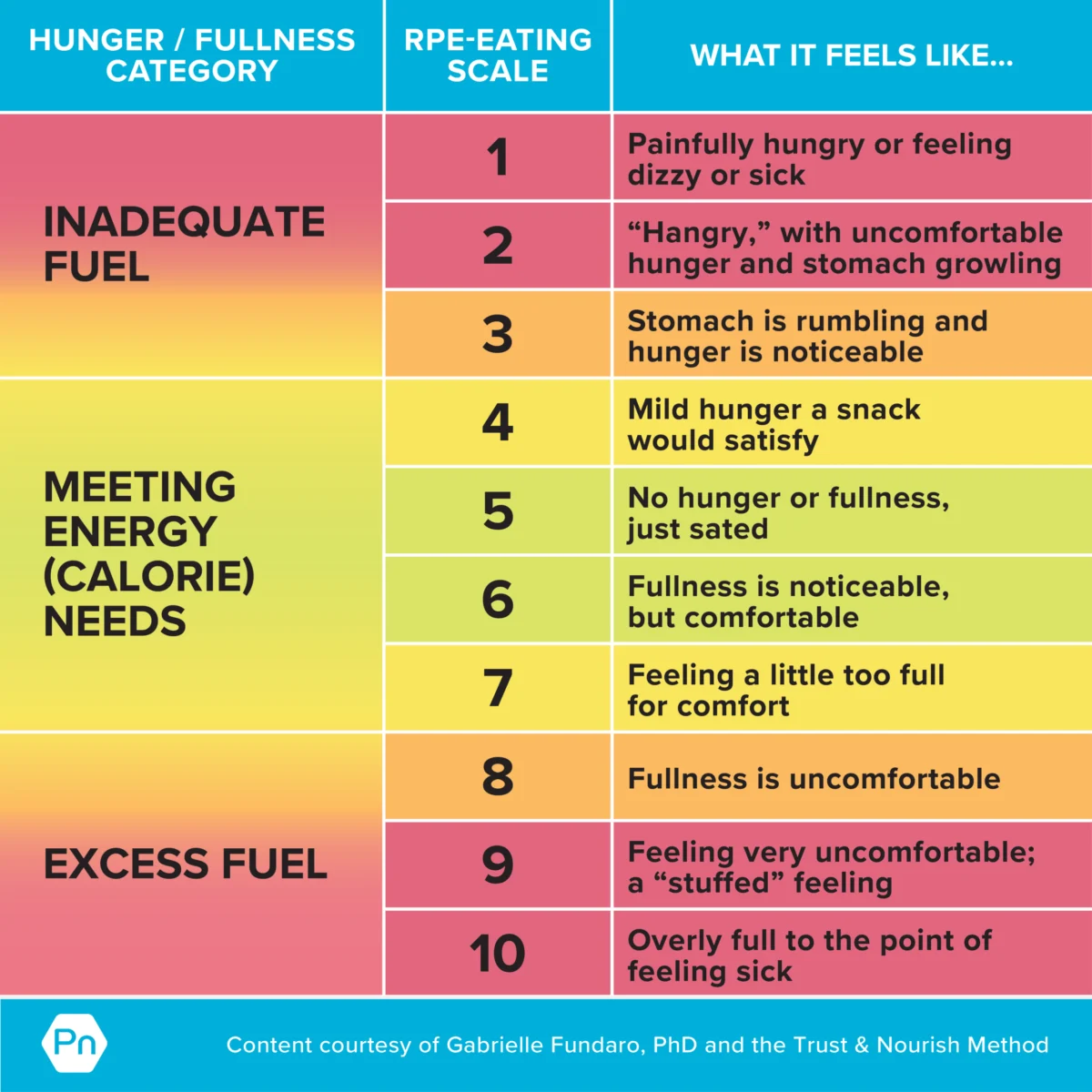
The scale, adapted to a 1-10 range for ease of use, categorizes different levels of hunger and fullness:
| Rating | Perceived Hunger/Fullness Level |
|---|---|
| 1 | Painfully hungry, dizzy, sick |
| 2 | "Hangry," uncomfortable hunger, stomach growling |
| 3 | Hunger noticeable, stomach rumbling |
| 4 | Mild hunger, a snack would satisfy |
| 5 | No hunger or fullness, just sated |
| 6 | Noticeable fullness, but comfortable |
| 7 | A little too full for comfort |
| 8 | Uncomfortable fullness |
| 9 | Very uncomfortable or "stuffed" |
| 10 | Overly full to the point of feeling sick |
The core objective of RPE-Eating is to cultivate interoceptive awareness – the ability to perceive and interpret internal bodily sensations. By consistently checking in with one’s hunger and fullness levels against this scale, individuals can learn to identify their body’s signals more accurately and respond with appropriate nourishment. This process aims to empower the individual to become their own most reliable guide, moving away from a reliance on external metrics that often disconnect them from their innate physiological needs.
The Four Pillars of RPE-Eating Practice
Implementing RPE-Eating is a learned skill, requiring conscious practice and patience, particularly for those accustomed to rigid external tracking. Dr. Fundaro outlines a four-step process for integrating this method:

-
Clarifying Goals Beyond Body Composition: RPE-Eating is not designed as another restrictive diet tool for rapid weight change or extreme physique goals. While adaptable, its primary purpose is to foster a healthier, more trusting relationship with food and one’s body. The emphasis shifts from "optimal" macros or a specific body weight to cultivating inner trust, confidence, and peace around eating. This means accepting that body composition might fluctuate, prioritizing mental well-being over strict aesthetic adherence. This foundational step is critical, as it reframes the entire approach to food from control to compassionate self-care.
-
Practicing Hunger Cue Identification: A fundamental aspect of RPE-Eating involves distinguishing between true physical hunger and appetite. Hunger is driven by physiological signals (stomach rumbling, lightheadedness) indicating a need for energy, while appetite is a desire or interest in food, often influenced by sensory appeal or emotional states. Years of dieting can blur these distinctions. To practice, individuals are encouraged to use the RPE-Eating scale before, during (halfway), and after meals, recording their perceived hunger/fullness levels. This mindful practice, performed in a distraction-free environment, helps to recalibrate the body’s internal compass, enhancing awareness of what "sated" truly feels like. Regular engagement with this exercise gradually builds an intuitive understanding of one’s energy needs.
-
Recognizing Non-Hunger Triggers: Eating is often intertwined with emotions, stress, and environmental cues. It’s common for individuals to eat in response to boredom, anxiety, sadness, or social pressure, rather than physiological hunger. Dr. Fundaro advocates for "notice and name" – a practice of identifying these non-hunger triggers. When compulsive or mindless eating occurs, the individual is encouraged to pause and identify the underlying emotion (e.g., stress from work, an argument) or situation. This awareness then opens the door to exploring alternative, non-food coping mechanisms, such as deep breathing, a walk, or connecting with a friend. By expanding one’s repertoire of self-soothing strategies, individuals can reduce reliance on food as the sole comfort mechanism, leading to more intentional eating choices.
-
Prioritizing Satiety and Satisfaction: The RPE-Eating framework distinguishes between satiety (physical fullness and met caloric needs) and satisfaction (a holistic sense of nourishment, including pleasure). Many diets achieve satiety but fail to deliver satisfaction, often by restricting enjoyable foods. This can lead to a feeling of deprivation, ultimately triggering cravings and cycles of restriction and overconsumption. RPE-Eating encourages individuals to incorporate genuinely enjoyable foods into their diet, using the scale to gauge their hunger and fullness even with previously "off-limits" items. This approach acknowledges that eating is not merely about fuel, but also about pleasure, tradition, and social connection. By allowing for satisfaction, the method aims to break the "restrict-binge" cycle and foster a more balanced and flexible relationship with all foods.
Broader Implications and Adaptability
The RPE-Eating Scale represents a significant philosophical shift in nutrition guidance, moving away from externally imposed rules towards internal wisdom. It is particularly well-suited for individuals who feel dependent on food tracking, experience anxiety when considering stopping, or desire a structured yet flexible system to guide their eating without rigid metrics. Furthermore, for those at elevated risk for disordered eating – such as individuals with a history of yo-yo dieting, body dissatisfaction, or participation in weight-class sports – RPE-Eating offers a potentially safer alternative to macro tracking, which can exacerbate such risks. It acts as an "off-ramp" from prescriptive eating, providing a transitional tool to develop lasting self-trust.
While Dr. Fundaro primarily advocates for RPE-Eating in a weight-neutral context, she acknowledges its potential for intentional weight modification. For weight gain, individuals might consistently aim for a 7-8 on the fullness scale, ensuring a caloric surplus. For weight loss, targeting a 4-5 on the scale, just adequately sated, would help create a caloric deficit. However, she stresses that it is not designed for extreme weight-modification scenarios, such as competitive bodybuilding, where precise, externally driven protocols are often necessary. In such cases, RPE-Eating would be akin to using physiotherapy exercises for powerlifting competition preparation – not the right tool for the specialized job.
Addressing Skepticism: "Feelings Over Facts?"
Skeptics might dismiss RPE-Eating as overly subjective or "feelings-based," arguing for the "hard facts" of nutrient tracking. However, similar initial resistance met the RPE scale in fitness. Today, RPE and autoregulation are widely accepted in sports science and supported by research as valid, accurate, and convenient methods for managing training intensity. The underlying principle is not a rejection of objective data but an embrace of interoceptive awareness as a valuable data point. Just as a lifter learns to interpret bar speed or muscle fatigue as indicators of proximity to failure, an RPE-Eating practitioner learns to interpret stomach sensations and energy levels as indicators of hunger and fullness. This internal data, while subjective, is highly personal and often more accessible and sustainable than continuous external monitoring like glucose tracking.
Challenges and Limitations
Despite its benefits, RPE-Eating is not without its challenges. It demands a significant investment of time and attention, requiring individuals to consistently check in with their physical and emotional states. This can be particularly difficult for individuals with demanding lifestyles, such as parents of young children or those with jobs requiring on-the-go eating, who may lack the luxury of leisurely, mindful meals. For these individuals, Dr. Fundaro suggests selective application, perhaps practicing RPE-Eating during quieter meals or focusing on isolated steps, such as simply improving awareness of hunger and fullness cues, without attempting to overhaul their entire eating pattern.
Furthermore, it is crucial to emphasize that RPE-Eating is a tool, not a cure-all. For individuals struggling with clinical eating disorders, this method does not replace professional care from a specialized therapist, doctor, or registered dietitian. It serves as a supportive framework for those seeking to heal their relationship with food and move towards greater autonomy in their nutritional choices.
In conclusion, Dr. Gabrielle Fundaro’s RPE-Eating Scale offers a compelling and timely alternative to the often-rigid world of diet tracking. By drawing parallels from the proven efficacy of autoregulation in physical training, she has created a system that prioritizes internal wisdom, cultivates self-trust, and fosters a more sustainable, peaceful, and ultimately healthier relationship with food. As the broader wellness community increasingly recognizes the psychological toll of perpetual dieting, approaches like RPE-Eating may pave the way for a more intuitive and empowering future in nutrition.