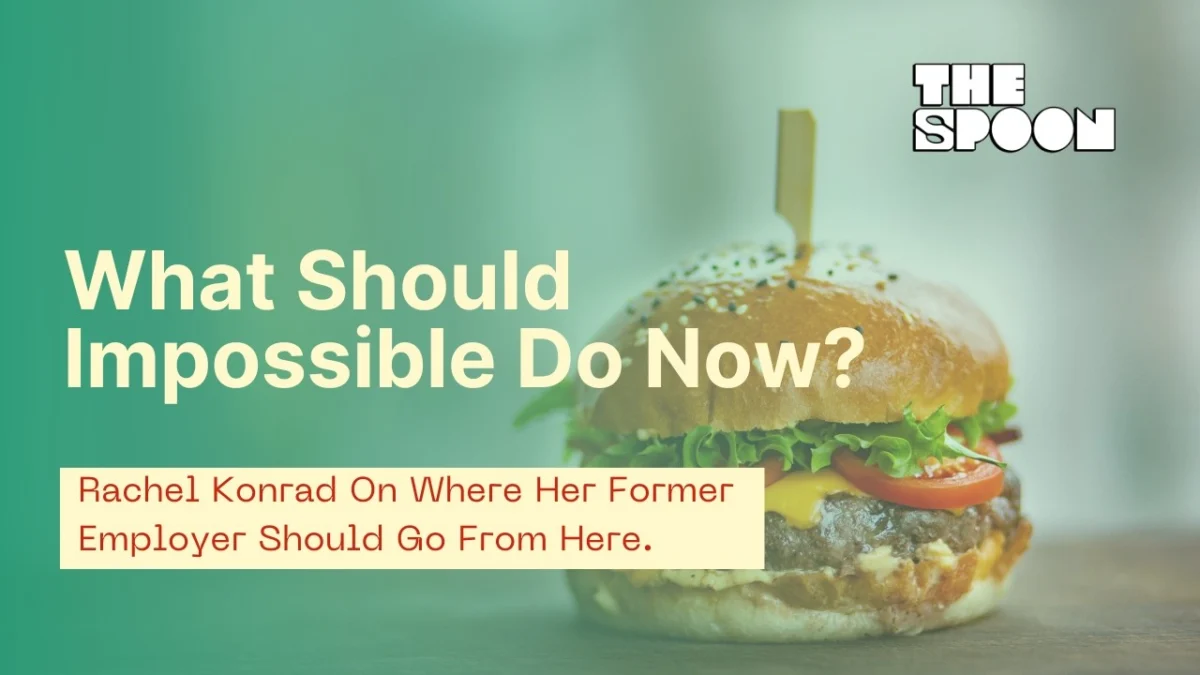

The recent announcement of Peter McGuinness’s departure as CEO of Impossible Foods after nearly four years at the helm has ignited a discussion about the company’s strategic trajectory, particularly among those who witnessed its formative years. While the company itself characterized the transition as a move "from a position of strength," former communications chief Rachel Konrad expressed a contrasting perspective, suggesting the change signals the culmination of a significant strategic shift away from the company’s original disruptive vision.
Konrad, speaking on The Spoon Podcast, revealed her initial motivations for joining Impossible Foods in 2016. "I would never have moved my whole family back from Europe to go to a CPG veggie burger company," she stated. "I went to join a radical, unusual, category-busting biotech juggernaut." This sentiment underscores a perceived divergence between the company’s early biotech ambitions and its subsequent focus on consumer packaged goods (CPG).
A History of Fierce Opposition and Strategic Debates
Impossible Foods entered the market with a bold mission: to revolutionize the food system by creating delicious, sustainable, and accessible meat alternatives. From its inception, the company faced significant headwinds and outright opposition from established industries, particularly the powerful cattle and meat sectors. Konrad recounted an early experience that vividly illustrated the intensity of this opposition. Shortly after she joined, Impossible Foods founder and CEO Pat Brown forwarded her an email from a "very highly placed in the ag sector" individual. This email, Konrad recalled, outlined a plan with an "unlimited budget to destroy this silly little company called Impossible Foods, likely funded by the Cattlemen’s Association. Take it down based on propaganda, fear, uncertainty, and doubt."
This external pressure, while significant, does not appear to be the sole factor contributing to the company’s evolving strategy, according to Konrad. She posits that a common pitfall for startups is their tendency to shift gears once they achieve initial traction. "The biggest mistake startups make is they get a little traction and suddenly decide, ‘Now we’re playing in the big leagues,’" Konrad explained. This often leads to an overhaul of the company’s structure and an adoption of the "incumbent playbook," which typically involves conventional branding, substantial advertising expenditures, and direct competition with established industry giants.
Konrad’s analysis suggests that Impossible Foods, under McGuiness’s leadership, fell into this very trap by explicitly positioning itself as a "tech-enabled CPG company." This pivot, in her view, marked a departure from its roots as a disruptive biotech firm. She argues that early investors, such as venture capitalist Vinod Khosla, were drawn to Impossible Foods precisely because of its potential to fundamentally alter the global food landscape, not merely to compete in the crowded CPG market. "Vinod did not invest in a stupid CPG veggie burger company," Konrad asserted. "He invests in things that change the trajectory of humanity."
The Biotech Juggernaut vs. the CPG Challenger
Konrad’s critique centers on the belief that Impossible Foods’ core strength lies in its proprietary technology, particularly its groundbreaking work with heme. She feels the company missed an opportunity to leverage this technological advantage more broadly. Instead of focusing on becoming a dominant consumer-facing brand, Konrad suggests that Impossible Foods could have pursued a more aggressive B2B strategy, becoming the underlying platform for next-generation meat alternatives.
"It’s a category-defining biotech company that makes heme," she emphasized. "Why didn’t Impossible license heme? Why didn’t it go into supplements? Why didn’t it become a major B2B player?" This line of questioning highlights a strategic debate about whether the company should have prioritized licensing its core technology to other food manufacturers or developing a proprietary end-product for direct consumer purchase.

The implications of this strategic choice are substantial. A B2B licensing model could have potentially accelerated the adoption of plant-based alternatives across a wider range of products and brands, reaching consumers through diverse channels and potentially at a lower cost. It could have also fostered a more collaborative ecosystem, with Impossible Foods acting as a key enabler rather than a direct competitor to existing food producers.
Conversely, the CPG approach, while aiming for direct market control and brand recognition, necessitates massive investments in marketing, distribution, and product development to compete with established players. This can lead to a slower pace of innovation and a higher risk of being outspent and outmaneuvered by larger, more resource-rich corporations.
The Shadow of Leadership and the "Steve Jobs Moment"
When questioned about whether the shift away from founder Pat Brown towards McGuiness represented a mistake, especially considering Brown’s famously "prickly" demeanor, Konrad drew a parallel to Apple’s history. She referenced the return of Steve Jobs to Apple, stating, "Apple only became Apple because Steve Jobs came back and said, ‘F*** that – we’re not doing SKU management.’" This analogy suggests that radical innovation and a refusal to compromise on core vision are crucial for transformative companies. "Impossible needs a Steve Jobs moment," Konrad declared, implying a need for decisive leadership that champions the company’s original disruptive ethos.
Pat Brown, a biochemist by training, has been a vocal proponent of scientific innovation as the key to solving global food challenges. His vision for Impossible Foods was rooted in a deep understanding of molecular gastronomy and a commitment to creating plant-based products that were indistinguishable from their animal-based counterparts. His departure from the day-to-day leadership, and the subsequent strategic shifts, are seen by some, including Konrad, as a dilution of this initial, ambitious scientific mandate.
Looking Ahead: A Call for a Return to Vision
Despite her criticisms, Konrad remains hopeful for Impossible Foods’ long-term success. Her optimism, however, is contingent on a fundamental reorientation. "My hope – for the planet, for people, for animals – is that Impossible goes back to that original vision," she concluded. "Without that, it’s going to be very hard to turn this around."
The broader implications of this internal debate extend beyond Impossible Foods itself. The success or failure of such ventures in transforming the global food system is critical in the fight against climate change, animal welfare concerns, and public health challenges associated with traditional meat production. Data from the UN’s Intergovernmental Panel on Climate Change (IPCC) consistently highlights the significant environmental footprint of animal agriculture, including greenhouse gas emissions, land use, and water consumption. Innovations in the plant-based sector are therefore crucial for achieving sustainability goals.
The plant-based food market has experienced significant growth, with market research firms projecting continued expansion. For instance, Grand View Research reported that the global plant-based meat market size was valued at USD 4.3 billion in 2021 and is expected to grow at a compound annual growth rate (CAGR) of 17.9% from 2022 to 2030. This growth indicates a strong consumer demand for alternatives. However, the competitive landscape is also intensifying, with a growing number of players entering the market, increasing the need for companies like Impossible Foods to maintain a clear and compelling competitive advantage.
The leadership transition at Impossible Foods and the ensuing strategic discussions underscore the inherent challenges and complexities of disrupting deeply entrenched industries. While the company’s recent announcement positions the CEO change as a positive step, the retrospective insights from former key personnel like Rachel Konrad offer a critical perspective on the potential long-term consequences of strategic deviations from a foundational, category-defining vision. The future success of Impossible Foods, and its contribution to a more sustainable food system, may well depend on its ability to recapture the radical, biotech-driven spirit that initially defined its ambitious mission.