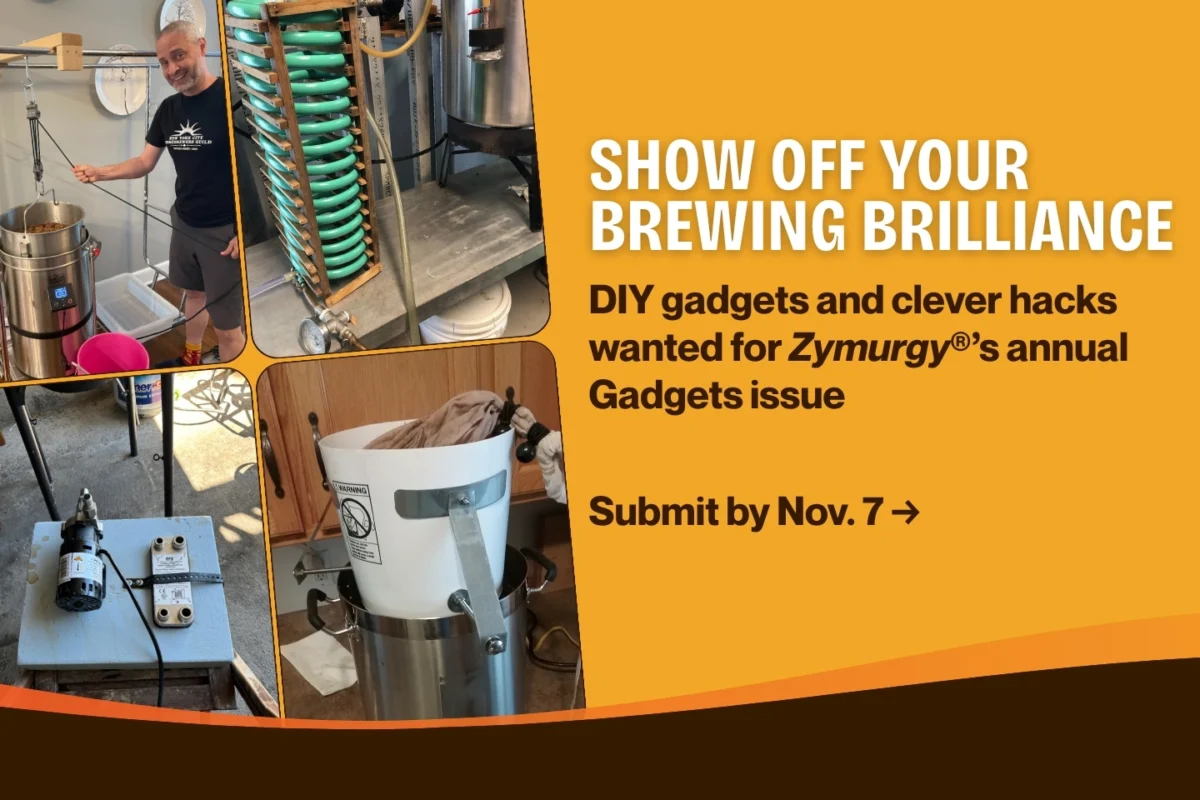

The American Homebrewers Association (AHA) has officially opened the submission window for its highly anticipated January/February 2026 "Gadgets" issue of Zymurgy magazine, the world’s longest-running publication dedicated specifically to the hobby of homebrewing. This annual tradition invites members of the brewing community to showcase their technical ingenuity, DIY spirit, and engineering prowess by submitting original inventions, modifications, and brewing shortcuts. The deadline for all submissions is Friday, November 7, 2025, providing a narrow window for amateur brewers to document and share the tools that have improved their efficiency, accuracy, or overall enjoyment of the brewing process.
As the flagship publication of the AHA, Zymurgy has served as the primary record of the homebrewing movement since its inception in the late 1970s. The upcoming Gadgets issue represents a cornerstone of the magazine’s editorial calendar, highlighting the unique intersection of craftsmanship and scientific inquiry that defines the hobby. From sophisticated electronic temperature controllers to simple, elegant solutions for grain handling or wort aeration, the featured gadgets often reflect the broader technological trends within the craft beer industry at large.
The Call for Innovation in the Homebrewing Community
The invitation to submit is extended to all current members of the American Homebrewers Association. The organization is seeking a wide array of entries, ranging from complex hardware builds to "life-hack" style improvements for the brew day. To participate, brewers are required to provide high-quality photographs of their inventions along with a concise description detailing the gadget’s purpose, construction materials, and the specific problem it solves in the brewhouse.
Innovation has always been the lifeblood of homebrewing. Because the hobby often involves scaling down industrial processes to a residential environment, homebrewers frequently encounter challenges that commercial equipment is not designed to solve. This necessity has birthed a culture of "MacGyver-like" ingenuity. The Gadgets issue serves as a centralized repository for these ideas, allowing a brewer in Oregon to benefit from a hardware modification perfected by a brewer in Florida.
Historical Context and the Evolution of Zymurgy Magazine
To understand the significance of this call for submissions, one must look at the history of Zymurgy and the AHA. Founded in 1978 by Charlie Papazian in Boulder, Colorado, the American Homebrewers Association was established at a time when homebrewing was still technically illegal under federal law in the United States. It wasn’t until the passing of H.R. 1337, signed by President Jimmy Carter, that the hobby was decriminalized at the federal level in 1979.
Zymurgy, named after the Greek term for the study of fermentation, was the first magazine to provide a professional platform for this newly legalized community. Over the decades, it has evolved from a black-and-white newsletter into a high-production-value journal featuring peer-reviewed technical articles, recipe formulations, and equipment reviews. The annual Gadgets issue has historically been one of the most popular editions among the AHA’s roughly 38,000 members, as it emphasizes the "do-it-yourself" ethos that originally fueled the craft beer revolution.
The Technical Trajectory of Homebrewing Hardware
The types of gadgets featured in Zymurgy have shifted significantly over the last forty years, reflecting the broader democratization of technology. In the 1980s and 1990s, submissions often focused on the basic mechanics of the "all-grain" brewing process. Common gadgets included homemade copper immersion chillers, converted picnic coolers for mash tuns, and modified kegs—often referred to as "keggles."
In the 2000s, the focus shifted toward automation and electronic control. The rise of PID (Proportional-Integral-Derivative) controllers allowed homebrewers to maintain mash temperatures within a fraction of a degree, a level of precision previously reserved for commercial breweries. The upcoming 2026 issue is expected to showcase the next generation of homebrewing technology, which includes:
- Integrated Smart Sensors: Devices that utilize Wi-Fi and Bluetooth to monitor fermentation gravity and temperature in real-time, sending data directly to smartphone applications.
- 3D-Printed Components: Custom-designed parts for draft systems, stir plates, and hop filters that can be manufactured at home for a fraction of the cost of commercial equivalents.
- Sustainable Systems: Water-reclamation gadgets designed to minimize the environmental footprint of the brewing process, particularly in regions facing water scarcity.
- Advanced Electric Brewing: Modifications to all-in-one electric brewing systems that enhance flow rates, heating efficiency, and ease of cleaning.
Supporting Data: The Economic and Cultural Reach of Homebrewing
According to the most recent data from the American Homebrewers Association, there are an estimated 1.1 million homebrewers in the United States. Collectively, these hobbyists produce more than 1 million barrels of beer annually, representing roughly 1% of the total U.S. beer production.
The homebrewing community also serves as a critical incubator for the professional craft beer sector. AHA surveys indicate that a significant percentage of professional brewery owners and head brewers began their careers as homebrewers. This professional-to-amateur pipeline is often fueled by the very gadgets featured in Zymurgy. Many successful brewing equipment companies, such as Blichmann Engineering and SS Brewtech, were founded by engineers who initially designed tools to solve their own homebrewing frustrations.
Furthermore, the DIY nature of the hobby contributes to a secondary market of hardware and component sales. Homebrewers are frequent consumers of stainless steel fittings, pumps, silicone tubing, and electronic components, contributing millions of dollars to the specialty retail economy.
Submission Guidelines and Editorial Process
For those interested in contributing to the January/February 2026 issue, the AHA has streamlined the submission process via an online portal. The editorial team emphasizes that submissions do not need to be professional-grade products; rather, they should be functional, clever, and reproducible by other hobbyists.
The timeline for the 2026 Gadgets issue is as follows:
- Submission Deadline: November 7, 2025.
- Editorial Review: November 2025. During this phase, editors select the most innovative and practical entries.
- Photography and Layout: December 2025. Selected gadgets may be professionally photographed or the submitter’s photos will be enhanced for publication.
- Publication Date: Late December 2025/Early January 2026.
Membership in the AHA is a prerequisite for submission. This requirement ensures that the content remains community-focused and supports the nonprofit mission of the association, which includes advocating for homebrewers’ rights and funding the Brewers Association’s various initiatives.
Analysis of Implications: The Future of Amateur Brewing
The continued focus on DIY gadgets suggests that despite the availability of high-quality commercial brewing systems, the spirit of "building it yourself" remains a core component of the hobby’s identity. This trend has broader implications for the craft beer industry. As homebrewers push the boundaries of what can be done in a garage or kitchen, they often pioneer techniques that eventually find their way into professional cellars.
For example, the current industry-wide interest in "low-oxygen" brewing and pressurized fermentation was largely driven by homebrewing forums and experimentalists who built their own closed-loop transfer systems long before commercial versions were widely marketed to small-scale breweries. The Zymurgy Gadgets issue acts as a catalyst for this type of grassroots research and development.
Moreover, the act of sharing these inventions fosters a sense of communal intellectual property. By publishing their designs in Zymurgy, brewers contribute to a collective knowledge base that lowers the barrier to entry for newcomers and raises the quality of beer produced at the amateur level.
Official Stance and Community Impact
While the AHA has not issued a formal press release beyond the call for submissions, the organization’s leadership has frequently highlighted the importance of member-contributed content. In previous editorial notes, Zymurgy staff have noted that the Gadgets issue is unique because it celebrates the "problem-solver" aspect of the brewer’s personality.
The impact of being featured in Zymurgy can be significant for an amateur brewer. For many, it is a point of pride and a validation of their technical skills. For a few, it has served as the "proof of concept" necessary to launch a business. As the November 7 deadline approaches, the AHA expects a surge in submissions from its global membership, continuing a tradition that spans nearly half a century of brewing history.
In a landscape where craft beer is increasingly consolidated and commercialized, the AHA’s call for gadgets serves as a reminder that at its heart, brewing is a hands-on, creative endeavor. Whether it is a simple clip to hold a thermometer or a fully automated, touch-screen controlled brewhouse, every submission represents a small step forward in the science and art of fermentation.