
The landscape of the American casual-dining sector is undergoing a profound transformation, and few brands illustrate this shift more vividly than Buffalo Wild Wings. As the industry grapples with changing consumer habits, rising operational costs, and a heightened demand for convenience, the "Great American Sports Bar" is recalibrating its physical presence. Recent data reveals a tale of two trajectories within the same brand: while the traditional, large-format casual-dining restaurants are experiencing a steady contraction, the brand’s quick-service offshoot, Buffalo Wild Wings GO, is entering a period of aggressive expansion.
By the conclusion of 2025, Buffalo Wild Wings’ traditional full-service footprint stood at 1,178 domestic locations, representing a net decrease of five units compared to the previous year. This contraction was the result of the company shuttering 16 corporate-owned restaurants while opening only 11 new franchised outlets. This trend is not an isolated incident but rather the continuation of a multi-year slimming of the brand’s legacy portfolio. The chain saw a net loss of two units in 2024 and four in 2023. In fact, the brand has not achieved positive net growth in its traditional format since 2018, the year it added eight locations to its roster.
The Strategic Retrenchment of Casual Dining
The stagnation of the traditional Buffalo Wild Wings model reflects a broader trend within the full-service restaurant (FSR) industry. For decades, the brand thrived on the "eatertainment" model—large-scale venues where customers would linger for hours to watch sporting events while consuming wings and beer. However, the high overhead associated with these massive footprints—often exceeding 6,000 square feet—has become increasingly difficult to justify in an era where labor is expensive and real estate costs remain elevated.
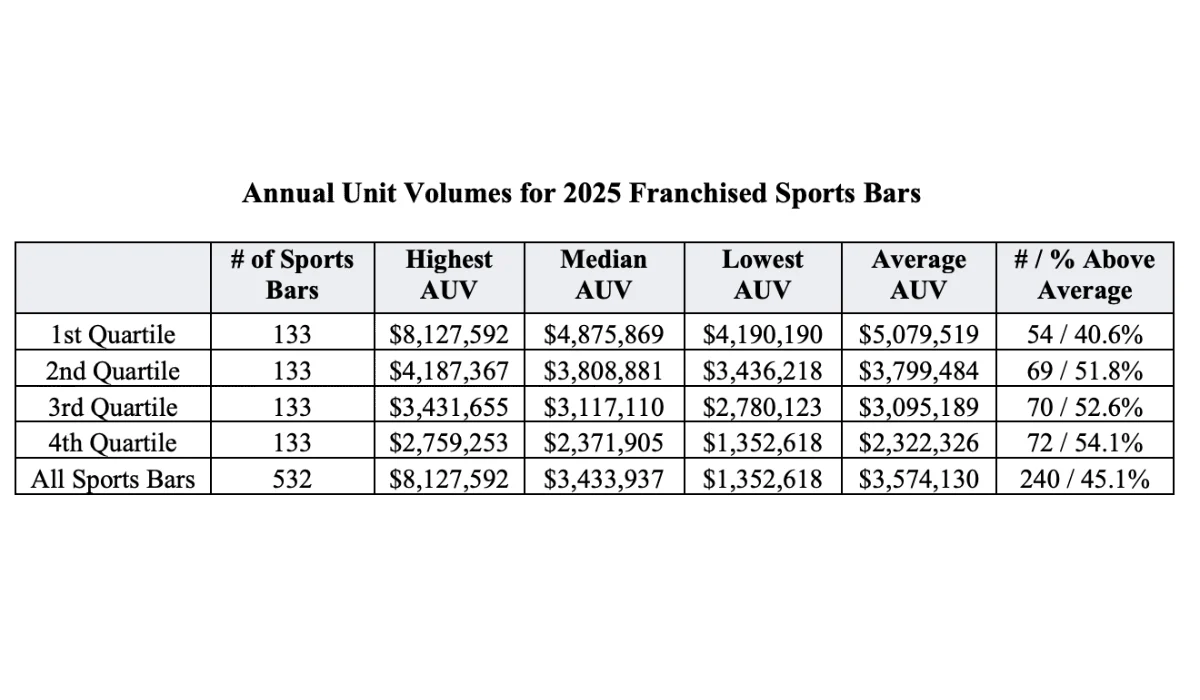
The 2025 performance data for franchised locations provides a glimpse into the economic realities of the traditional model. Among the 532 franchised restaurants that operated for the full year, the Average Unit Volume (AUV) reached $3.57 million. While this represents a marginal 0.19 percent increase year-over-year, the growth barely keeps pace with inflationary pressures. The performance gap between the top and bottom tiers remains significant; the highest-performing traditional unit generated a staggering $8.13 million in revenue, while the lowest-performing outlet brought in just $1.35 million. This wide variance suggests that while the brand remains a powerhouse in prime markets, marginal locations are struggling to remain viable under the weight of high operating expenses.
Looking ahead to 2026, the company’s Franchise Disclosure Document (FDD) suggests that the retreat from corporate-owned growth will continue. Buffalo Wild Wings projects 16 new franchise openings for the coming year, but notably, it plans zero company-owned debuts. These new franchised locations are expected to be concentrated in states including Texas, California, Florida, Georgia, and Michigan, indicating a strategy of bolstering presence in high-growth Sun Belt and suburban markets while likely pruning underperforming units in older, more saturated regions.
The Meteoric Rise of BWW GO
While the traditional model faces headwinds, Buffalo Wild Wings GO (BWW GO) is proving to be the brand’s primary engine for growth. Launched as a response to the surge in off-premise dining during the pandemic, the "GO" concept features a smaller footprint focused entirely on takeout and delivery. In 2025, BWW GO opened a net of 79 restaurants, setting a new record for the concept and bringing its total count to 219 locations.

The growth trajectory of BWW GO is steep and consistent. The concept added 38 units in 2023 and 61 in 2024, demonstrating that Inspire Brands—the parent company of Buffalo Wild Wings—is successfully scaling the model. Of the 219 current GO locations, 194 are franchised, underscoring the high level of interest from independent operators. For 2026, the brand aims to open at least 75 more franchised GO outlets.
The economic appeal of the GO model is rooted in its capital efficiency. The total investment required to open a BWW GO restaurant ranges from approximately $375,845 to $919,500. In stark contrast, a traditional full-service Buffalo Wild Wings requires an investment of between $2.464 million and $4.9 million. By lowering the barrier to entry, Inspire Brands has unlocked a new tier of franchise growth. Furthermore, the AUV for BWW GO units open for the full fiscal year 2025 was $928,702. While this is lower than the traditional AUV, the significantly lower rent, labor, and utility costs associated with the smaller format often result in a more attractive return on investment (ROI) and a faster payback period for franchisees.
Maintaining Cultural Relevance in a Competitive Market
As the brand pivots its physical strategy, it is also working aggressively to maintain its cultural "cool" and top-of-mind awareness among younger consumers. Buffalo Wild Wings has historically been a male-centric brand focused on sports fans, but recent marketing initiatives suggest an attempt to broaden its demographic appeal.
One notable effort is the introduction of the "Espresso Proteini," a beverage that leans into the "espresso martini" trend while adding a protein-focused twist, likely targeting fitness-conscious diners and the late-night crowd. The brand also tapped into pop culture by collaborating with Grammy-winning artist T-Pain to create a new musical anthem, a move designed to resonate on social media platforms like TikTok and Instagram.
Furthermore, in an environment where consumers are increasingly price-sensitive, Buffalo Wild Wings has leaned heavily into its "Pick 6" value platform. This bundle offers a combination of wings, sides, and drinks for a set price, allowing the brand to compete with the aggressive value menus of quick-service giants like McDonald’s and Wendy’s. By positioning itself as both a premium sports destination and a value-oriented meal solution, the brand is attempting to capture a larger share of the "stretching" consumer dollar.
The Inspire Brands Ecosystem
The shift toward the GO model is a direct reflection of the broader strategy employed by Inspire Brands. Since acquiring Buffalo Wild Wings in 2018 for $2.9 billion, Inspire—which also owns Arby’s, Sonic Drive-In, Jimmy John’s, and Dunkin’—has focused on "platforming" its brands. This involves leveraging shared data, supply chain efficiencies, and real estate expertise across its entire portfolio.
Inspire Brands recently revealed that it has commitments for nearly 600 BWW GO stores, with more than 85 percent of those commitments coming from existing franchisees within the Inspire system. This internal "cross-pollination" is a significant advantage. A franchisee who already operates several Jimmy John’s or Dunkin’ locations is often a prime candidate for a BWW GO unit because they are already familiar with small-format, high-velocity operations. This strategy reduces the risk for the parent company and ensures that growth is driven by experienced operators who understand the Inspire ecosystem.

Industry Implications and the "Shrinking Dining Room"
The Buffalo Wild Wings story is a microcosm of a larger phenomenon often referred to as the "shrinking of the American dining room." As delivery apps like DoorDash and Uber Eats become the primary way many consumers interact with food brands, the need for 200-seat dining rooms is diminishing.
Competitors like Wingstop have already proven the success of a digital-first, small-footprint model. Wingstop’s footprint is almost entirely geared toward off-premise consumption, and its stock market performance in recent years has reflected the efficiency of that model. Buffalo Wild Wings is essentially playing a game of catch-up, attempting to retro-fit a legacy casual-dining giant into a modern, nimble competitor.
However, the transition is not without its risks. The traditional Buffalo Wild Wings experience—the wall-to-wall televisions, the roar of the crowd during a touchdown, and the social atmosphere—is the core of the brand’s identity. If the brand pivots too far toward the "GO" model, it risks losing the unique experiential value that differentiates it from a standard fast-food chicken joint. The challenge for 2026 and beyond will be maintaining the prestige of the "Sports Bar" while reaping the profits of the "Takeout Window."
Chronology of Footprint Evolution
To understand the current state of Buffalo Wild Wings, one must look at the timeline of its evolution under Inspire Brands:
- 2018: Buffalo Wild Wings is acquired by Inspire Brands. The chain ends the year with a net growth of eight traditional units, the last year of positive growth for the FSR format.
- 2020: The COVID-19 pandemic hits, forcing a total rethink of the business model. The "BWW GO" concept is accelerated to meet the surge in delivery demand.
- 2023: The brand loses a net of four traditional units but begins to see triple-digit percentage growth in the GO pipeline.
- 2024: Traditional footprint shrinks by another two units. GO openings reach a net of 61.
- 2025: A record year for BWW GO with 79 net openings. Traditional units see a net loss of five, bringing the total count to 1,178.
- 2026 (Projected): Zero company-owned traditional openings planned. 16 franchised traditional openings expected. 75+ GO openings projected.
Conclusion: A Dual-Track Future
As Buffalo Wild Wings enters the middle of the decade, its strategy is clear: rationalize the legacy fleet and aggressively expand the digital-forward footprint. The traditional restaurants that remain will likely be high-volume flagship locations in major markets, serving as the "billboards" for the brand’s culture and sports-centric identity. Meanwhile, the BWW GO units will provide the convenience and accessibility required to compete in the fast-casual and QSR space.
For investors and industry analysts, the success of this pivot will be measured by whether the AUV of the GO units can continue to grow and whether the traditional units can maintain their $3.5 million+ volumes in the face of dwindling foot traffic. If Inspire Brands can successfully manage this balancing act, Buffalo Wild Wings will likely emerge as a more resilient, profitable, and versatile brand than it was in its pre-acquisition days. However, the days of the sprawling 6,000-square-foot sports bar being the primary vehicle for growth appear to be firmly in the rearview mirror.