
The contemporary obsession with life extension has transformed from a niche pursuit of the ultra-wealthy into a mainstream cultural phenomenon. Driven by high-profile biohackers, viral social media trends, and a proliferation of longevity-focused podcasts, millions of individuals are now seeking to "optimize" their biology to stave off disease and extend their healthspan—the number of years spent in good health—well into their 90s and beyond. However, as the industry surrounding longevity grows into a multi-billion-dollar global market, health experts and researchers are increasingly questioning whether the pursuit of "peak optimization" is a pursuit of actual health or simply an exercise in diminishing returns.

The Rise of the Optimization Culture
The longevity movement gained significant momentum over the past decade, fueled by advancements in genomics, wearable technology, and a shift in medical focus from reactive treatment to proactive prevention. Figures such as Dr. Peter Attia and Dr. Andrew Huberman have brought complex physiological concepts—like VO2 max training, glycemic variability, and metabolic health—into the public consciousness.
Simultaneously, high-profile "biohackers" like Bryan Johnson have pushed the boundaries of human experimentation, utilizing extensive blood panels, experimental supplements, and rigorous protocols to track and alter their biological age. While these efforts have raised awareness regarding preventable chronic disease, they have also created a psychological burden for the average person. The prevailing narrative suggests that unless one is engaged in daily ice baths, hyper-specific supplement stacks, or continuous glucose monitoring, they are failing to secure their future health.

Defining the Foundational Pillars of Health
Despite the allure of cutting-edge interventions, clinical data consistently demonstrates that the most effective strategies for longevity are neither complex nor expensive. Public health research confirms that the "basics" of human health—regular physical activity, a nutrient-dense diet, restorative sleep, stress management, and social integration—remain the primary determinants of life expectancy.
Data from the Centers for Disease Control and Prevention (CDC) and various longitudinal studies indicate that the overwhelming majority of chronic disease is linked to deviations from these fundamental behaviors. For instance, only 10 percent of American adults consume the recommended daily servings of fruits and vegetables, and fewer than 25 percent meet the combined guidelines for aerobic and resistance exercise.

The Economics of Effort and Diminishing Returns
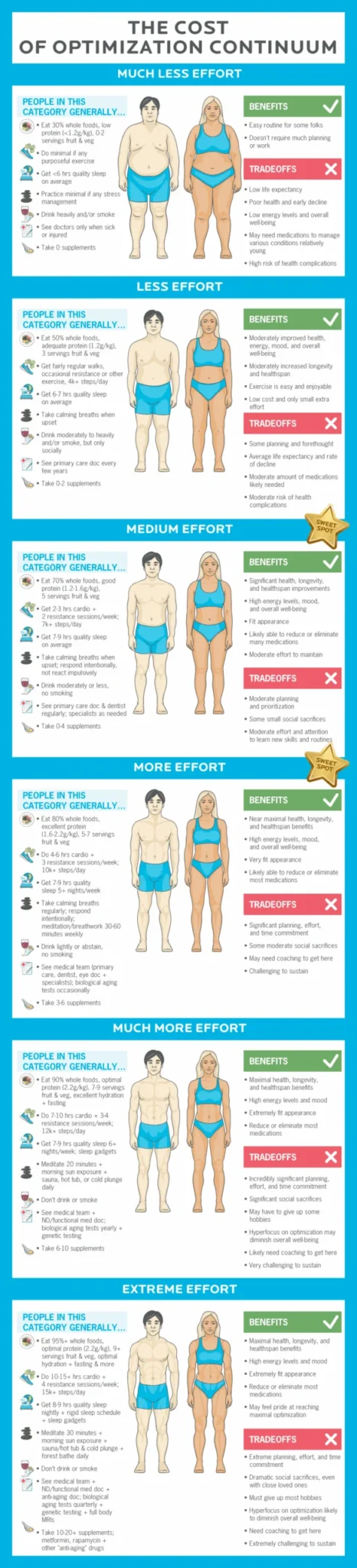
A critical point of analysis for public health professionals is the "law of diminishing returns" as applied to health protocols. While the leap from a sedentary lifestyle to moderate physical activity provides a profound reduction in all-cause mortality, the jump from "high-functioning" to "optimized" often requires an exponential increase in time and financial capital with only marginal improvements in health outcomes.
A comparative analysis of lifestyle investments reveals a stark divide. A "medium-effort" individual, who exercises for 150 minutes per week, eats whole foods, and maintains consistent sleep hygiene, likely captures 80 to 90 percent of the potential health benefits available. In contrast, an "optimizer" who spends thousands of dollars on monthly blood panels, advanced supplementation, and complex recovery modalities may find that the extra effort yields minimal additional protection against disease. For the average person, the high cost of entry to "optimization culture" often acts as a deterrent, leading to an "all-or-nothing" mentality where individuals abandon healthy habits entirely if they cannot maintain a perfect protocol.

Exercise as Medicine: The U-Shaped Curve
Physical activity represents the most robust evidence for longevity. Research published in The Lancet and other major medical journals consistently shows that exercise reduces the risk of death from any cause, regardless of genetic predisposition or prior health status. However, the relationship between exercise volume and longevity is U-shaped.
While sedentary behavior is a major risk factor for cardiovascular disease, diabetes, and cancer, the "Extreme Exercise Hypothesis" suggests that chronic, excessive training without adequate recovery can lead to negative cardiac outcomes, such as atrial fibrillation or coronary artery calcification. The sweet spot for most adults lies in a balanced routine of 150 to 300 minutes of moderate aerobic activity per week, complemented by at least three sessions of resistance training to preserve muscle mass and bone density, which are critical for preventing falls in later life.

Nutrition and the Myth of Complexity
In the nutrition sector, the industry has shifted toward highly specific diets and expensive nutraceuticals. Yet, large-scale studies involving millions of participants suggest that dietary patterns—rather than the exclusion of specific food groups—are the primary drivers of longevity. The consistent intake of whole, minimally processed foods, combined with a daily consumption of five servings of fruits and vegetables, is associated with a 13 percent reduction in all-cause mortality.
Furthermore, protein intake is increasingly recognized as a vital component for aging populations to prevent sarcopenia, or muscle wasting. While the minimum recommended dietary allowance (RDA) for protein is 0.8 grams per kilogram of body weight, current research suggests that 1.2 to 1.6 grams per kilogram is more appropriate for maintaining metabolic health and muscle mass, especially for those utilizing modern weight-loss medications like GLP-1 agonists, which can accelerate muscle loss.

The Role of Stress and Social Connection
Perhaps the most overlooked factor in the longevity conversation is the role of social integration and psychological health. The Harvard Study of Adult Development, which has tracked participants for over 87 years, identified strong social relationships as the single most significant predictor of life satisfaction and longevity, surpassing wealth, IQ, and even genetic profile.
Social isolation is currently classified by the U.S. Surgeon General as a public health epidemic, with mortality risks comparable to smoking 15 cigarettes a day. When combined with chronic, unmanaged stress—which contributes to systemic inflammation and cardiovascular strain—the absence of community can undermine even the most rigorous diet and exercise plans. Managing stress does not necessarily require costly mindfulness retreats; rather, it involves developing resilience and purposeful recovery strategies that fit within the context of a balanced, everyday life.

The Impact of Harm Minimization
A rational approach to longevity must also prioritize harm minimization. The statistical impact of eliminating tobacco and moderating alcohol consumption remains the most effective "intervention" available to the public. Alcohol, in particular, has been increasingly scrutinized, with the World Health Organization (WHO) noting that there is no "safe" level of consumption regarding cancer risk. However, for many, the focus remains on finding a level of intake that balances social enjoyment with health risks, rather than absolute abstinence.
Implications for Future Public Health Policy
The proliferation of "optimization culture" presents both an opportunity and a challenge for healthcare systems. While the increased interest in longevity can motivate individuals to improve their health, the focus on fringe, unproven methods can distract from the foundational public health goals of diet, exercise, and preventative screenings.

The broader implication is that the democratization of health information is a double-edged sword. While access to data is higher than ever, the ability to synthesize this information into a realistic, sustainable lifestyle is lacking. Healthcare providers are increasingly tasked with correcting misconceptions and helping patients distinguish between evidence-based health practices and the latest trends in the longevity marketplace.
Conclusion: A Realistic Path Forward
For the vast majority of the population, the path to a long and vibrant life is found in the consistent application of fundamental health behaviors. True health optimization is not achieved through the adoption of complex, expensive, or experimental protocols that risk burnout and psychological fatigue. Instead, it is found in the steady, sustainable commitment to physical activity, nutritious intake, restorative sleep, and meaningful human connection. By focusing on these core pillars, individuals can secure a high quality of life, allowing them to enjoy the very longevity they seek to attain. The most effective health plan is not the one that is most complex, but the one that an individual can actually sustain for the duration of their life.