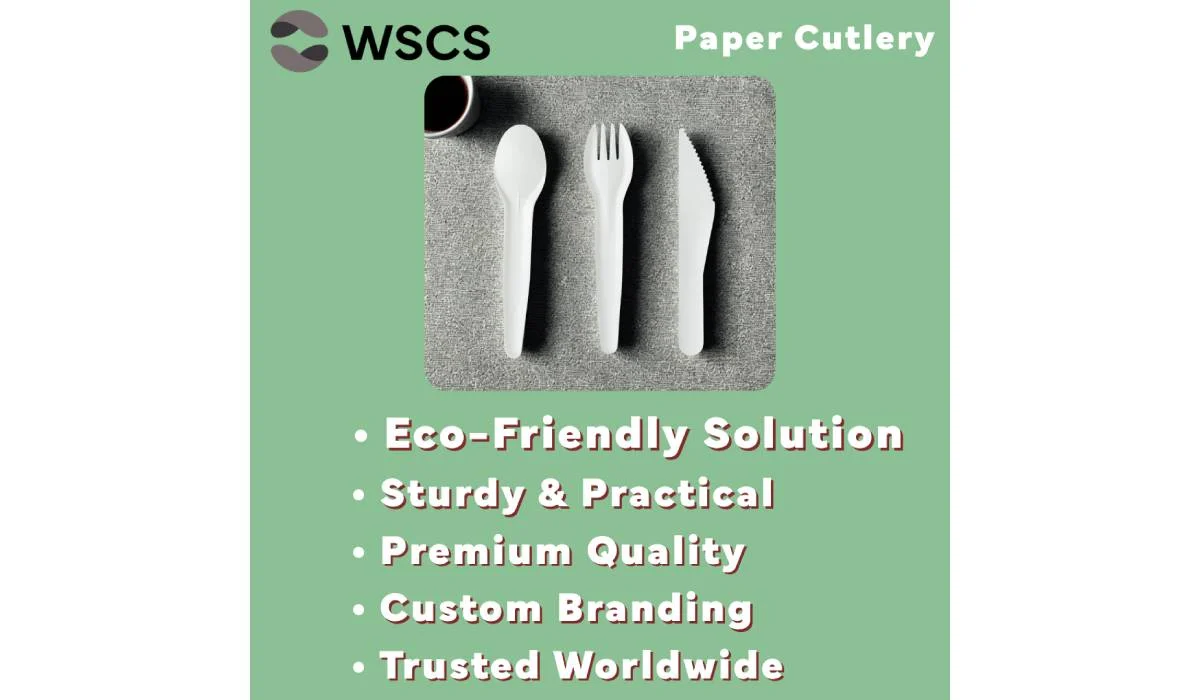

The international packaging sector has reached a significant milestone in the transition toward circular economy models as WSCS Global, a prominent developer of sustainable food service solutions, officially announced that its comprehensive line of paper cutlery has been awarded the DIN EN 13432:2000-12 certification. This accreditation, widely regarded as the gold standard for compostable materials within the European Union, serves as a definitive validation of the company’s engineering prowess and its adherence to the highest environmental safety standards. By securing this certification, WSCS Global provides a scientifically backed alternative to traditional single-use plastics, which have long been a primary contributor to marine and terrestrial pollution. The certification process involves rigorous laboratory testing to ensure that the material breaks down under specific conditions without leaving behind toxic residues or microplastics, thereby ensuring that the product’s end-of-life cycle contributes positively to soil health rather than detracting from it.
The Significance of DIN EN 13432 in the Global Market
To understand the weight of this achievement, one must examine the technical rigor of the DIN EN 13432 standard. It is not merely a label of "biodegradability," which can often be a vague or misleading marketing term; rather, it is a strict technical requirement for packaging recoverable through composting and biodegradation. For a product to receive this certification, it must pass four distinct types of tests: chemical composition analysis (limiting heavy metals), biodegradation (conversion of at least 90% of the organic carbon to CO2 within six months), disintegration (physical breakdown so that no more than 10% of the original mass remains on a 2mm sieve after 12 weeks), and ecotoxicity (ensuring the resulting compost does not negatively affect plant growth).
WSCS Global’s success in meeting these criteria places its paper cutlery in an elite category of food service disposables. As global regulatory frameworks, particularly the European Union’s Single-Use Plastics Directive (SUPD), continue to tighten, the demand for certified compostable alternatives has reached an all-time high. The achievement by WSCS Global provides a clear pathway for large-scale catering operations, international airline carriers, and global restaurant chains to meet their ESG (Environmental, Social, and Governance) targets without compromising on the functionality of their service ware.
A Chronology of Innovation and Sustainability
The journey toward the DIN EN 13432 certification for WSCS Global did not happen in isolation but is the result of a multi-year strategic roadmap focused on material science and responsible sourcing. Over the past decade, the company has transitioned from a general packaging provider to a specialized leader in eco-friendly materials.
The timeline of this development began with the identification of the inherent flaws in traditional plastic cutlery, which can take up to 400 years to decompose. In response, WSCS Global initiated a research and development phase focused on high-density paper fibers that could withstand the thermal and mechanical stresses of dining—specifically heat resistance for hot soups and structural integrity for cutting proteins. Following the successful prototype phase, the company moved toward securing FSC (Forest Stewardship Council) certification for its raw materials, ensuring that every piece of cutlery originates from responsibly managed forests that provide environmental, social, and economic benefits.
The final phase of this chronology was the submission of their proprietary paper blends to independent European testing bodies. The successful acquisition of the DIN EN 13432:2000-12 certification marks the culmination of this timeline, transitioning the product from a developmental innovation to a market-ready, globally compliant solution.
Technical Analysis of Product Performance and Material Composition
The paper cutlery produced by WSCS Global is engineered using a multi-layered pressed paper technology. Unlike early iterations of paper utensils that were often criticized for a "mouthfeel" issue or lack of durability, WSCS Global has utilized advanced fiber-binding techniques that ensure a smooth finish and high tensile strength. This is particularly crucial for the food service industry, where the user experience is paramount.
Data from internal stress tests indicates that the certified cutlery maintains its structural rigidity for over 60 minutes in liquids up to 85 degrees Celsius, a benchmark that outperforms many uncertified biodegradable alternatives currently on the market. Furthermore, the use of FSC-certified paper ensures that the carbon footprint of the production process is minimized. By utilizing renewable wood fibers rather than petroleum-based resins, WSCS Global achieves a significantly lower Global Warming Potential (GWP) per unit compared to traditional polystyrene (PS) or polypropylene (PP) utensils.
Official Responses and Strategic Leadership
Ian Brett, the Managing Director of WSCS Global, emphasized that this certification is a reflection of the company’s core identity rather than just a regulatory hurdle. "Eco-conscious consumers and businesses alike are increasingly seeking alternatives to plastic, and we are excited to lead the way with our certified compostable cutlery," Brett stated. "This certification underscores our ongoing commitment and core competencies to providing sustainable solutions that are not only functional but also environmentally responsible."
Industry analysts suggest that this move by WSCS Global will likely trigger a ripple effect across the supply chain. Procurement officers for major hospitality groups are increasingly under pressure to provide transparent data regarding the "end-of-life" of their disposables. By providing a product that is 100% biodegradable and certified for industrial composting, WSCS Global simplifies the waste management logistics for these organizations.
While not officially part of the announcement, environmental advocacy groups have historically praised such certifications as a necessary step in combating "greenwashing." By adhering to the DIN EN 13432 standard, WSCS Global provides third-party verified proof of its environmental claims, which builds consumer trust and sets a higher bar for competitors in the sustainable packaging space.
Broader Impact on the Global Food Service Industry
The implications of WSCS Global’s certification extend far beyond the company’s own balance sheet. The global compostable food service packaging market is projected to grow at a compound annual growth rate (CAGR) of over 5% through 2030, driven by legislative bans on single-use plastics in regions such as Europe, Canada, and parts of the United States and Asia.
The transition to certified paper cutlery addresses one of the most difficult "problem plastics" in the waste stream. Due to their small size and varied resin types, plastic forks, knives, and spoons are rarely recycled, often falling through the sorting grates at recycling facilities and ending up in landfills or oceans. WSCS Global’s solution allows these items to be diverted into organic waste streams. When disposed of in industrial composting facilities, this cutlery transforms into nutrient-rich compost, effectively closing the loop and supporting the principles of a circular economy.
Moreover, the adoption of such products helps businesses mitigate the risks associated with "plastic taxes" being implemented in various jurisdictions. As governments begin to levy fees on non-recyclable packaging, certified compostable materials offer a cost-avoidance strategy that aligns with long-term ecological health.
Future Outlook and Continued Innovation
WSCS Global has indicated that the DIN EN 13432 certification is not the final destination but rather a foundation for future expansion. The company’s research and development team is reportedly exploring further innovations in barrier coatings that are also fully compostable, aiming to expand their product line to include more complex food packaging solutions that require grease and moisture resistance.
As the food service industry continues to evolve in the post-pandemic era, the focus on hygiene and sustainability has converged. Disposable cutlery remains a necessity for take-out and delivery services, but the "throwaway culture" of the past is being replaced by a "responsible disposal" culture. WSCS Global is positioning itself at the forefront of this shift, inviting partners and stakeholders to move away from the legacy of plastic pollution.
In conclusion, the certification of WSCS Global’s paper cutlery under the DIN EN 13432:2000-12 standard represents a significant victory for material science and environmental policy. It proves that with sufficient investment in R&D and a commitment to rigorous testing, the industry can produce disposables that meet the demands of modern convenience without sacrificing the integrity of the natural world. For restaurants, catering services, and event planners, the message is clear: the technology exists to provide a premium dining experience that is as kind to the planet as it is practical for the consumer. WSCS Global’s achievement stands as a testament to the fact that the future of the food service industry is not just biodegradable, but scientifically certified to be sustainable.