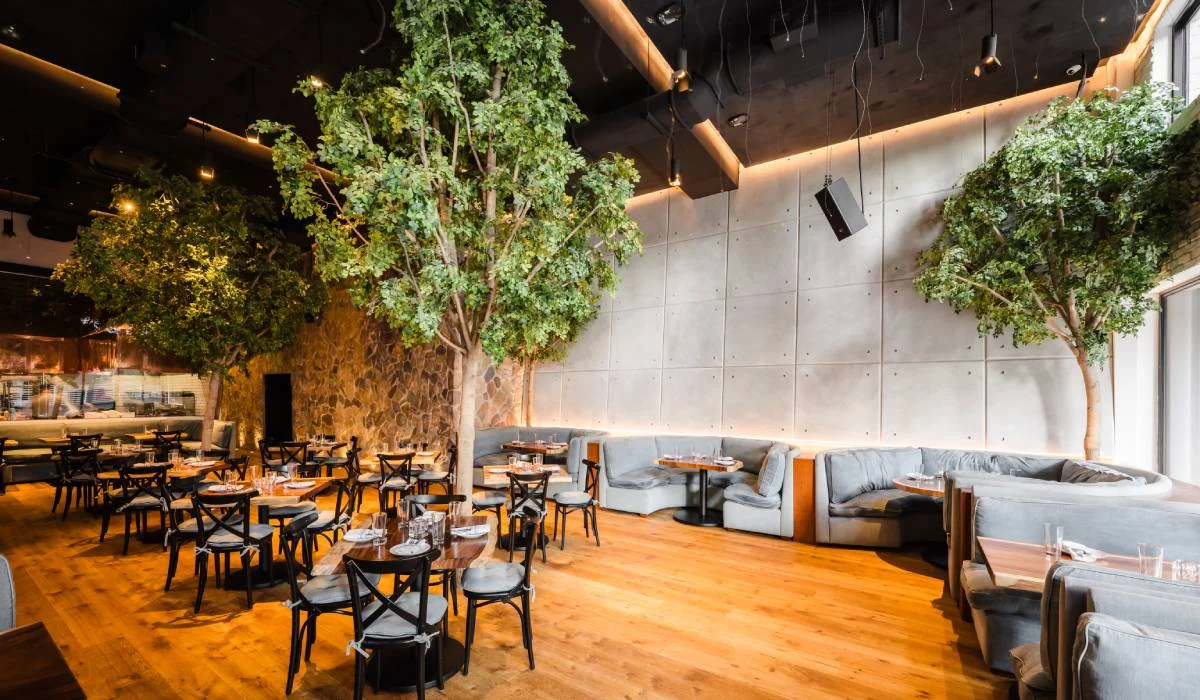

The emergence of TIMBR in Fort Lauderdale, Florida, has signaled a paradigm shift in the full-service dining sector, demonstrating that intentional design and premium positioning can effectively insulate a brand against the volatility of discount-driven market trends. Since its debut in February 2025, the 8,500-square-foot venue has not only captured the attention of the digital landscape—garnering over 32,000 Instagram followers and exceeding two million views on design-centric content—but has successfully converted that virtual engagement into sustained commercial performance. In its inaugural year, the concept secured more than 30,000 unique reservations, maintaining a consistent monthly average of 7,000 bookings. Beyond volume, the establishment has solidified its reputation as one of the highest price-per-head check averages in the region, proving that modern consumers are willing to pay a significant premium for experiences that offer social currency and immersive storytelling.
The Architecture of Experience: A Three-Act Narrative
The success of TIMBR is rooted in the vision of hospitality veteran Michael Tronn and his partners at 3 Hospitality, Paul Brown and Max Van Fleet. Tronn, whose professional lineage includes the development of over 30 destination venues and a background in film and television production, approached the project not as a traditional restaurant build-out, but as a theatrical production. The physical layout of TIMBR is structured as a layered progression through three distinct environments, each designed to evoke a specific emotional response and narrative arc.

The journey begins in "The Park," a ground-floor dining space that serves as a reimagining of a twilight picnic. The room is anchored by nine custom-installed 15-foot tree trunks, their branches stretching toward an 18-foot ceiling. This verticality is punctuated by approximately 750 custom-engineered "firefly" lights, which utilize a specific flicker frequency to simulate a starlit canopy. The tactile elements of The Park further distinguish the space; Tronn utilized treated denim upholstery for the banquettes—a choice rarely seen in high-traffic hospitality due to dye-transfer concerns, but solved here through specialized chemical treatments. This choice provides a rugged yet sophisticated texture that complements the custom live-edge wood tables.
Transitioning deeper into the venue, guests encounter "The Atrium," frequently referred to by patrons as the "Flower Room." This space serves as the venue’s architectural centerpiece, featuring a soaring 33-foot ceiling capped by a 400-square-foot skylight. The walls and ceiling are adorned with an estimated 90,000 silk and preserved flowers, creating a lush, vertical garden that surrounds a pergola-topped bar. Finally, the narrative concludes in the upstairs "Lounge," a space that pivots from the organic warmth of the lower levels to a darker, more seductive palette of charcoal greys and blacks. This progression ensures that the guest experience remains dynamic, encouraging movement and exploration within the venue.
Chronology of a Concept: From Void to Icon
The development of TIMBR followed a rigorous timeline of market analysis and creative iteration. Tronn identified a significant void in the Fort Lauderdale culinary landscape, which he characterized as being dominated by large-scale commercial chains and "Florida Maximalism"—a trope often defined by rattan, wicker, and pastel palettes.

- Conceptualization (2023–2024): Tronn and 3 Hospitality spent over a year in the design phase, focusing on "micro-decisions." This involved testing between 10 and 15 variations for every element, from the grain of the Italian wood flooring to the specific ergonomics of ADA-compliant hardware.
- Construction and Craftsmanship (Late 2024): The build-out emphasized authenticity over synthetic alternatives. A notable example is the restaurant’s façade; Tronn collaborated with a master brick mason to develop soft-edged, weathered bricks. The goal was to create an exterior that appeared "blanketed in a pie crust," giving the new structure the gravitas of a century-old landmark.
- The Launch (February 2025): TIMBR opened to immediate critical and social media acclaim. The strategy focused on "experiential elements" rather than traditional advertising, allowing the design to serve as the primary marketing engine.
- The First Year (2025–2026): The restaurant maintained a high-demand status, successfully navigating the seasonal fluctuations of the South Florida market by focusing on local regulars who were drawn back by the consistency of the service and food, rather than just the initial "Instagrammable" allure.
Data-Driven Luxury: The Economics of the High Check Average
While the aesthetic of TIMBR is designed to inspire imagination, its business model is built on high-margin luxury offerings and precision operations. The menu pricing reflects a clear commitment to premium positioning, catering to a demographic that prioritizes quality and atmosphere over cost-saving.
Analysis of the dinner menu reveals a strategic focus on high-end proteins and rare vintages. The 30-day wet-aged ribeye is priced at $75, while the prime bavette steak sits at $62. Pasta dishes, such as the garganelli bolognese with basil-whipped ricotta, are positioned at $38, a price point that signals a "premium-casual" entry level for the brand. The beverage program is even more aggressively positioned for the luxury market. The wine list includes prestigious labels such as Opus One 2021 ($690), Aloft Cabernet Sauvignon ($575), and Sassicaia ($510). For celebratory high-spenders, the champagne selection features Dom Pérignon Rosé at $875.
This pricing strategy is supported by what Tronn calls "theatrical lighting." Drawing on his film background, Tronn designed the lighting to be flattering to the "actors" (the guests). By using warm tones that reflect off skin to minimize imperfections, the environment enhances the guest’s sense of self-confidence. Psychologically, this "flattery by design" has been shown to increase dwell time and average spend, as guests feel more comfortable and "at home" in the spotlight.

Comparative Analysis and Market Impact
The success of TIMBR offers a case study in how independent operators can compete with institutional hospitality groups. In South Florida, the market is often split between the "Miami Look"—characterized by mid-century parametric wood designs—and the "Beach Look." Tronn’s rejection of these established aesthetics has created a unique brand identity that is difficult to replicate.
One of the key differentiators cited by Tronn is the use of authentic materials. While other local operators have attempted to mimic TIMBR’s indoor forest concept, many have opted for synthetic "plastic bark" trees. Tronn’s insistence on real tree trunks, despite the increased cost and logistical difficulty, serves as a hallmark of the brand’s commitment to "nothing fake." This authenticity resonates with a modern consumer base that is increasingly adept at identifying—and dismissing—superficial design.
Furthermore, TIMBR’s performance challenges the prevailing industry wisdom that restaurants must offer discounts or "happy hour" incentives to drive traffic during off-peak periods. By maintaining a clear identity and a high barrier to entry (in terms of both price and reservation availability), the venue has created an aura of exclusivity that sustains demand.

Broader Implications: The "Symphony for the Senses"
The philosophy underpinning TIMBR is currently being codified into Michael Tronn’s forthcoming book, Symphony For the Senses. The text aims to provide a strategic framework for "venue-driven experiences," suggesting that the principles applied at TIMBR—intentionality, micro-detailing, and identity-first design—can be scaled to urban planning, neighborhood development, and other facets of the hospitality industry.
The broader implication for the restaurant industry is a move toward "Identity-Based Hospitality." Tronn argues that in a hyper-competitive market like Fort Lauderdale, mediocrity is a death sentence. To survive, a concept must know exactly who it is for and what promise it is making to the guest. At TIMBR, that promise is a temporary escape into a meticulously crafted world where the lighting is perfect, the materials are real, and every detail has been considered.
As the industry looks toward the 2030s, the "TIMBR model" suggests that the future of fine dining lies not in the simplification of the experience, but in its complication—the layering of sensory inputs that justify a premium price point. For operators, the lesson is clear: in an era where food can be delivered to one’s door with a click, the physical restaurant must offer something that cannot be put in a box—an atmosphere that inspires the imagination and a stage where the guest is the star of the show.