
The human relationship with health and self-assessment has undergone a profound transformation. From relying on visceral feelings and observable physical changes, modern individuals now navigate a landscape dominated by sophisticated digital tools. Today, if one is curious enough, they can measure heart rate, step count, exercise intensity, and sleep quality—often all on a single, sleek device. These wearable technologies, ranging from fitness bands to smartwatches and ring trackers, promise an unprecedented level of insight into our physiological states and daily habits. In the best cases, these devices offer a critical bridge between what one subjectively feels and what can be objectively measured, a development generally regarded as both cool and amazing.
Our subjective feelings and assessments, while inherently important, are not always the most reliable indicators of our true physiological state or behavioral patterns. Humans, by nature, are not particularly skilled at quantifying experiences and behaviors with cold precision. Consider the anecdote of a colleague who believed he was consistently eating within a narrow caloric window. After meticulous tracking, he discovered he was inadvertently consuming an additional 500 Calories daily, primarily from barbecue sauce—a significant oversight that highlights the disparity between perception and reality. While some individuals possess an exceptional ability for self-assessment, such as the Canadian sprinter Ben Johnson, who reportedly could estimate his 100-meter time within a tenth of a second, such performance is an outlier. This disparity raises a fundamental question: How accurate are individuals at assessing themselves, and how can this accuracy be improved through the wise application of technology, like fitness trackers, to facilitate better health decisions? This article delves into the efficacy and challenges of modern health tracking, exploring its benefits, pitfalls, and strategies for optimal integration into personal wellness journeys.
The Rise of the Quantified Self: A Historical and Technological Perspective
The concept of the "quantified self"—the practice of using technology to acquire data on aspects of a person’s daily life in terms of inputs, states, and performance—has roots stretching back to early personal record-keeping, but it truly exploded in the 21st century with advancements in miniaturized sensors, battery life, and data processing. Early forms of self-tracking were rudimentary, perhaps a daily weight check on a scale or a manual diary of food intake. The digital revolution, however, ushered in an era where data collection became passive, continuous, and highly detailed.
The market for wearable technology has witnessed exponential growth, with global market revenue projected to reach tens of billions of dollars annually. This expansion is fueled by continuous innovation in sensor technology, artificial intelligence (AI) algorithms, and seamless integration with smartphone ecosystems. From basic pedometers in the early 2000s to today’s sophisticated smartwatches and rings that monitor heart rate variability, blood oxygen levels, skin temperature, and even electrodermal activity, the evolution has been rapid. These devices leverage accelerometers, gyroscopes, GPS, photoplethysmography (PPG), and other sensors to capture a wealth of physiological and activity data, offering users an unprecedented window into their bodily functions and lifestyle choices. This technological leap has democratized health monitoring, moving it from clinical settings into the palms and onto the wrists of everyday consumers.
Precision and Pitfalls: Understanding Tracking Device Accuracy
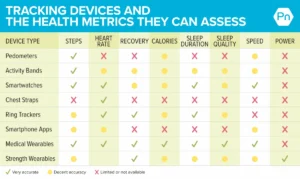
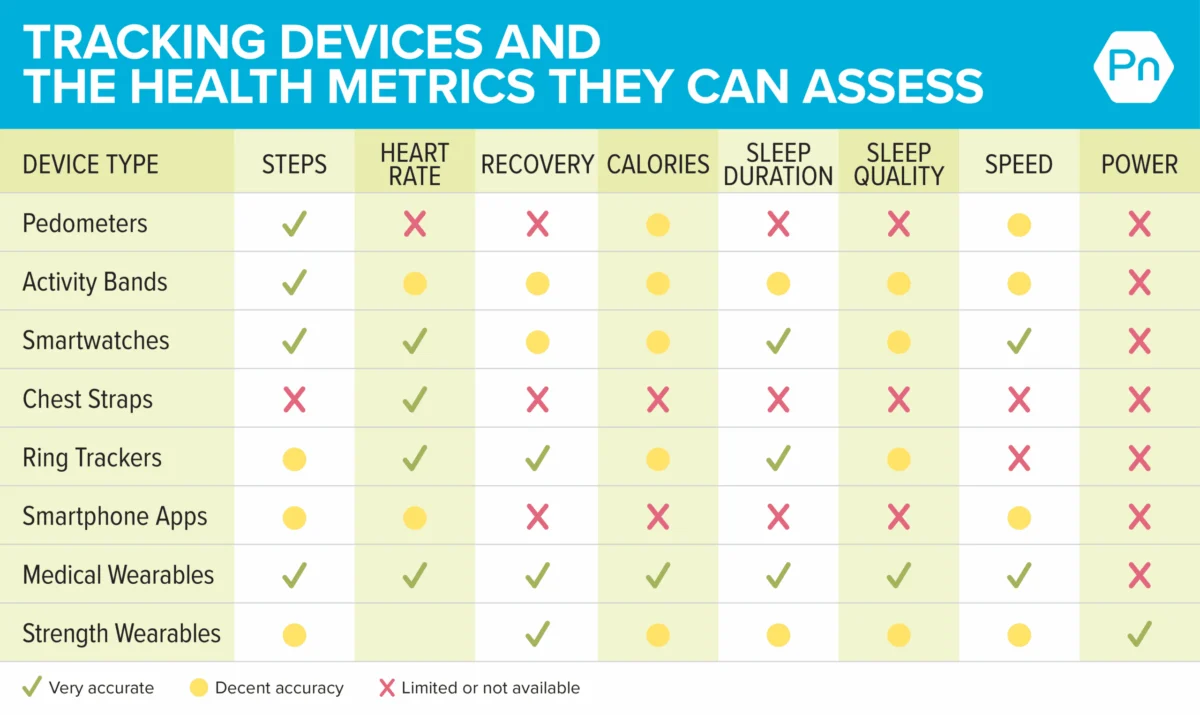
While the proliferation of data trackers offers immense potential, it is crucial to approach their outputs with a discerning eye. Not all data is created equal, and the accuracy of tracking devices varies significantly, influenced by brand quality, software sophistication, and the inherent difficulty of quantifying certain biological metrics. Generally, metrics like heart rate and step count are considered relatively reliable across a range of devices, supported by numerous independent validation studies. For instance, chest strap heart rate monitors, which use electrocardiography (ECG) technology, are widely regarded as the gold standard for heart rate accuracy in consumer devices. Wrist-based optical sensors, while convenient, can have varying degrees of accuracy depending on activity type, skin tone, and device fit, though they have improved significantly over time.
However, many other types of outputs, from estimated calories burned to detailed sleep stage analysis or movement velocity, often come with substantial margins for error. Calorie expenditure calculations, for example, are complex, relying on algorithms that factor in age, sex, weight, and activity, but often struggle to account for individual metabolic rates and nuanced movement patterns. Similarly, while devices can accurately track sleep duration, the precise identification of sleep stages (REM, deep, light) remains a challenge for most consumer wearables compared to polysomnography, the clinical standard. This discrepancy is a critical consideration for users relying on these metrics for health decisions. A comprehensive understanding of what each device and metric can reliably deliver, versus what it merely estimates, is paramount for effective utilization.
Navigating the Data Deluge: The Paradox of Information

The abundance of data generated by tracking devices presents a unique paradox: while information is crucial for informed decision-making, an excess of it can be counterproductive. As computer scientist Samantha Kleinberg, who studies decision-making, notes, "What’s really remarkable is that even a tiny amount of surplus information has a big negative effect on our decision-making." This phenomenon can be illustrated by an inverted U-shaped curve, where an optimal amount of relevant information leads to the best decisions, but performance declines sharply when there is either too little or too much data.
Today, it is surprisingly easy to fall victim to information overload. This "analysis paralysis" is familiar to anyone who has spent hours sifting through hundreds of reviews for a seemingly simple purchase, only to end up more confused than when they started. In the realm of health and fitness, where marketers often compete to offer "more science, more customization, and more complexity," this deluge can be particularly overwhelming. When all this information blurs together without a clear path forward, individuals may find themselves immobilized rather than empowered. The art lies in finding "just enough" information to make sound decisions, a skill that requires conscious effort and a critical approach to the data presented. Before diving deep into every metric, a simple self-reflection can be powerful: "Does tracking genuinely increase my well-being and performance?" A clear yes or no can guide the decision to continue, modify, or discontinue tracking.
Empowering Decisions: When Tracking Data Truly Helps
Despite the potential for overload, tracking devices offer powerful benefits when used judiciously, particularly in three key areas:
1. Decreasing Stress and Validating Methods: For individuals who might doubt the efficacy of a new health regimen or their own capabilities, objective data can provide invaluable reassurance. Consider Zak, a high-achieving individual who initially struggled to trust the benefits of zone 2 cardio because it "felt" too easy. His heart rate monitor, however, consistently showed a dropping resting heart rate and improved recovery times. This objective validation allowed Zak to relax into the process, leading to further physiological improvements. In such cases, tracking acts as a calibrator, aligning subjective perception with objective reality, thereby building confidence and reducing anxiety, especially for those who inherently question their "good enough-ness." Similarly, continuous glucose monitors (CGMs), initially for diabetes management, are now used by some to "optimize" blood sugar, potentially validating certain food choices. While this can be helpful, it also risks becoming an unnecessary source of stress if not used appropriately.
2. Enhancing Motivation and Facilitating Behavior Change: For behaviors to occur, according to psychologist B.J. Fogg’s Fogg Behavior Model, three elements are needed: motivation, ability, and a prompt. Fitness trackers excel at providing prompts and reinforcing motivation when ability is already present. Take Margaret, who believed her nightly glass of wine aided sleep. Her sleep tracker, however, revealed significantly poorer sleep quality on nights she imbibed. This clear, objective prompt—her sleep score—directly linked her behavior to its consequence, enabling her to adjust her habits. When important data is highlighted, the right choices become clearer, embodying the adage, "Once you see it, you can’t un-see it." This principle was exemplified by Timothy Jones, CEO of Precision Nutrition, who leveraged feedback from various lifestyle trackers to significantly reduce his genetically high cholesterol levels, transforming his health and life in the process.
3. Deepening Self-Understanding: The common belief that "the harder you work, the better your results" is not always true. This mindset often leads to "grinders" pushing themselves into "junk volume" — effort that accumulates fatigue without improving performance, or even worsening it. Conversely, many individuals chronically underestimate their effort and capacity. Data can help correct these misperceptions. For instance, in high-intensity interval training (HIIT), fixed rest periods are often estimates. Heart rate data can provide an individualized picture of actual recovery needs, revealing whether one is recovering faster or slower than expected. This allows for more precise training, preventing overtraining or undertraining. A skilled coach uses these metrics to guide clients away from unproductive effort, ensuring training and recovery are efficient and tailored to individual physiological responses. By observing real-time metrics of output, fatigue, and recovery, both individuals and coaches can gain a profound understanding of potential and limitations.
The Shadow Side: When Technology Undermines Well-being
While beneficial, an uncritical reliance on tracking technology can also introduce significant drawbacks, negatively impacting mental and even physical health.
1. Increasing Stress and Anxiety: Data, particularly negative data, can induce stress without any actionable upside. A new parent struggling with fragmented sleep due to a newborn, for example, gains little benefit from a device constantly reporting "poor sleep quality." Such feedback, when the circumstances are beyond immediate control, becomes an unnecessary burden, intensifying feelings of inadequacy or helplessness. In these scenarios, tracking can be counterproductive, creating stress where priorities should lie elsewhere, like bonding with a child. Recognising these moments allows individuals to pause tracking and revisit it when circumstances change.

2. Decreasing Intrinsic Motivation: When the focus shifts from the inherent enjoyment or purpose of an activity to the numbers on a screen, intrinsic motivation can erode. Jan, an avid recreational cyclist, initially enjoyed demolishing local trail records. However, his singular focus on speed and metrics eventually led to over-recovery and burnout. The joy of cycling for its own sake was replaced by the relentless pursuit of data points, turning a passion into a chore. When workouts become primarily about numbers rather than technique, experience, or simple enjoyment, tracking is likely doing more harm than good.
3. Disconnection from Internal Cues: Perhaps the most insidious pitfall is the risk of becoming overly reliant on external data, leading to a diminished ability to interpret one’s own internal signals. This can manifest as a loss of touch with hunger and fullness cues, energy levels, or fatigue. A notable example is "The Great My Fitness Pal Blackout" in January 2019, when the popular calorie-tracking app (with 200 million users) went down. For individuals who relied entirely on the app to dictate their caloric intake, the outage caused mild panic and a feeling of being adrift, highlighting a deep disconnection from their own internal sensations of hunger and satiety. This overreliance, sometimes termed "nomophobia" (no-mobile-phone phobia), underscores the importance of cultivating a healthy relationship with technology and actively tuning into the body’s innate wisdom.
Harmonizing Data and Intuition: Strategies for Wise Technology Use
To truly leverage the power of modern health trackers, the key lies not in blind adherence to data, but in a synergistic approach that integrates objective metrics with subjective experience. The ultimate goal is to enhance self-assessment, not replace it. It’s important to remember that motivation rooted purely in progress or other extrinsic goals will inevitably falter during plateaus or setbacks. Exercisers who cultivate intrinsic motivations—focusing on feelings of mindfulness, mastery, meaning, and success—develop a more resilient practice and genuinely enjoy the process, whether it’s running, lifting, or savoring a meal. Fitness trackers can actually help calibrate and improve this connection to felt experience in three practical ways:
1. Check in with Yourself Before Checking the Data: Imagine asking someone about their vacation and having them refer to their photos before answering. This analogy highlights the detachment that can occur when relying solely on external data. Whether tracking distance, calories, or heart rate, the most mindful approach is to pause, breathe, and access your brain’s powerful, albeit sometimes inaccurate, prediction-making abilities. Formulate your own assessment first. Then, compare it with the detailed (though not always perfectly accurate) outputs of your fitness tracker. Over time, this conscious practice can significantly narrow the gap between your self-assessment and the objective data, refining your interoception and proprioception. Regular app updates are also crucial, as algorithms are continually adjusted for improved predictive accuracy.
2. Develop Mental Shortcuts to Stand in for Objective Measures: Coaches often ask clients to estimate their limits, such as how many more reps they could perform at a given weight until failure. Novices are typically far off, but with calibration from objective trackers (or even simple visual cues and coaching prompts), they can dramatically reduce their margin of error. While fancy tools like accelerometers or blood lactate measurements exist, simpler prompts can be equally effective. For example, asking "For a million dollars a rep, how many more reps do you think you could do?" can serve as a powerful shortcut to understanding maximal effort. This leverages the Rate of Perceived Exertion (RPE), a validated sensory-driven approach where individuals rate how hard they’re working. While not everyone is inherently good at RPE, consistent practice, coupled with occasional objective data checks, can significantly improve this skill.
3. Continuously Develop Your Ability to Dial Into Your Senses: While trackers rely on accelerometers, GPS, and gyroscopes, the human body is an incredibly sophisticated sensor network. We possess proprioception (awareness of body position), interoception (sensing internal states like hunger, thirst, pain), balance, visual acuity, auditory perception, olfactory senses, and gustatory senses. This rich tapestry of sensory information is constantly fed into the nervous system’s powerful pattern-recognition machine, offering insights technology cannot yet fully replicate. To hone this innate ability, regularly check in with what and how you are feeling. Are you truly hungry, or just bored? Is that muscle soreness or a sign of injury? By consciously engaging with these internal signals and calibrating them with objective data, individuals can leverage the cool advances in wearable technology while ensuring their own felt experience remains central to their health journey.
The Future of Integrated Health: A Synergistic Path
The trajectory of wearable technology points towards even more sophisticated sensors, AI-driven personalized insights, and predictive analytics that could potentially flag health issues before symptoms even appear. However, the enduring importance of human judgment, intuition, and self-awareness cannot be overstated. Technology should serve as an augmentation to our inherent capacity for self-knowledge, not a replacement. The goal is to foster a synergistic relationship where data provides clarity and direction, while our internal senses keep us grounded, mindful, and responsive to our body’s unique needs. This balanced approach ensures that we reap the full benefits of technological innovation without losing touch with the essence of what it means to be human—a holistic blend of objective reality and subjective experience. By strategically integrating these tools, individuals can make more accurate self-assessments, leading to better decisions about their health and a richer, more meaningful life.