
The evolution of coffee appreciation has moved significantly beyond a mere morning ritual, transforming into a nuanced scientific endeavor for a growing number of enthusiasts. What began for many as a simple necessity—a caffeine infusion to combat long commutes or demanding academic schedules—has blossomed into a profound exploration of flavor, extraction, and the intricate chemistry behind the daily brew. This shift, particularly prominent within the "third-wave coffee" movement, emphasizes quality, transparency, and a deep understanding of every variable influencing the final cup.
From Commuter Fuel to Connoisseurship: A Personal and Industry Evolution
For one chemist, the journey into coffee connoisseurship began not in a passionate pursuit of flavor, but out of sheer practical need. Following the completion of a Ph.D. in chemistry and the commencement of a demanding professional career, a daily hour-long commute necessitated a reliable source of alertness and focus. Coffee, once an occasional indulgence, became a daily staple. Fast forward fifteen years, and while the daily habit persists, the relationship with coffee has profoundly transformed. Commutes are shorter, even allowing for cycling during summer months, but the most significant change is a newfound appreciation for lightly roasted, single-origin specialty coffees. This personal evolution mirrors a broader trend, especially vibrant in Scandinavia, which boasts a highly active third-wave coffee scene. Services like monthly coffee subscriptions from providers such as Kaffebox, delivering selections from various Norwegian, Swedish, and Danish roasters, exemplify this burgeoning culture.

The extraordinary circumstances of 2020 further intensified this scientific and sensory exploration. With social interactions curtailed, more time was available for reading, contemplation, and, naturally, coffee. A Coffee Advent Calendar from Kaffebox offered 24 days of blind tasting, transforming daily brewing into an engaging experiment. Success in identifying bean origin or processing methods brought satisfaction, while misidentification underscored the subtle yet profound impact of processing on flavor. This period also saw the introduction of new coffee hand grinders, adding layers of variability to the daily routine and exposing the initial struggles in achieving reproducible, high-quality pour-over coffee. This frustration, however, served as a catalyst, prompting a deep dive into the scientific literature and practical methodologies of coffee extraction.
This is not the first foray into the world of extraction for this particular chemist, whose prior explorations have included water, oil, and ethanol extractions, as well as beer brewing. Past articles have touched on diverse coffee topics, from Norwegian egg coffee and the convenience of Aeropress to the curious addition of salt to coffee, even testing this with renowned barista Tim Wendelboe, and the intricacies of espresso extraction. Yet, the recent immersion revealed the vastness of knowledge accumulated over the past decade, particularly concerning pour-over and drip coffee. The sheer volume of scientific publications now directly relevant to both professional cafés and home brewing is staggering, offering unprecedented opportunities to refine the craft.
Deconstructing the Brew: Key Parameters for Precision Coffee
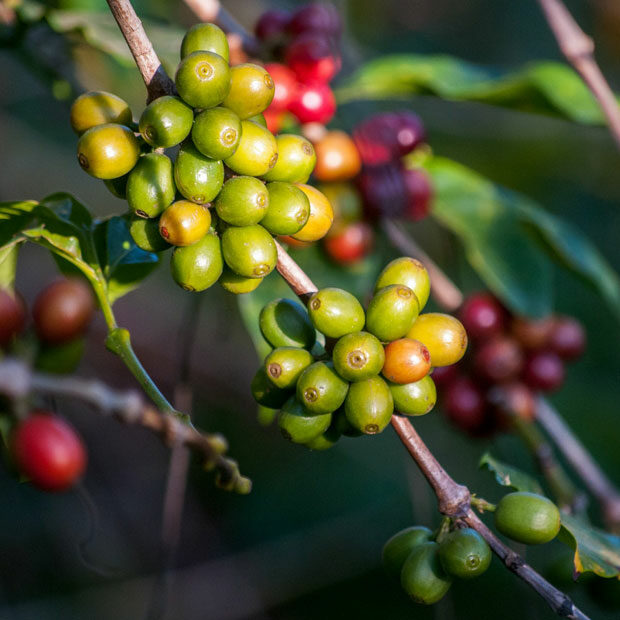
Tracing a cup of coffee back to its origin as a fruit on a Coffea arabica shrub reveals a complex chain of influence, involving numerous individuals and processing steps that dictate the final beverage’s quality. While much of this intricate journey—from dedicated farmers to skilled processors and enthusiastic roasters—remains outside the consumer’s direct control, the arrival of high-quality roasted beans on the kitchen bench marks the point where significant impact can be made. Mastering the brewing process involves understanding and controlling several critical parameters, each contributing to the sensory profile of the final cup.
Brew Ratio (BR): The Foundation of a Recipe
The brew ratio, defined as the amount of water relative to the amount of coffee grounds, serves as the fundamental recipe for coffee. A common starting point is 60 grams of coffee for 1000 grams of water, yielding a BR of approximately 16.7 (1000/60). Similar to the Baker’s percentage in baking, the brew ratio offers a concise way to standardize and scale coffee recipes. Typical brew ratios for black coffee generally fall within the range of 15 to 25. A lower brew ratio (e.g., 1:15) indicates a higher concentration of coffee solids, resulting in a stronger brew, while a higher ratio (e.g., 1:25) produces a lighter, more delicate cup. Understanding and adjusting the brew ratio is crucial for both consistency and for adapting recipes to different bean characteristics or personal preferences.
Total Dissolved Solids (TDS): Measuring Strength, Unlocking Flavor
A key revelation for many coffee enthusiasts is the profound impact of coffee strength on flavor perception. A brew perceived as "too strong and bitter" can, with the addition of a small amount of hot water, miraculously transform, revealing a spectrum of fruity and complex notes previously masked. This phenomenon highlights the importance of Total Dissolved Solids (TDS), the easiest and most objective measure of coffee strength. While TDS does not directly quantify taste quality, it provides critical numerical feedback, indicating whether a brew falls within an optimal range or is significantly off.
Traditionally, measuring dissolved solids involves gravimetric analysis—evaporating the water from a coffee sample and weighing the residue. However, this method is impractical for home use, requiring highly accurate laboratory balances capable of measuring milligram quantities. Fortunately, refractometry offers a far more accessible alternative. Light travels at different speeds through pure water versus water containing dissolved solids, a principle that refractometers exploit.
Refractometry: A Practical Scientific Tool
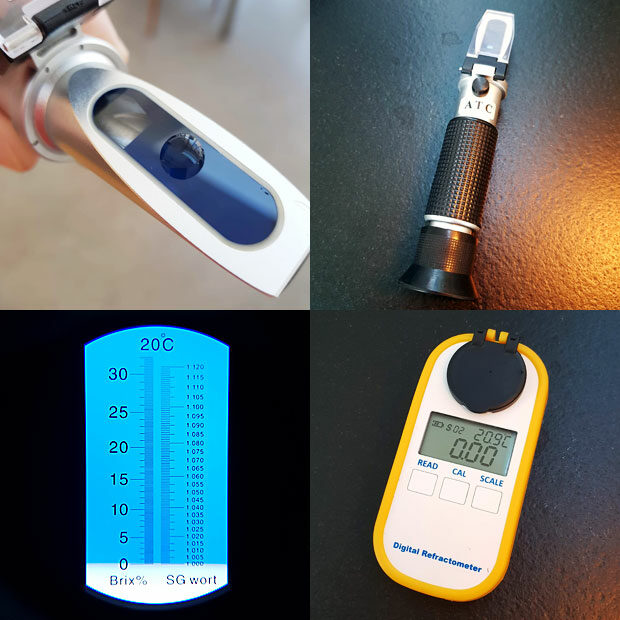
Analog handheld refractometers, often equipped with a %Brix scale, can be acquired relatively inexpensively. Brix, a measure of sugar content, can be converted to %TDS by multiplying by approximately 0.85. While these devices provide a resolution of 0.0-0.2 %Brix, sufficient to confirm if a brew is within the typical 1.2-1.5% TDS range, they lack the precision for fine-tuning. Their utility extends beyond coffee, making them valuable kitchen tools for tasks like dialing in sugar content for sorbets or measuring specific gravity in homebrewing beer. For greater accuracy, digital refractometers are available, including specialized coffee models that offer 0.01 °Brix readout and automatic TDS conversion, though these come at a higher price point. The underlying physics relies on the refractive index of the solution, which changes predictably with the concentration of dissolved solids. Maintaining consistent sample temperature is crucial for accurate readings, as temperature also affects refractive index.
DIY Sample Preparation for Accurate TDS
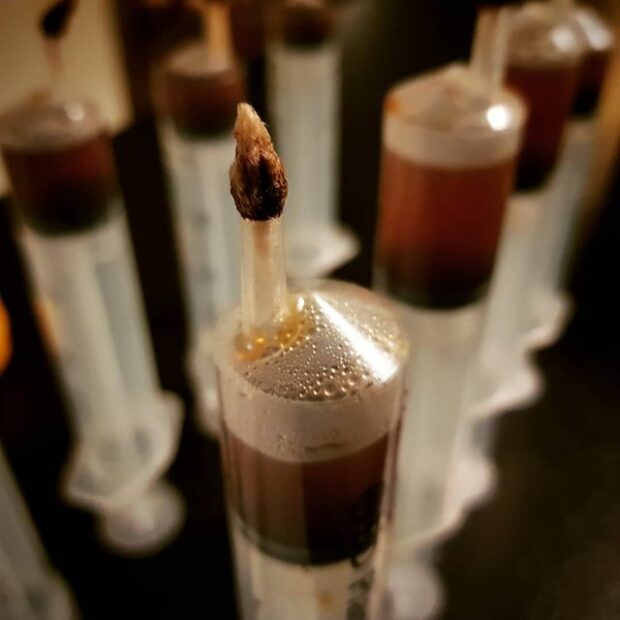
For measuring TDS during extraction, samples must be hot-filtered to halt the extraction process and then cooled completely before measurement. A simple and effective DIY method involves using plastic syringes fitted with a small cotton plug. This allows for rapid hot filtration, followed by cooling with minimal evaporation (cotton acting as a plug, condensation visible inside the syringe). The cooled sample is then dispensed onto the refractometer using the syringe’s plunger, eliminating the need for additional pipettes and minimizing waste. This method offers a cost-effective, practical solution for home brewers keen on scientific rigor.
Extraction Yield (EY) and Effective Extraction Yield (EEY): Quantifying Efficiency
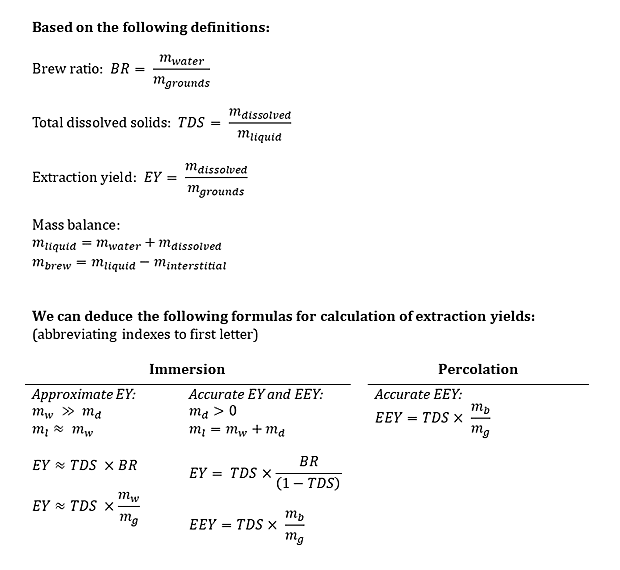
Beyond mere strength, understanding how much soluble material is extracted from the coffee grounds is crucial. This is quantified by the Extraction Yield (EY). However, the complexity of percolation brews (like pour-overs), where some liquid remains trapped within the grounds (interstitial liquid), necessitates a clearer definition. Two distinct yield calculations are useful:
- Extraction Yield (EY): The total mass of dissolved solids extracted from the coffee grounds, relative to the initial mass of dry coffee grounds. This reflects the efficiency of extraction from the bean itself.
- Effective Extraction Yield (EEY): The mass of dissolved solids delivered to the cup, relative to the initial mass of dry coffee grounds. This is particularly relevant from an economic perspective and for the consumer’s sensory experience.
For immersion brews (like French press), where the entire liquid mass is uniformly mixed, EY and EEY are often considered equivalent if one disregards liquid trapped within the grounds. For percolation brews, however, the interstitial liquid, which never reaches the cup, means EY and EEY diverge. Experts like Scott Rao and Jonathan Gagné have extensively discussed these complexities.
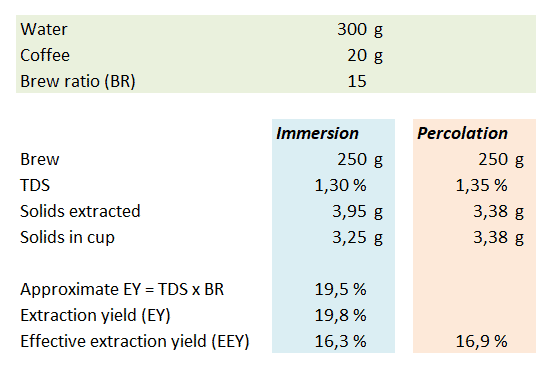
Consider an example: using 300g water and 20g coffee to produce 250g of brewed coffee.
- Immersion Brew (e.g., French Press): If the measured TDS is 1.30%, the total dissolved solids (m_dissolved) in the entire liquid mass (water + dissolved solids) is approximately 3.95g. This corresponds to an EY of about 19.8% (calculated as TDS x BR / (1-TDS)). However, the solids delivered to the cup (EEY) are 1.30% of 250g, or 3.25g, yielding an EEY of 16.3%.
- Percolation Brew (e.g., Pour-over): Assuming a higher measured TDS in the cup of 1.35% (due to fresh water continuously contacting grounds), the solids delivered to the cup would be 1.35% of 250g, or 3.38g. This results in an EEY of 16.9%. In percolation, EY typically equals EEY as the focus is on what reaches the cup, and the interstitial liquid is conceptually distinct.
This comparison reveals that while immersion might extract slightly more total solids from the grounds into the entire liquid mass, percolation methods are often more efficient at delivering those solids into the final beverage. The difference in extracted mass (e.g., 3.95g vs. 3.38g in the example) directly explains the sensory distinctions between immersion and percolation coffees. Different chemical compounds extract at varying rates and solubilities, meaning a 0.57g difference in extracted solids significantly alters the final flavor profile. The Specialty Coffee Association (SCA) brewing control chart, which plots TDS against EY, provides a widely recognized framework for targeting ideal extraction ranges, aiming for balanced flavors and optimal efficiency. Considerations like water evaporation and the inherent moisture content of roasted beans further refine these calculations for ultimate scientific precision.
Grind Size and Particle Size Distribution (PSD): The Unseen Architecture of Extraction
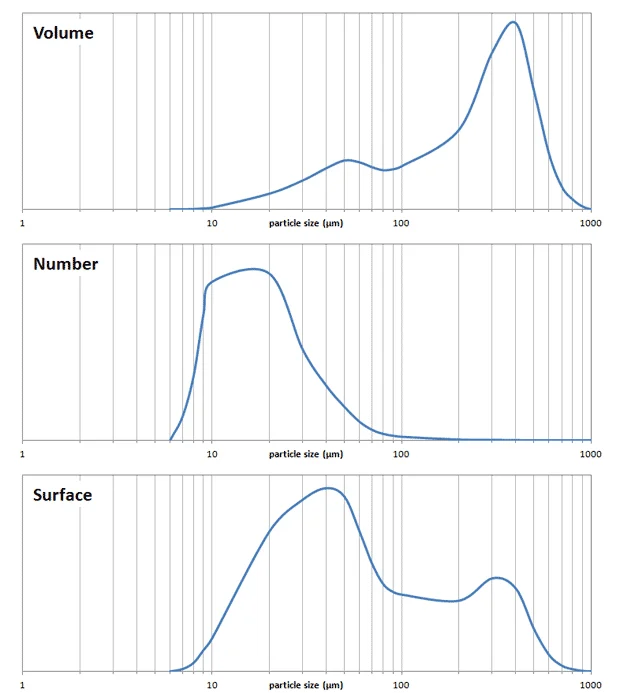
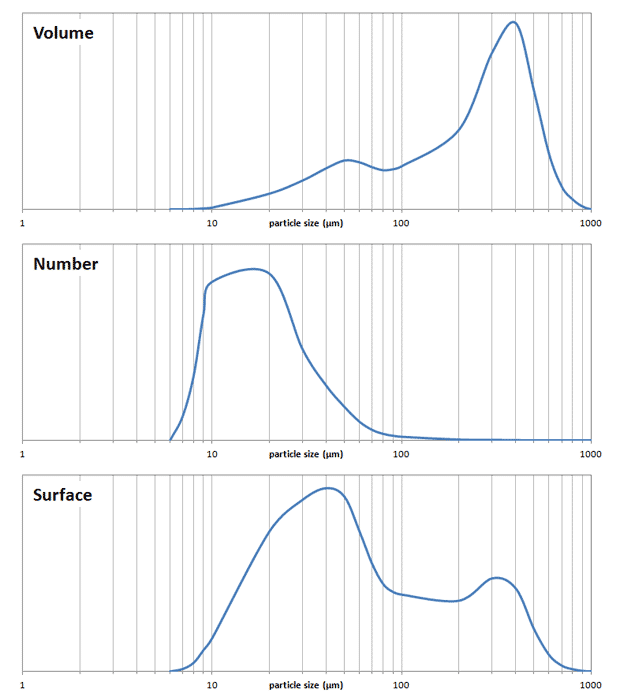
Grinding roasted coffee beans results in a heterogeneous mix of particle sizes, ranging from large "boulders" to extremely fine particles, or "fines," generally defined as those smaller than 100 µm. This Particle Size Distribution (PSD) is paramount, influencing both the rate of extraction and the flow dynamics in percolation brewing.
Measuring and Visualizing PSD:
While specialized lab equipment like MicroTrac or Sympatec offers precise PSD analysis, home enthusiasts can use sifters, such as those made by Kruve, or employ image analysis apps. However, fines tend to agglomerate, making accurate measurement challenging. Critically, the way PSD is visualized impacts interpretation. While volume distribution (the most common) might suggest fines are negligible, viewing by particle number reveals their sheer abundance. Most impactful for extraction, however, is the surface area distribution. This perspective often shows that over half of the total extraction surface area can come from particles smaller than 100 µm. This is significant, especially considering preliminary research from Barista Hustle’s Matt Perger suggesting that coffee particles are extracted only to a depth of about 100 µm. This implies that larger particles often contain an unextracted core, representing "wasted" coffee. Despite this, larger particles are crucial for forming a stable filter bed, ensuring adequate flow rate and preventing clogging in pour-over methods.
The Grinder’s Crucial Role:
The choice of grinder profoundly impacts PSD. Inexpensive blade grinders (often called knife grinders) produce a highly inconsistent grind with an excessive amount of fines and boulders, leading to uneven extraction and undesirable flavors. Burr grinders, available in manual and electric forms, are the standard for quality coffee. These come with various burr materials, geometries, and sizes, ranging from compact conical burrs (common in hand grinders) to larger flat burrs favored in high-end café machines. Different burr designs are optimized for specific brewing methods; for instance, some flat burrs are engineered to produce fewer fines for pour-over, while others are designed for espresso, where a controlled amount of fines is desirable for crema formation and flow resistance. Industrial-scale cylindrical grinders can achieve extremely narrow PSDs, suggesting that professionally ground, inert-gas-packaged coffee could theoretically offer superior grind uniformity compared to most home grinders. However, the rapid oxidation of ground coffee upon exposure to air makes fresh, on-demand grinding of whole beans essential for preserving flavor integrity. Experimenting with techniques like double grinding (coarse followed by fine) may help home brewers achieve a narrower PSD and more consistent extraction.
Freshness of Beans: The Race Against Oxidation
The mantra of specialty coffee is simple: use freshly roasted beans. Once roasted, coffee beans undergo a degassing process, releasing carbon dioxide, and are also susceptible to oxidation. Exposure to oxygen initiates chemical reactions that degrade delicate flavor compounds, leading to stale, rancid notes. Grinding coffee drastically increases its surface area, accelerating these oxidative processes. Therefore, beans should be stored in airtight bags, with as much air removed as possible, and ground only immediately before brewing. For larger quantities, storing beans in the freezer or refrigerator can slow down oxidation, preserving freshness for longer periods, as chemical reactions proceed more slowly at lower temperatures.
Water Composition: The Unsung Hero of Flavor
Often overlooked, water is far from a neutral solvent; its mineral composition profoundly impacts the taste of coffee. Just as in beer brewing, specific mineral profiles enhance coffee extraction and flavor. Previous explorations into DIY mineral waters, even gaining recognition in publications like Wired, demonstrated how tailored mineral additions to tap water could replicate commercial mineral waters. This principle extends directly to coffee. Minerals like magnesium and calcium interact with coffee compounds, influencing the extraction of acids, sugars, and bitter compounds. Bicarbonates, acting as buffers, affect the water’s pH and, consequently, the perceived acidity and body of the coffee. The SCA provides detailed water chemistry guidelines for optimal coffee brewing. While some recipes focus on building water profiles from distilled water, adapting local tap water (e.g., soft water prevalent in Norway) by adding specific mineral salts offers a practical and sustainable approach.
Temperature: Orchestrating Solubility and Kinetics
Temperature is a critical variable, influencing both the solubility of chemical compounds and their diffusion rates during extraction. Generally, higher temperatures increase solubility and accelerate extraction. For maximizing extraction efficiency, brewing close to 100 °C is desirable, though "maximum extraction" does not always equate to the "best possible cup," as undesirable bitter compounds can be extracted at higher temperatures or longer contact times. Cold brewing, for example, intentionally uses lower temperatures, slowing extraction significantly (typically overnight) and resulting in a distinct flavor profile, often characterized by lower acidity and bitterness. Furthermore, the serving temperature of coffee directly affects sensory perception; studies show that sweetness and bitterness diminish as a beverage cools, while sourness and saltiness remain more stable. This underscores the importance of consistent brewing and serving temperatures for optimal enjoyment.
Filter Material: Refining the Sensory Experience
The choice of filter material significantly impacts the clarity, body, and flavor profile of the final brew. Paper filters are the most common and, crucially, the most effective at retaining fine particles. The human palate is remarkably sensitive, capable of discerning particle size differences as small as 5 µm in foods like chocolate. This explains why a French press, which uses a metal mesh filter, often tastes "muddy" or possesses a heavier "body" due to suspended fines, compared to the "clean" taste of a Chemex brew, which employs a much thicker paper filter that traps even minute particles.
Beyond microscopic particles, paper filters also retain coffee oils, which contribute significantly to taste and mouthfeel, particularly in espresso. Experimenting with metal filters in pour-over devices can reveal the sensory impact of these oils. Paper filters themselves offer variety: bleached versus unbleached. While environmental concerns often drive the choice for unbleached filters, bleached filters generally contain fewer residues that could impart off-flavors. Modern bleaching processes predominantly use environmentally friendlier oxidizing agents, minimizing concerns about chlorine. The science of filtration is vast, as evidenced by the diverse grades of laboratory filter papers like Whatman. Detailed analyses, such as those found on Coffee Ad Astra, use microscopy to compare filter papers from various brands (Hario, Chemex, Cafec, Aesir), revealing differences in pore size and structure, though it’s important to remember that cellulose fibers swell when wet, altering the filter’s performance.
Prioritizing the Pursuit: A Guided Path to Better Coffee
For those embarking on a scientific journey into coffee brewing, a systematic approach is key. The following hierarchy, based on impact and interdependence, is recommended for exploration:
- Brew Strength (TDS) & Extraction Yield (EY/EEY): These are foundational. Without achieving a balanced strength and optimal extraction, even the finest beans will disappoint.
- Grind Size & Particle Size Distribution: Crucial for controlling extraction rate and flow, directly influencing TDS and EY.
- Freshness of Beans: While essential, its impact is minimized if the first two parameters are uncontrolled. Freshness ensures the raw material is at its peak potential.
- Water Composition: Refines and enhances the flavors extracted, but only truly impactful once foundational brewing parameters are dialed in.
- Temperature: Fine-tunes extraction rates and solubility, allowing for specific flavor emphasis.
- Filter Material: Impacts clarity and mouthfeel, a final refinement of the sensory experience.
For the active explorer, managing parameters at the top of this list is a prerequisite for noticing the subtle effects of those further down. For instance, without consistent grind and extraction, the nuances of water adjustments or filter types become indistinguishable. Tools like the "Coffee Compass" from Barista Hustle provide a practical troubleshooting guide, helping brewers diagnose issues like "sour" (under-extracted) or "bitter" (over-extracted) coffee and adjust variables accordingly.
In conclusion, the journey from casual coffee drinker to scientific connoisseur is one of continuous discovery. By systematically exploring and controlling variables such as brew ratio, total dissolved solids, extraction yield, grind size, bean freshness, water composition, temperature, and filter material, the daily act of brewing coffee transforms into a precise craft. This scientific approach empowers enthusiasts to unlock unparalleled flavor potential and consistency, elevating the coffee experience for both the individual brewer and the broader coffee community.