
The electrifying buzz surrounding the potential of humanoid robots to revolutionize our kitchens and daily lives, a prominent theme at both IFA last fall and CES in Las Vegas, is prompting a deeper examination of the realistic trajectory of domestic automation. While the vision of dexterous, bipedal robots performing culinary tasks has captured the public imagination and been amplified by pronouncements from industry leaders like Jensen Huang predicting a massive acceleration in physical AI by 2025 and beyond, a closer look at the current landscape and developmental hurdles suggests a more nuanced and perhaps less dramatic near-term future for kitchen robotics. The allure of science fiction is powerful, but practical implementation and consumer adoption paint a different picture.
The Allure and the Reality of Humanoid Kitchen Assistants
The spectacle of robots folding laundry, pouring drinks, and even attempting to cook meals at major tech expos has undeniably fueled the narrative of an impending humanoid robot revolution in the home. These demonstrations, often showcasing advanced manipulation capabilities, seem to validate predictions of a future where robots are integral to nearly every facet of our lives. However, when the focus narrows to the specific challenges and opportunities within the home kitchen, the question arises: will humanoids truly become the dominant form factor for robotic assistance, or will other designs prove more practical and accessible for the average consumer?
The current landscape offers a spectrum of robotic kitchen solutions. Companies like Moley Robotics have showcased sophisticated robotic arms designed to replicate human cooking motions, representing a high-end, aspirational approach. Simultaneously, integrated countertop systems, such as Chefee, offer a more streamlined, embedded automation solution. Yet, the prevailing sentiment among experts and industry observers suggests that neither of these fully humanoid or fully integrated systems represents the most probable immediate future for the average household kitchen.
The Rise of the Smart Countertop Cooker
Instead, the most likely evolution in the short to medium term points towards advanced countertop cooking devices. These innovations are envisioned as an evolution of the multifunctional cookers already familiar to consumers, such as the Thermomix or Instant Pot, but infused with significantly more sophisticated automation and multistep cooking intelligence. This approach prioritizes practicality, affordability, and ease of integration into existing kitchen environments.
A growing number of startups are actively pursuing this vision. These companies are developing countertop robots that can be best described as the sophisticated offspring of devices like the Thermomix and the Anova Precision Oven, enhanced with the capability to automatically dispense ingredients and seamlessly transition between various cooking functions to prepare an entire meal from start to finish. This "kitchen-in-a-box" concept aims to tackle the most time-consuming and repetitive aspects of meal preparation.
The lineage of these countertop cooking robots can be traced back over a decade. Early pioneers like Sereniti paved the way, and subsequent innovations from companies like Else Labs (with its Oliver appliance), GammaChef, Posha, and Nosh have continued to refine the concept. While some, like Else Labs/Oliver, have pivoted towards commercial and office environments, others are making significant strides towards consumer markets.
Posha and Nosh: Leading the Charge in Automated Home Cooking
Posha appears to be one of the most advanced in bringing a fully automated home cooking robot to market. Raghav Gupta, CEO of Posha, articulates a clear evolutionary path for his company’s product, drawing a direct parallel to the Thermomix. "What Posha is is actually Thermomix plus plus," Gupta explained, emphasizing the leap in autonomy. He likens the progression from a Thermomix to Posha to the transition from a vehicle with advanced driver-assistance systems to a fully autonomous self-driving car.
"In Thermomix, you still have to be around your device. You still have to be behind the wheel," Gupta elaborated. "In Posha, you don’t have to be behind the wheel anymore. It’s like the Waymo equivalent of driving. You can sit in the back seat, read a book while your self-driving car takes you from point A to point B." This analogy highlights the core value proposition: freeing users from the constant supervision and manual intervention typically required during cooking.

Amit Gupta (no relation to Raghav Gupta), co-founder of Nosh, echoes this sentiment, framing the challenge through the lens of the daily burden of home cooking. "Eating right is impossible because cooking is a burden," Amit Gupta stated in a previous interview with The Spoon. Nosh has garnered significant attention and funding, raising over $800,000 through a successful Kickstarter campaign for its first-generation robot.
Nosh’s approach, much like Posha’s, bets on a future where cooking robotics eschew legs and arms in favor of a contained, countertop system. This design is optimized for automating not just the heating and timing elements of cooking but also the nuanced judgment calls that human chefs make. Amit Gupta describes Nosh as a "kitchen in a box," a comprehensive system engineered to streamline the entire cooking process.
This focus on contained, appliance-like automation is likely to resonate with a broad consumer base over the next five to ten years, offering a tangible and accessible path towards automated home cooking.
The Long Game: When Will Humanoids Enter the Kitchen?
The question of when fully humanoid robots will become a practical reality in our homes, particularly for tasks as complex as cooking, hinges on several critical advancements. The development of AI and robotics is a complex, iterative process. Just as early training models in the 2010s were instrumental in ushering in the era of autonomous driving, the current push is focused on building massive datasets that enable robots to navigate and interact with the real world effectively.
Initiatives like Instawork, which equips temporary workers with bodycams to capture everyday tasks, are contributing to this effort. This approach builds upon foundational research like the EPIC Kitchens project, a university initiative launched in 2018 that utilized video capture of physical interactions to train computer vision systems for robotics. These modern efforts are significantly scaling the collection of real-world training data, propelled by substantial investments flowing into the AI-meets-robotics sector.
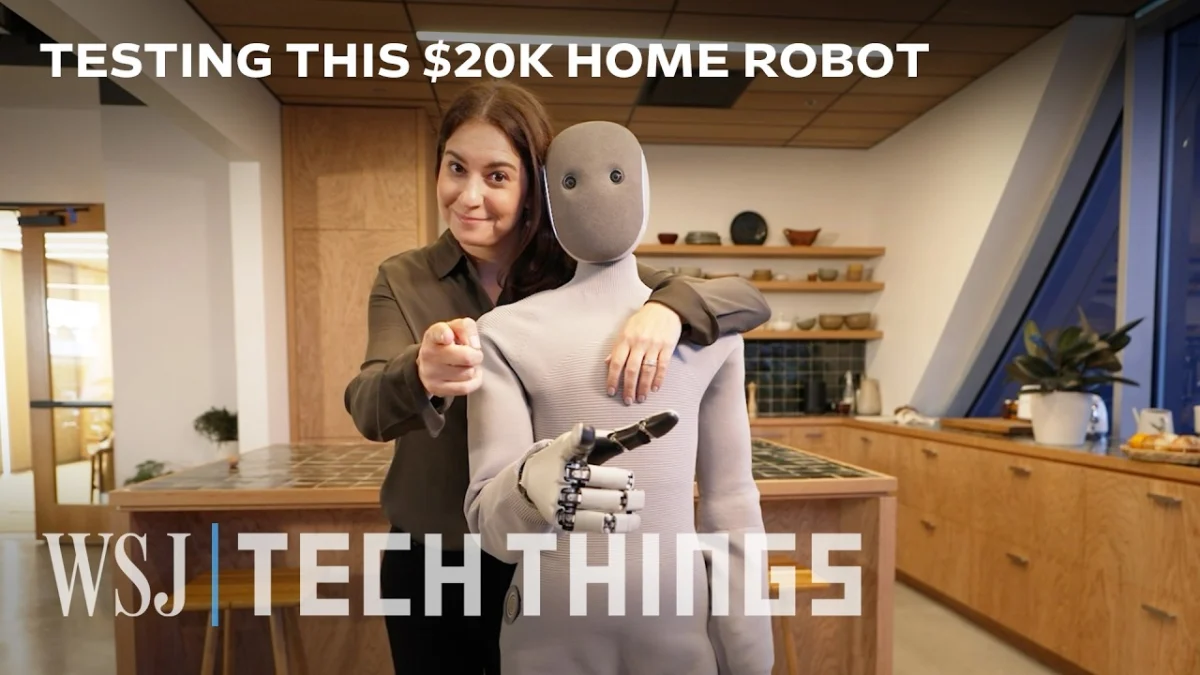
While the cost of renting robots for specific tasks is currently around $500 per day, early systems, as demonstrated in trials like Joanna Stern’s experience with the NEO 1, remain largely geared towards early adopters. A significant barrier to widespread adoption is the current limitation of these robots in performing complex, useful tasks like cooking. Furthermore, many of these early models, including the NEO 1, still rely on teleoperation, meaning a human operator remotely controls the robot’s actions within a user’s home in real-time. This lack of full autonomy and task proficiency is a major hurdle.
The Transformative Potential for Independent Living
The long-term outlook for humanoid robots in the home is undeniably transformative, particularly for individuals facing mobility, dexterity, or other challenges related to independent living. As global populations age and the costs associated with managed care continue to rise, the potential for humanoid robots to provide essential support is immense.
Consider the experience of many elderly individuals. Voice assistants like Alexa have already proven invaluable, offering a simple interface for accessing information, setting reminders, and controlling smart home devices. For individuals like the author’s mother, who is in her 80s and lives independently, such technology offers a vital connection to the modern world and practical assistance. A robotic assistant, capable of performing more complex tasks, could represent a natural and highly beneficial progression, especially as cooking becomes increasingly challenging.
While the immediate future of kitchen robotics is likely to be dominated by practical, countertop solutions, the eventual arrival of two-legged robotic assistants holds the promise of profound societal impact. The challenges of developing robots that can reliably and safely perform the intricate tasks required for cooking and other household chores are substantial. However, with continued advancements in AI, sensor technology, and robotics, the vision of humanoids seamlessly integrated into our homes, supporting independent living and enhancing quality of life, remains a powerful and compelling long-term goal. The journey from the current generation of smart appliances to fully capable humanoid domestic helpers is a marathon, not a sprint, but the potential rewards for society, particularly for its aging population, are significant.