
The burgeoning landscape of artificial intelligence is rapidly moving from the digital realm into our physical spaces, with a significant focus on robotics. Recent major technology expos, including IFA last fall and the Consumer Electronics Show (CES) in Las Vegas this year, have underscored a pervasive trend: the ascent of humanoid robots from the pages of science fiction to tangible, multifaceted tools for both professional and domestic environments. This surge aligns with predictions, such as those made by NVIDIA CEO Jensen Huang, foreseeing a substantial acceleration in physical AI applications by 2025 and beyond, permeating nearly every facet of daily life. However, when the conversation turns to the heart of the home – the kitchen – a critical question emerges: will humanoid robots become the ubiquitous form factor for culinary automation, or will more specialized, appliance-like solutions dominate the domestic sphere in the foreseeable future?
The Humanoid Hype vs. Kitchen Realities
The vision of a humanoid robot seamlessly preparing meals, performing household chores, or even offering companionship has captured the public imagination. Companies are showcasing impressive prototypes capable of tasks ranging from folding laundry and pouring beverages to executing complex cooking procedures. This progress has fueled speculation that these sophisticated, bipedal machines are poised to revolutionize domestic life. Yet, the practicalities and economic realities of deploying such advanced robotics in average households present significant hurdles.
The immediate future of kitchen automation, particularly for the average consumer, may not feature the anthropomorphic dexterity of humanoids. Instead, the more probable trajectory points towards advanced countertop cooking appliances. These devices are envisioned as evolutions of existing multifunction cookers, enhanced with sophisticated automation and intelligent, multi-step cooking capabilities. This approach leverages the familiarity of current kitchen appliances while integrating higher levels of AI-driven assistance.
The Rise of the Countertop Culinary Robot
A growing number of startups are actively pursuing this more grounded vision of kitchen robotics. These companies are developing countertop cooking robots that can be conceptualized as a fusion of established kitchen powerhouses like the Thermomix and advanced ovens such as the Anova Precision Oven. The innovation lies in their ability to automatically dispense ingredients, seamlessly transition between various cooking functions, and ultimately prepare an entire meal with minimal human intervention.
The concept of an automated kitchen appliance is not entirely new. Early iterations of these countertop cooking robots began to emerge over a decade ago, with devices like the Sereniti appliance paving the way. Since then, the sector has seen continued development, with companies such as Else Labs (which developed the Oliver robot), GammaChef, Posha, and Nosh making notable contributions.
Posha, in particular, appears to be at the forefront of bringing a fully functional home cooking robot to market. While Else Labs/Oliver has largely shifted its focus to commercial and office environments, and Nosh has gained traction through a successful Kickstarter campaign, Posha is positioned to make a significant impact on the consumer landscape.
Posha: The "Thermomix Plus Plus"
Raghav Gupta, CEO of Posha, articulates his company’s vision by drawing a direct evolutionary parallel between existing kitchen technology and his company’s offering. He describes Posha as "Thermomix plus plus," signifying a substantial leap in automated culinary capabilities. Gupta likens the advancement from a device like the Thermomix to Posha to the transition from a car with advanced driver-assistance systems to a fully autonomous vehicle.
"In Thermomix, you still have to be around your device. You still have to be behind the wheel," Gupta explained. "In Posha, you don’t have to be behind the wheel anymore. It’s like the Waymo equivalent of driving. You can sit in the back seat, read a book while your self-driving car takes you from point A to point B." This analogy highlights the shift from a device that assists the user to one that operates independently, freeing up the user’s time and attention.
Nosh: A "Kitchen in a Box" Approach
Amit Gupta (no relation to Raghav Gupta), co-founder of Nosh, echoes this sentiment, framing the challenge of home cooking as a significant daily burden. "Eating right is impossible because cooking is a burden," Amit Gupta stated in a previous interview with The Spoon. Nosh’s strategy, which has successfully raised over $800,000 through a Kickstarter campaign for its first-generation robot, is also centered on a contained, countertop system. Their focus is on automating the repetitive and time-consuming aspects of meal preparation, moving beyond simple heat and timing controls to incorporate the nuanced judgment calls inherent in cooking. Amit Gupta aptly describes Nosh as a "kitchen in a box," a self-contained unit designed to streamline the entire cooking process.

This emphasis on contained, appliance-like automation is likely to resonate with a broad consumer base over the next five to ten years. Such systems offer a tangible benefit by reducing the effort and time required for meal preparation, directly addressing the pain point of cooking being a chore.
The Long Road to Humanoid Integration
While countertop robots may represent the immediate future, the question of when and how humanoids will integrate into our homes, particularly for tasks like cooking, remains a subject of ongoing development. The timeline for widespread humanoid adoption hinges on two critical factors: accessibility and functional proficiency.
The ability of robots to perform everyday tasks reliably and safely in dynamic home environments requires significant advancements in AI and robotics. Much like the development of early training models in the 2010s laid the groundwork for the autonomous driving era, current efforts are focused on building massive datasets to enable robots to navigate and interact with the real world.
Initiatives like Instawork, which equips temporary workers with body cameras to record their performance of everyday tasks, contribute to this data accumulation. This approach draws inspiration from academic projects like EPIC Kitchens, launched in 2018. EPIC Kitchens aimed to capture physical interactions on video to train computer vision systems for robotics. These contemporary efforts are significantly scaling the acquisition of real-world training data, bolstered by substantial investments flowing into the AI-meets-robotics sector.
Early Adopter Challenges and Future Potential
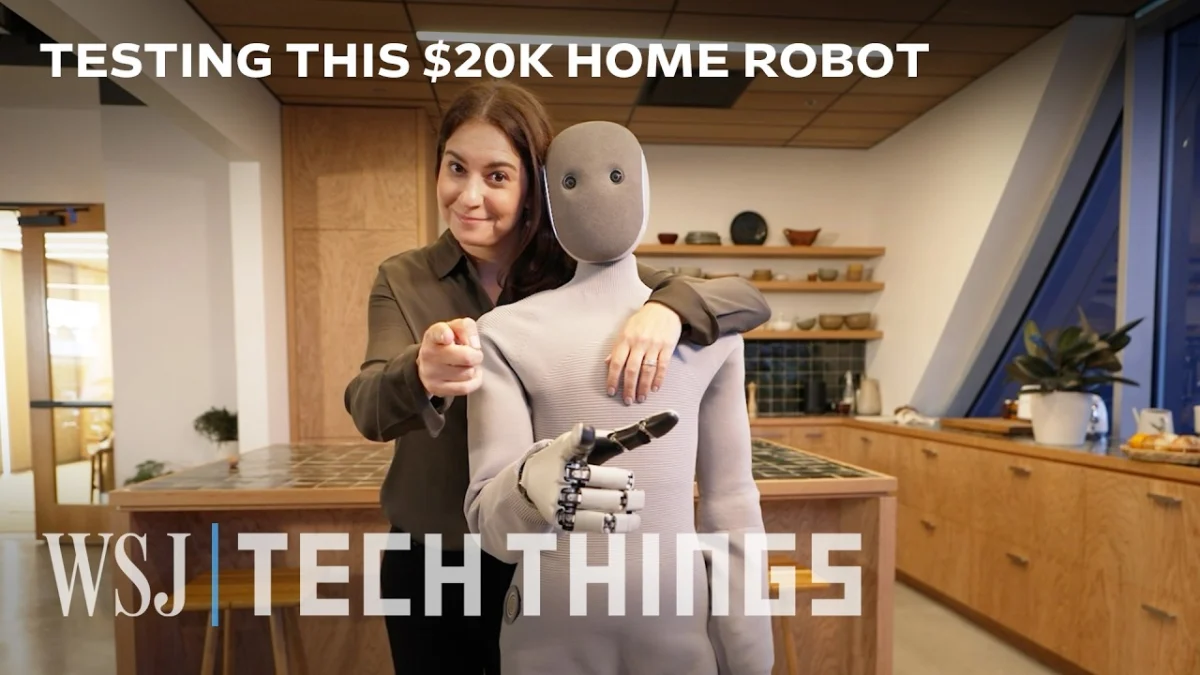
Currently, the cost of renting advanced robots can be around $500 per day, indicating that many of these early systems are geared towards early adopters and specialized industries rather than mass-market consumer use. As demonstrated in demonstrations of early humanoid robots like the NEO 1, significant challenges persist. These systems often lack the trained capabilities for complex tasks such as cooking and may still rely on teleoperation, where a human operator remotely controls the robot’s actions within a user’s home in real-time. This reliance on remote human oversight highlights the nascent stage of true robotic autonomy.
The long-term potential for humanoid robots in domestic settings is profound, particularly for individuals requiring assistance with independent living. As populations age globally and the costs of managed care continue to escalate, the prospect of robots assisting with daily tasks, including cooking, could become invaluable for people with mobility, dexterity, or other challenges.
Consider the experience of an aging individual. Many already find significant utility in voice assistants like Alexa for accessing information, setting reminders, and entertainment. For an elderly person, especially as cooking becomes more physically demanding, the transition to a robotic assistant performing these tasks could be a natural progression. The idea of a robot that can assist with meal preparation, medication reminders, or even simple physical tasks could significantly enhance quality of life and enable greater independence.
Conclusion: A Gradual Integration
The future of kitchen robotics is likely to unfold in stages. While the allure of fully autonomous humanoid robots performing every household chore is compelling, the immediate and near-term reality points towards more specialized, appliance-based solutions for the kitchen. These countertop robots offer a practical and achievable path to automating culinary tasks, addressing a common domestic burden for consumers.
In the longer term, as advancements in AI, sensor technology, and robotics continue to mature, humanoids will undoubtedly play a more significant role in our homes. Their potential impact on enabling independent living for aging populations and individuals with disabilities is immense. However, for the average household seeking to simplify their daily routines, the future of kitchen robotics will likely begin not by walking through the door on two legs, but by sitting quietly and efficiently on the kitchen counter. The journey from science fiction to widespread domestic integration is ongoing, with practical innovation leading the charge in the present.