
The past year has brought the concept of exponential growth into unprecedented public discourse, predominantly in the somber context of the SARS-CoV-2 virus’s global proliferation. This fundamental mathematical principle, often counterintuitive in its progression, has manifested starkly in both the grim trajectory of public health crises and, paradoxically, in the surprising resilience and ingenuity observed in everyday life, particularly within the domestic kitchen. As societies grappled with lockdowns and the ensuing shifts in lifestyle, a significant, albeit positive, surge in home baking emerged, inadvertently highlighting the very same exponential dynamics through the humble yet powerful action of yeast. The demand for baking ingredients, especially yeast, skyrocketed, leading to widespread shortages in many regions, including Norway, where supplies of instant dry yeast became elusive for extended periods. This scenario underscored the critical importance of understanding and leveraging exponential processes, not just for containment but also for sustainable resource management and culinary creativity.
The initial stages of the COVID-19 pandemic saw public health officials and epidemiologists frequently referencing exponential growth to explain the rapid increase in infection rates. The "wheat and chessboard problem" serves as a classic illustration of this phenomenon, where what appears to be a slow, manageable progression suddenly escalates into an overwhelming surge. This counterintuitive nature often leads to underestimation of risks in early phases, only to be followed by a sudden, seemingly out-of-nowhere explosion of cases. The R0 (basic reproduction number) of a virus, for instance, dictates how many secondary infections arise from one infected individual, and even a slightly elevated R0 value can lead to exponential spread if not mitigated effectively. The public’s growing familiarity with epidemiological curves, flattening the curve, and the critical role of social distancing measures were direct consequences of battling a threat that grew exponentially.
Chronology of a Culinary Resurgence Amidst Crisis
The global imposition of lockdowns and stay-at-home orders, starting predominantly in early 2020, triggered a profound shift in daily routines. With commutes eliminated and external social activities curtailed, many individuals found themselves with unprecedented amounts of free time. This period coincided with a heightened sense of anxiety and a desire for comfort, control, and self-sufficiency. The kitchen, often relegated to quick meals in pre-pandemic life, transformed into a sanctuary of creativity and productivity.
The timeline of this culinary renaissance can be broadly outlined:
- March-April 2020: Initial lockdowns globally. Reports of panic buying of staples like flour, sugar, and yeast begin almost immediately. Social media platforms explode with images of homemade breads, pastries, and sourdough starters.
- April-June 2020: Sustained high demand for baking ingredients leads to widespread shortages. Retailers struggle to restock shelves as supply chains, optimized for pre-pandemic consumption patterns, are overwhelmed. Yeast, in particular, becomes a prized commodity. In regions like Norway, this shortage persisted for weeks and even months.
- Summer-Autumn 2020: Home bakers, faced with limited yeast supplies, begin to adapt. Interest in sourdough baking, which relies on wild yeast cultures, surges as a self-sufficient alternative. For those preferring instant dry yeast, a collective learning curve begins: how to maximize limited resources by employing longer fermentation times and smaller quantities of yeast. Precision weighing scales, previously niche kitchen gadgets, gain popularity.
- Late 2020 and Beyond: While initial panic subsided, the trend of home baking largely continued, albeit at a slightly moderated pace. The pandemic had instilled new skills and hobbies, fostering a sustained interest in from-scratch cooking and baking.
The Science of Exponential Growth in Baking
The very existence of leavened bread is a testament to the power of exponential growth, albeit on a microbial scale. Yeast, specifically Saccharomyces cerevisiae, is a single-celled fungus that reproduces through budding, a form of asexual reproduction. Under ideal conditions—access to nutrients (sugars), warmth, and moisture—a single yeast cell can astonishingly divide into two cells in approximately 100 minutes. This doubling time, or generation time, is the engine of its exponential proliferation.
The progression is a classic example of geometric growth:
- Start: 1 cell
- After 100 minutes: 2 cells
- After 200 minutes: 4 cells
- After 300 minutes: 8 cells
- …and so on.
This seemingly slow start quickly accelerates. After 24 hours (roughly 14.4 doubling periods), a single cell can become approximately 16,000 cells. Extend this to 48 hours, and the count reaches an astounding 268 million cells. Before three full days have passed, the population can swell to an astonishing one trillion (1,000,000,000,000) yeast cells. To put this into perspective, a typical 50-gram block of compressed fresh yeast contains a similar order of magnitude of cells. This phenomenal reproductive capacity is why a small amount of yeast can ultimately leaven a substantial volume of dough, provided sufficient time and optimal environmental conditions.
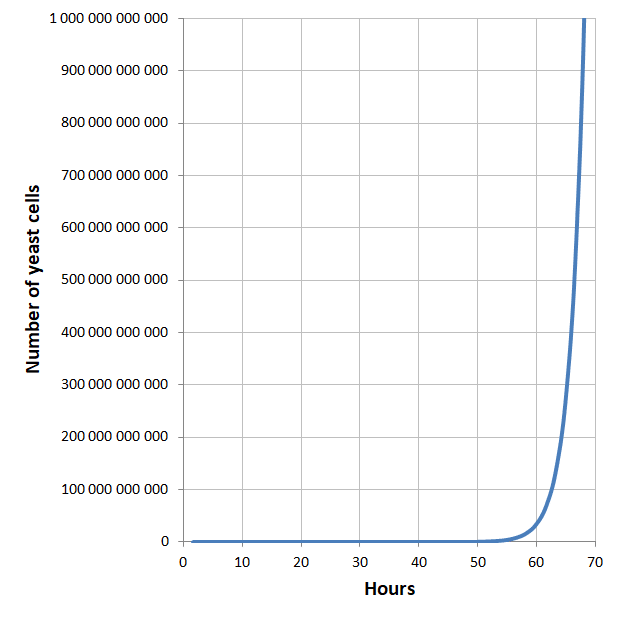
However, these ideal conditions are more readily achievable in a commercial bioreactor, where temperature, nutrient supply, and aeration are meticulously controlled. In a typical bread dough, factors such as declining sugar availability, accumulation of metabolic byproducts (like alcohol), and fluctuating temperatures will inevitably slow down the growth rate, causing it to deviate from its initial exponential trajectory and eventually enter a stationary phase. Nonetheless, the initial rapid growth phase is crucial for establishing a robust yeast population that can then ferment the dough and produce carbon dioxide, creating the characteristic airy texture of bread.
Leveraging Exponential Growth: Economical Yeast Use
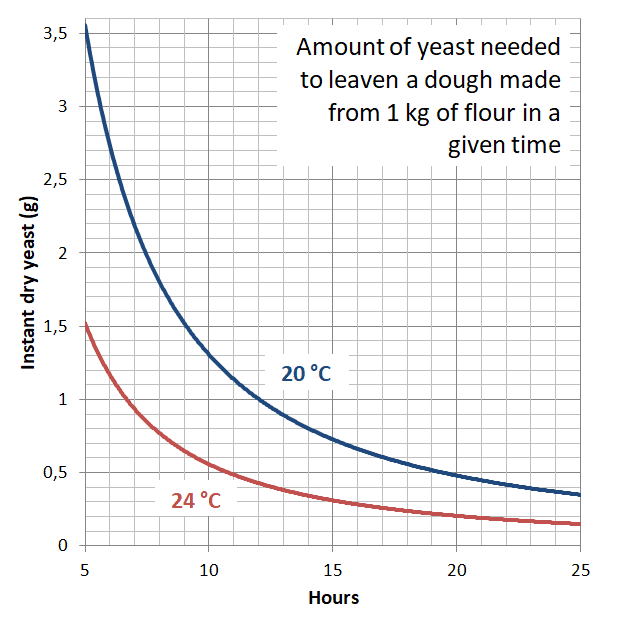
The widespread yeast shortages forced many home bakers to re-evaluate their usage, leading to a rediscovery of traditional, slower fermentation methods. Instead of relying on larger quantities of yeast to achieve a quick rise, bakers learned to harness the exponential growth principle by simply providing more time. This approach, where a minute amount of yeast is given extended hours to multiply and ferment, yields not only well-leavened dough but also enhanced flavor profiles.
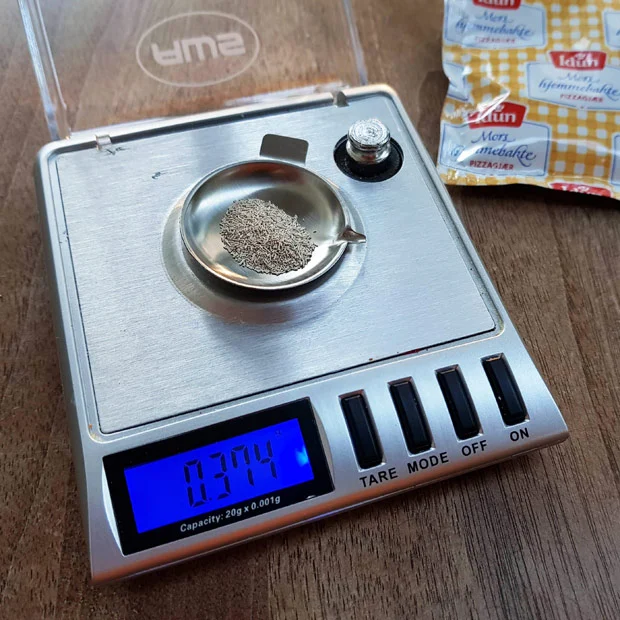
Consider a typical dough made with 1 kilogram of wheat flour. Using a conventional recipe, one might add 7-10 grams of instant dry yeast for a rise lasting 1-2 hours. However, with the aid of tools like the PizzApp+ application (available for Android), bakers can calculate precise, minute quantities of yeast required for significantly longer fermentation periods. For example, the app might recommend as little as 0.48 grams of instant dry yeast for a 1 kg flour dough if allowed to ferment for 20 hours at a moderate room temperature of 20°C.
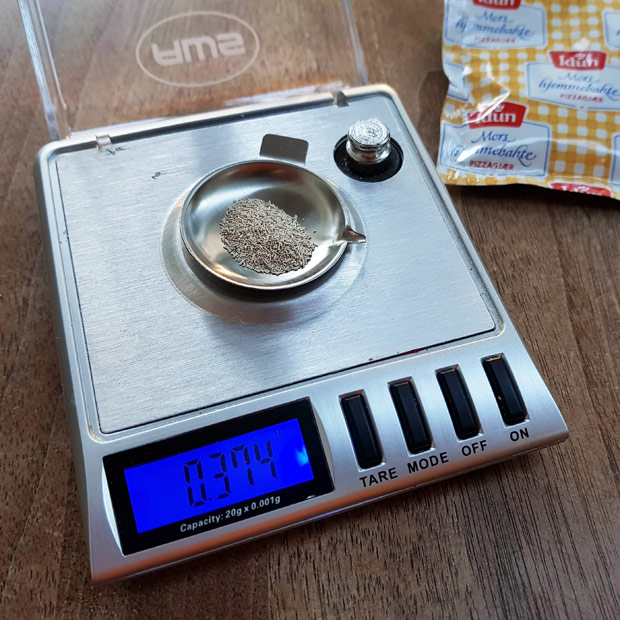
Achieving such precise measurements necessitates the use of accurate kitchen scales, often those capable of measuring down to 0.001 grams. While laboratory-grade balances can be costly, consumer-grade precision scales have become increasingly affordable and accessible, making this level of accuracy attainable for the home baker. This method not only conserves yeast but also contributes to the dough’s complexity. The extended fermentation time allows for the development of beneficial lactic acid bacteria, naturally present in flour, which contribute nuanced tangy notes and improved crust characteristics, mirroring some of the benefits typically associated with sourdough.
Industry Reactions and Broader Implications
The unprecedented surge in demand for baking ingredients presented both challenges and opportunities for the food industry. Yeast manufacturers, accustomed to stable demand patterns, struggled initially to ramp up production to meet the sudden, exponential increase in orders. This led to temporary stockouts and calls from industry bodies for consumers to buy responsibly. Retailers, in turn, adjusted their inventory management and sometimes imposed purchase limits to ensure broader availability.
While no explicit "official responses" in the form of government statements on yeast shortages were issued, the market response was clear:
- Manufacturers: Increased production shifts, optimized supply chains, and potentially fast-tracked new product lines to cater to the home baking segment. Many took to social media to reassure customers and provide tips on yeast conservation.
- Baking Experts/Culinary Influencers: Played a crucial role in disseminating knowledge about long fermentation techniques, sourdough starters, and economical yeast usage, empowering home bakers to navigate the shortages effectively.
- Tech Developers: Apps like PizzApp+ saw increased downloads and utility, highlighting the growing intersection of culinary science and digital tools.
The broader implications of this phenomenon extend beyond the kitchen:
- Shift in Consumer Behavior: The pandemic fostered a greater appreciation for home-cooked and home-baked goods. This shift could have long-term impacts on food consumption patterns, potentially leading to continued interest in scratch cooking and a more discerning palate for quality ingredients.
- Economic Impact: While retail sales of baking ingredients surged, some segments of the food service industry faced severe challenges. The increased demand for staple goods provided a boost to agricultural and food processing sectors.
- Educational Value: The pandemic inadvertently served as a global lesson in the practical implications of exponential growth. From understanding viral spread to managing yeast for baking, millions gained a tangible grasp of this powerful mathematical concept, illustrating its relevance in diverse, real-world scenarios.
- Resilience and Adaptability: The ingenuity displayed by home bakers in response to ingredient shortages exemplified human adaptability in crisis. It showcased a return to basic principles, valuing time and process over instant gratification.
In conclusion, the past year has been a unique period where the abstract concept of exponential growth transitioned from academic discourse to tangible, everyday experience. While its negative manifestations in viral spread underscored vulnerabilities, its positive application in the resurgence of home baking offered a reassuring counter-narrative of resilience and innovation. The humble yeast, with its inherent capacity for exponential proliferation, became a symbol of both scarcity and abundance, driving a global culinary awakening and reminding us that understanding fundamental scientific principles can empower us to navigate even the most challenging times with creativity and resourcefulness. The allure of instant gratification may often prevail, but the pandemic-induced yeast shortage illuminated the profound benefits of patience, precision, and the elegant power of nature’s own growth mechanisms.