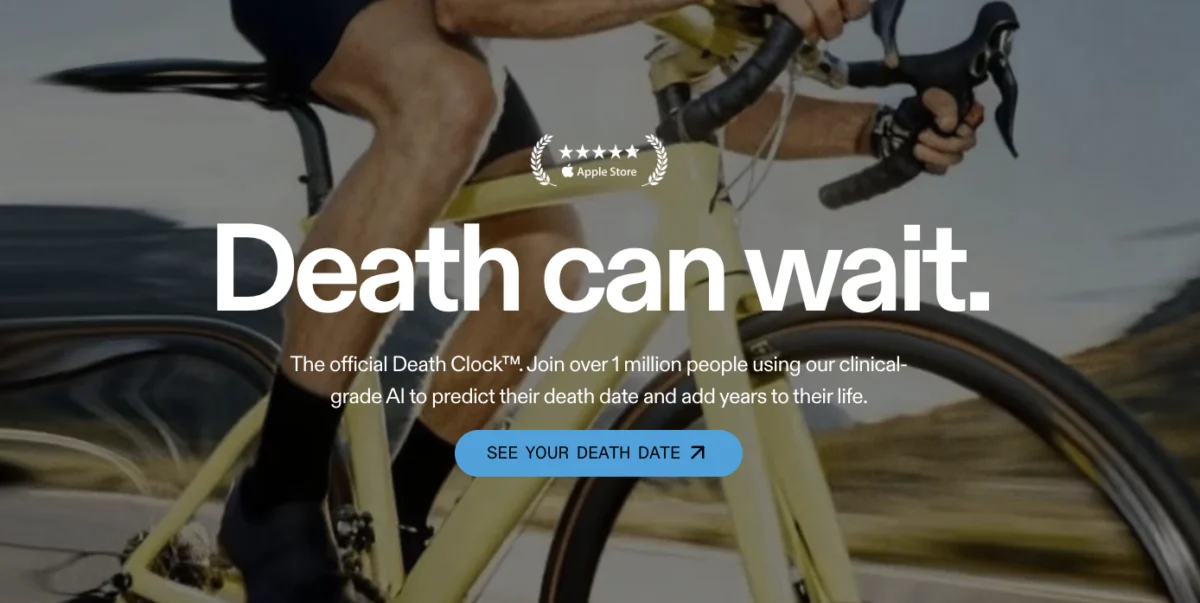

What do you do when your company is teetering on the brink of collapse? For Brent Franson, the answer was a radical pivot, a bold rebranding, and the creation of an app that provocatively asks users to confront their own mortality: Death Clock. This digital tool, born from the ashes of a failed $10 million health-tracking venture, has defied expectations, evolving from a daring gamble into a viral sensation and a foundational element of a new, AI-driven approach to preventative health.
Franson’s journey is a testament to entrepreneurial resilience and a sharp critique of the prevailing healthcare system. His previous venture, which aimed to revolutionize health tracking, ultimately faltered. The experience, however, provided him with invaluable insights into the shortcomings of traditional medicine, particularly its struggles with fostering genuine behavioral change and prioritizing preventative care. This realization became the bedrock upon which Death Clock was built.
The Birth of Death Clock: A Calculated Risk
“It’s probably a really, really stupid idea to actually name it Death Clock,” Franson admitted in a candid interview on The Spoon Podcast. He further elaborated on the precarious nature of the decision, stating, “But if it’s a good idea, it’s a really good idea. It’s an 80 percent chance it’s a terrible idea. But there’s a 20 percent chance that it’s a really good idea.” This candid assessment highlights the high-stakes gamble Franson took, leaning into the shock value of the name as a potential catalyst for engagement.
The app’s viral success can be attributed, in large part, to this provocative nomenclature. However, beneath the sensationalism lies a sophisticated, AI-powered engine trained on extensive longevity research. Death Clock doesn’t merely offer a morbid prediction; it aims to be a catalyst for proactive health management. The core of its functionality revolves around two key predictions derived from its AI model: an estimated date of death and a projection of potential lifespan extension contingent on improved health behaviors.
The AI Behind the Clock: Data-Driven Mortality
At the heart of Death Clock’s predictive capabilities is a sophisticated artificial intelligence model. Franson revealed that this AI has been meticulously trained on approximately 1,200 distinct longevity studies. This extensive dataset allows the AI to analyze a multitude of factors and correlations that influence human lifespan. The training process involves complex algorithms that identify patterns and predict outcomes based on a vast array of health-related variables, lifestyle choices, and genetic predispositions, as interpreted through the lens of established scientific research.
“We trained an AI on 1,200 longevity studies to make a few predictions,” Franson explained. “One, it predicts the day you’re going to die. And two, it predicts how much longer it thinks you can live if you manage your health.” This dual-functionality is crucial. It doesn’t just present a finality; it offers a tangible pathway toward improvement. The app aims to quantify the impact of lifestyle choices, thereby empowering users with actionable insights.
A Viral Sensation and a Shift in Preventative Health
The reception to Death Clock exceeded Franson’s initial expectations. The app rapidly ascended app store charts in numerous countries, indicating a significant, perhaps previously unmet, demand for accessible and engaging preventative health tools that operate outside the traditional, often cumbersome, healthcare infrastructure. This widespread adoption suggests a societal yearning for more direct control over one’s well-being, facilitated by modern technology.
The success of Death Clock has paved the way for an ambitious expansion. This week marked the official launch of Life Lab, an innovative AI-powered health concierge seamlessly integrated within the Death Clock application. Life Lab represents a significant evolution, moving beyond mere prediction to active intervention and personalized guidance.

Life Lab: A Personalized Health Roadmap
Life Lab aims to democratize access to high-quality, preventative healthcare insights. It achieves this by integrating a comprehensive suite of services designed to provide users with a “private doctor quality roadmap.” This includes:
- Nationwide Blood Testing: Facilitating convenient access to essential diagnostic tests across the United States, enabling early detection of potential health issues.
- Biomarker Tracking: Continuously monitoring key biological indicators to provide a dynamic understanding of a user’s health status and response to interventions.
- Uploaded Physician Records: Allowing users to securely integrate their existing medical history, providing the AI with a holistic view of their health journey.
Franson articulated the underlying philosophy driving Life Lab: “The number one factor that determines how long you’re going to live is how much money you have. Basically, the more money you have, the more you can opt out of the healthcare system and cash pay for good preventative health.” Life Lab’s core mission is to dismantle this socioeconomic barrier, leveraging software to provide a level of personalized health guidance previously accessible only to those with significant financial resources. By offering a data-driven, AI-curated health plan, Life Lab seeks to empower individuals to make informed decisions and take proactive steps toward a longer, healthier life, regardless of their economic standing.
Navigating the Longevity Landscape: A Critical Perspective
Death Clock and Life Lab are positioned squarely within Silicon Valley’s burgeoning longevity movement, a sector attracting substantial investor interest and fueled by ambitious claims of life extension. However, Franson remains a critical voice within this space. While acknowledging the genuine demand for solutions that promote healthier living, he expresses strong reservations about what he perceives as excessive claims and a degree of disingenuous marketing at the fringes of the movement.
“Selling immortality is one of the oldest frauds in the book,” Franson asserted. He is particularly critical of companies that imply their products can grant eternal life. “If you’re insinuating that if you buy my stuff, you might not die, I think that’s reckless. And I think it gives everybody in the space a bad name.” This stance reflects a commitment to scientific rigor and ethical communication, distinguishing his approach from what he views as speculative or misleading ventures.
A Realistic Vision: Ten More Years, Not Forever
Instead of chasing the elusive promise of immortality, Franson has set a more grounded and achievable objective for Death Clock: to help 100 million people live ten years longer. This ambition underscores a focus on improving the quality and duration of life through practical, evidence-based strategies. “That’s not live forever. That’s just being healthier for longer,” he clarified. This pragmatic goal resonates with a broader audience seeking tangible improvements in their well-being rather than fantastical promises.
Implications and the Future of Preventative Health
The emergence of Death Clock and its subsequent evolution into Life Lab carries significant implications for the future of healthcare and personal wellness.
- Democratization of Health Insights: By leveraging AI and accessible technology, Life Lab has the potential to provide personalized health roadmaps to a wider demographic, challenging the traditional model where such services are often cost-prohibitive.
- Behavioral Change Catalyst: The app’s core premise – confronting mortality and quantifying potential lifespan gains – acts as a powerful motivator for behavioral change. This approach bypasses the often-ineffective top-down guidance of traditional health advice.
- Integration of Digital and Clinical Health: Life Lab’s integration of blood testing, biomarker tracking, and medical records signals a growing trend towards a more holistic and interconnected approach to health management, blending digital tools with clinical data.
- Challenging the Status Quo: Franson’s critique of the existing healthcare system highlights a growing dissatisfaction with its reactive nature and its limitations in fostering preventative care. Companies like Death Clock offer an alternative paradigm.
- Ethical Considerations in AI and Health: As AI plays an increasingly significant role in health predictions and recommendations, the ethical implications of data privacy, algorithmic bias, and the responsible communication of results become paramount. Death Clock’s emphasis on realistic goals and transparency sets a potential benchmark.
In a longevity landscape increasingly populated by extreme biohacking enthusiasts and opportunistic marketers, Franson and Death Clock are charting a course that prioritizes realistic aspirations and a touch of dark humor. Their strategy suggests that a grounded approach, coupled with cutting-edge technology and a willingness to engage with uncomfortable truths, might prove to be a more enduring and impactful path toward improving human health and longevity.
The full conversation with Brent Franson is available for listening on Apple Podcasts and Spotify.