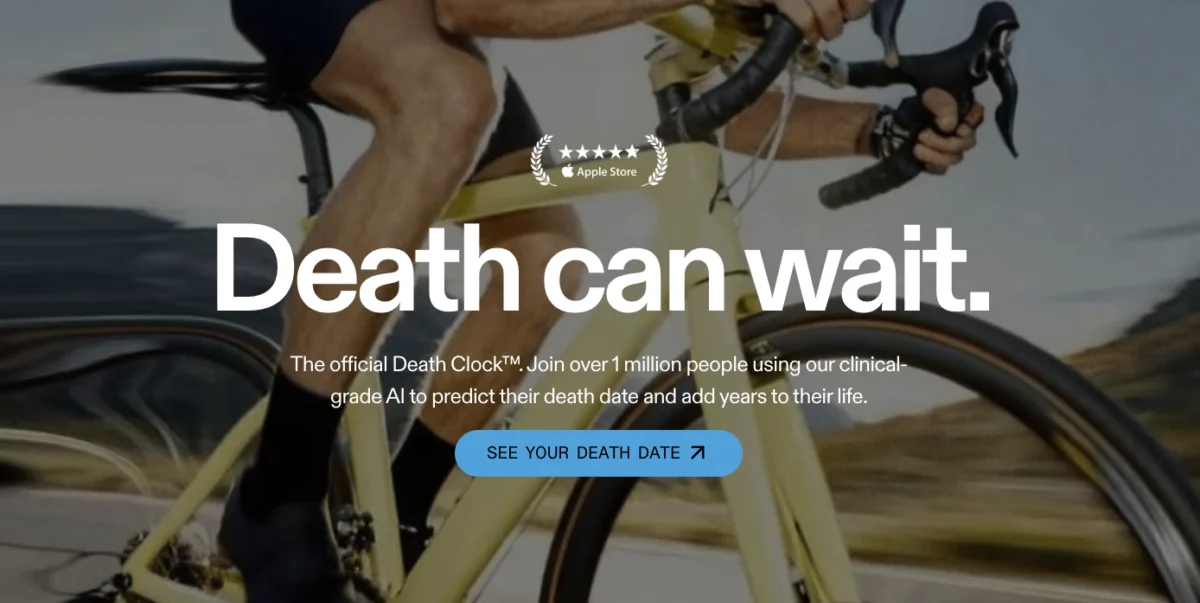

In a world increasingly obsessed with optimizing every facet of life, from productivity hacks to personalized nutrition, a provocative new player has emerged in the longevity space, aiming to confront a fundamental human question with a blend of data-driven AI and a healthy dose of dark humor. Brent Franson, the founder of Death Clock, has leveraged a near-company-ending crisis into a viral sensation and, more recently, a sophisticated AI-powered health concierge, challenging traditional notions of preventative healthcare and the often-hyped promises of radical life extension.
The genesis of Death Clock is a testament to entrepreneurial resilience. Franson, after a substantial $10 million investment in a previous health tracking app failed to gain traction, found his company on the brink of collapse. In a bold and perhaps counterintuitive move, he pivoted, not away from health, but towards a more direct and confronting engagement with it. The result was Death Clock, an application that, by its very name, courted controversy and curiosity in equal measure.
"It’s probably a really, really stupid idea to actually name it Death Clock," Franson candidly admitted on an episode of The Spoon Podcast. "But if it’s a good idea, it’s a really good idea. It’s an 80 percent chance it’s a terrible idea. But there’s a 20 percent chance that it’s a really good idea."
This calculated gamble, steeped in the pragmatism born from failure, paid off handsomely. The app’s provocative moniker, far from being a deterrent, became its most potent marketing tool, propelling it to viral status and topping app store charts across numerous countries. This unexpected success, however, was not merely a product of shock value. Beneath the surface of its attention-grabbing name lay a deeply ingrained thesis about the shortcomings of the current healthcare system and a burgeoning demand for proactive, personalized health solutions.
The Flaws in the System and the Rise of Proactive Health
Franson’s disillusionment with the established healthcare framework was a key catalyst for Death Clock’s development. "What I became pretty convinced of in my life is that our healthcare system is just not very good at helping people change behavior," he explained. "It’s not good at preventative health. And that’s really obvious in addiction."
This observation resonates with a growing body of evidence suggesting that traditional healthcare models often fall short in fostering sustained behavioral change, particularly in the realm of chronic disease prevention and addiction management. The emphasis is frequently on treating illness rather than cultivating wellness. A 2022 report by the Centers for Disease Control and Prevention (CDC) highlighted that chronic diseases, such as heart disease, cancer, and diabetes, are among the leading causes of death and disability in the United States, yet many are preventable through lifestyle modifications.
The AI at the core of Death Clock is trained on an extensive dataset of 1,200 longevity studies. This sophisticated algorithm aims to provide users with personalized insights into their potential lifespan. "We trained an AI on 1,200 longevity studies to make a few predictions," Franson stated. "One, it predicts the day you’re going to die. And two, it predicts how much longer it thinks you can live if you manage your health." This dual approach, acknowledging mortality while simultaneously empowering users with actionable data for improvement, addresses a crucial gap in personal health management.
From Death Clock to Life Lab: Expanding the Vision
The overwhelming positive reception to Death Clock indicated a significant pent-up demand for tools that empower individuals to take control of their health outside the traditional medical system. This success has fueled the company’s ambition, leading to the recent launch of "Life Lab," an integrated AI-powered health concierge within the Death Clock app.
Life Lab represents a significant expansion of Franson’s vision. It aims to provide consumers with a "private doctor quality roadmap" by integrating a comprehensive suite of health tracking capabilities. This includes nationwide blood testing, advanced biomarker tracking, and the ability to upload physician records. The goal is to create a holistic and personalized health profile for each user, enabling more informed decision-making and proactive interventions.
The stark reality of health disparities is a central concern for Franson. He articulated this by stating, "The number one factor that determines how long you’re going to live is how much money you have. Basically, the more money you have, the more you can opt out of the healthcare system and cash pay for good preventative health." Life Lab, he believes, can democratize access to high-quality, preventative healthcare by leveraging software to bridge the gap often created by socioeconomic status.

Navigating the Longevity Landscape with Realism
Death Clock is positioned squarely within Silicon Valley’s burgeoning longevity movement, a sector experiencing a surge in investor interest and innovation. However, Franson maintains a critical stance towards some of the more extravagant claims and promises within this space.
"Selling immortality is one of the oldest frauds in the book," Franson asserted. "If you’re insinuating that if you buy my stuff, you might not die, I think that’s reckless. And I think it gives everybody in the space a bad name." This pragmatic approach differentiates Death Clock from entities focused on radical life extension or the pursuit of biological immortality.
Instead, Franson has set a more attainable yet profoundly impactful objective for Death Clock: to help 100 million people live 10 years longer. "That’s not live forever. That’s just being healthier for longer," he clarified. This focus on incremental yet significant improvements in healthspan, rather than simply lifespan, aligns with a growing understanding of the importance of quality of life in later years.
A Data-Driven Approach to Mortality and Well-being
The technological underpinnings of Death Clock and Life Lab are rooted in the rapid advancements in artificial intelligence and data analytics. The AI models are continuously refined through ongoing research and user data, aiming to enhance the accuracy and personalization of their predictions and recommendations. The integration of blood testing and biomarker tracking provides objective physiological data, which, when combined with user-provided lifestyle information and medical history, creates a rich dataset for analysis.
For instance, insights derived from blood tests can reveal early indicators of conditions like pre-diabetes, high cholesterol, or nutrient deficiencies. Life Lab’s AI can then cross-reference this data with longevity studies and population health trends to provide tailored advice on diet, exercise, sleep, and stress management. The ability to track progress over time and see how lifestyle changes impact biomarkers offers a tangible feedback loop, crucial for sustained behavioral change.
The implications of such a system are far-reaching. By empowering individuals with accessible, data-driven health insights, Death Clock and Life Lab have the potential to:
- Reduce the burden of chronic diseases: Earlier detection and intervention can significantly mitigate the progression and impact of preventable diseases.
- Improve quality of life: Enabling people to live healthier for longer can enhance their independence, productivity, and overall well-being in their later years.
- Democratize healthcare access: By offering a more affordable and accessible alternative to traditional personalized health coaching, the platform can reach a wider demographic.
- Inform public health initiatives: Aggregated, anonymized data could provide valuable insights into population health trends and the effectiveness of various preventative measures.
A Measured Response to the Longevity Boom
The longevity sector has seen an influx of capital, with venture firms and angel investors pouring billions into companies exploring everything from cellular rejuvenation to AI-driven drug discovery. Companies like Altos Labs, backed by Jeff Bezos and Yuri Milner, are exploring fundamental biological mechanisms of aging, while others are focused on developing diagnostics and therapeutics.
However, this rapid growth has also attracted scrutiny. Critics point to the potential for overhyped claims, the ethical considerations of radical life extension, and the risk of creating a two-tiered system where only the wealthy can afford cutting-edge longevity treatments. Franson’s measured approach and focus on attainable goals stand in contrast to some of the more extreme aspirations within the field.
His critique of the "live-forever crowd" highlights a concern that the pursuit of extreme longevity can sometimes overshadow the more immediate and achievable goal of improving healthspan. By focusing on helping people live healthier lives for longer, Death Clock is addressing a widespread desire for well-being and vitality, rather than a fringe aspiration for immortality.
The company’s strategy appears to be one of building a sustainable business by addressing real, everyday health concerns with advanced technology, rather than chasing speculative, far-future solutions. The success of the Death Clock app and the subsequent launch of Life Lab suggest that there is a significant market for tools that provide actionable, personalized health guidance grounded in scientific evidence, delivered with a unique brand of approachable honesty.
In a landscape often characterized by grand pronouncements and futuristic visions, Brent Franson and Death Clock are carving out a niche by embracing a more grounded, data-driven, and perhaps more realistic path towards a healthier future. Their bet is that a touch of dark humor and a commitment to tangible improvements in quality of life will ultimately prove to be a more enduring and impactful strategy than the elusive promise of eternal life. The conversation with Franson is available for download on Apple Podcasts and Spotify, offering further insight into his philosophy and the future of Death Clock.