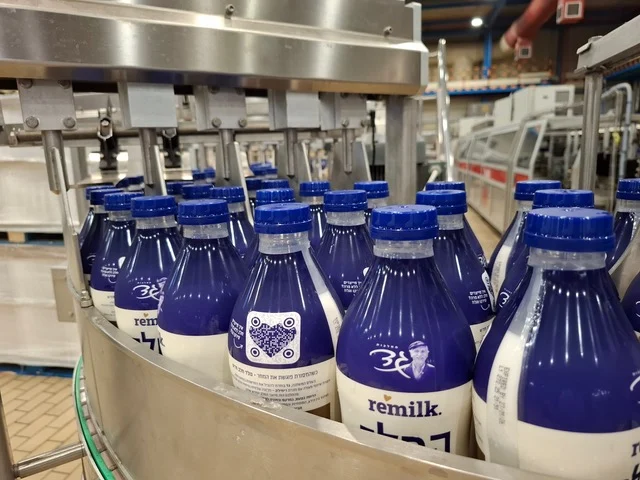

After investing half a decade and an impressive $150 million in funding to perfect the production of recombinant proteins via precision fermentation, Remilk has officially announced the launch of its innovative dairy product, dubbed "New Milk." This significant milestone is being realized through a strategic partnership with Gad Dairies, one of Israel’s leading dairy distributors. The joint venture signifies Remilk’s transition from a business-to-business ingredient supplier to a consumer-facing brand, marking a pivotal moment in the company’s trajectory and the broader alternative dairy market. The initial rollout of New Milk will commence nationwide across Israel, with plans to expand into cafes, coffee shops, and eventually retail outlets later this year, setting the stage for a targeted U.S. market entry in 2026.
The Genesis of New Milk: Precision Fermentation Meets Dairy Innovation
Remilk’s journey began with a focus on developing and supplying essential dairy proteins produced through precision fermentation. This advanced biotechnology process utilizes microorganisms, such as yeast, to produce specific proteins that are identical to those found in traditional milk. The core of New Milk lies in its primary ingredient: beta-lactoglobulin, the principal whey protein in cow’s milk. By harnessing the power of genetically engineered yeast, Remilk can replicate this protein on an industrial scale, a feat that has eluded many in the alternative protein space.
"We are using yeast and precision fermentation to produce beta-lactoglobulin, the primary whey protein in milk," explained Avi Wolff, CEO of Remilk, in a recent interview. "We are responsible for the formulation and the manufacturing of the finished product, while Gad will be handling distribution. So we are producing milk in bottles at a commercial scale, and this is the product that we’re launching. We’ve already distributed thousands of gallons of milk to consumers, to cafés and restaurants."
This transition to a finished product marks a significant strategic shift for Remilk. Initially, the company aimed to provide its protein ingredients to established consumer packaged goods (CPG) companies. A pilot program with General Mills three years prior offered valuable insights. "We piloted some products with General Mills three years ago, and what we realized is that a whole lot of innovation and skill sets are required to turn this subset of protein into a delicious dairy product," Wolff elaborated. This realization prompted Remilk to take a more integrated approach, controlling the entire value chain from protein production to the final consumer offering. The company has dedicated nearly six years and substantial investment to refine the formulation, ensuring a product that meets both nutritional and sensory expectations.
The Gad Dairies Partnership: A Synergistic Approach to Market Entry
The decision to partner with Gad Dairies for the Israeli launch was a deliberate strategic move to leverage existing market expertise and infrastructure. Establishing a direct-to-consumer (B2C) business model from scratch presents considerable challenges, particularly in logistics, sales, and distribution, which are outside Remilk’s core competencies.
"We knew establishing a pure B2C business model is complex and would take a lot of time. We also recognize that this is not within our area of expertise. In simple terms, we believe that distribution and sales are more of a commodity, allowing us to utilize other partners," Wolff stated.
The joint venture has resulted in the formation of a new, co-owned company where Remilk and Gad Dairies divide responsibilities. Gad Dairies, with its extensive experience in the dairy sector, manages all aspects of distribution, sales, and logistics, ensuring efficient delivery to points of sale, whether retail or foodservice. Remilk, on the other hand, retains control over product manufacturing, formulation, and the production of the recombinant protein itself. This division of labor allows each partner to focus on their strengths, optimizing the go-to-market strategy and maximizing the chances of success.
"We manufacture the finished product, they take it, they store it, they load it on the trucks, and they’re responsible for selling it and driving it to the point of sales, whether it’s retail or foodservice. And obviously, each party has their own KPIs and objectives," Wolff explained, highlighting the clear delineation of roles and performance metrics within the partnership.

Addressing Market Dynamics and Competitive Landscape
Remilk’s strategic decision to target the U.S. market in 2026, while initially focusing on Israel, is influenced by global regulatory and consumer perceptions surrounding genetically modified organisms (GMOs). When questioned about the rationale behind prioritizing North America over Europe, Wolff confirmed, "Yes, that’s the primary reason." European regulations concerning GMOs can be more stringent and complex, potentially creating hurdles for novel food technologies. The U.S. market, while also having its regulatory frameworks, has shown a greater openness to innovation in the alternative protein sector, making it a more attractive next frontier for Remilk’s expansion.
The alternative dairy market is increasingly competitive, with companies like Perfect Day also utilizing precision fermentation to produce dairy proteins. Remilk differentiates itself by emphasizing the nuanced technical challenges and breakthroughs involved in recreating a truly authentic milk experience.
"I think it’s in the small breakthroughs and how you take this protein to make it more functional, and how you create a specific flavor profile. If you mix protein with water and fats, it doesn’t taste like milk, and it will not work in coffee like milk. So you need to enhance functionality, and you need to enhance flavoring and aroma and everything. And this is something that we’ve been doing, I would say, perfectly," Wolff asserted.
This focus on superior functionality and taste stems from Remilk’s deep scientific expertise. Unlike traditional food scientists, Remilk’s team comprises a significant proportion of PhDs in biology, chemistry, and related fields. This specialized scientific acumen allows them to delve into the intricate molecular properties of milk proteins and develop formulations that not only mimic the taste and texture of conventional milk but also perform comparably in culinary applications, such as in coffee.
The Path to Scalability: Outsourcing Manufacturing, In-housing Expertise
A key aspect of Remilk’s scaling strategy is its reliance on contract manufacturers for the production of New Milk, rather than building its own extensive manufacturing facilities. This approach allows for greater flexibility and capital efficiency, enabling the company to focus its resources on research, development, and market penetration. The current production of New Milk is being undertaken in Spain through a contract manufacturing agreement. This model is particularly advantageous for a company venturing into a new product category and geographical markets.
"We have 100 employees in Remilk, 70% of them are scientists, PhDs in biology, chemistry, and they’re developing the products," Wolff highlighted, underscoring the company’s commitment to scientific innovation. "We’re not just traditional food scientists who used to work at the large dairy companies, because we’re conducting deep research on the protein, on the flavoring, on the milk itself. We analyze the milk in order to understand how to mimic the specific smell and taste." This dedication to fundamental research is crucial for achieving the precise sensory and functional qualities that differentiate their product.
Future Outlook: Israeli Momentum and U.S. Ambitions
Remilk’s immediate focus is on solidifying its presence and achieving significant traction in the Israeli market. The company anticipates that the unique characteristics of the Israeli market will facilitate rapid growth. "Definitely for the next six to nine months, our focus is going to be succeeding in Israel. Again, we believe that given the nature of this market, we can reach strong momentum relatively quickly," Wolff stated.
Simultaneously, Remilk is laying the groundwork for its U.S. market entry. While the bulk of the company’s operations will remain centered in Israel, a select team of key personnel will spearhead negotiations for a similar partnership model in the United States. The objective is to secure a U.S. partnership and commence market activities by 2026. This phased approach, beginning with a robust domestic launch and strategically expanding internationally, reflects a well-considered plan to navigate the complexities of the global food industry and establish Remilk as a significant player in the future of dairy. The success of New Milk in Israel will serve as a critical validation of Remilk’s technology and business model, paving the way for its ambitious global expansion.