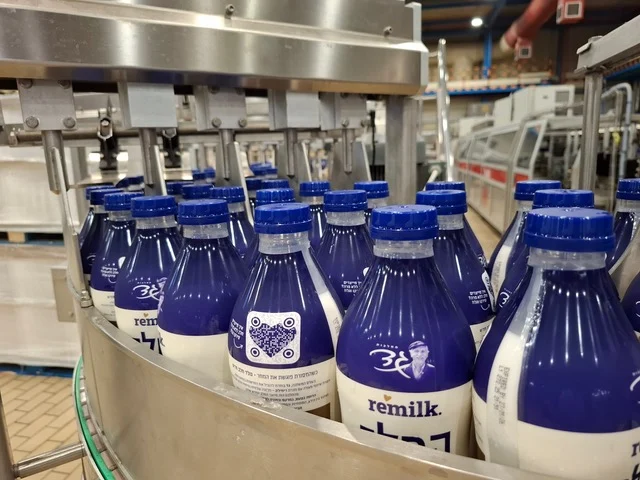

After a significant investment of $150 million and five years dedicated to pioneering the development of recombinant proteins through precision fermentation, Remilk has officially announced the commercial launch of its innovative dairy alternative, dubbed "New Milk." This groundbreaking product is being introduced to the market through a strategic partnership with Gad Dairies, one of Israel’s leading dairy distributors. The collaboration marks a pivotal moment for Remilk, transitioning from a B2B ingredient supplier to a consumer-facing brand, with initial distribution commencing nationwide across Israel.
The newly launched "New Milk" boasts a compelling nutritional profile, featuring 75% less sugar compared to conventional cow’s milk. Production of this novel beverage is slated to occur in Spain, utilizing a contract manufacturing facility. Remilk has also indicated plans to initially target the foodservice sector, supplying cafes and coffee shops, before expanding its reach to retail outlets later this year. Looking ahead, the company has set its sights on the United States market, with a projected launch in 2026.
To gain deeper insights into Remilk’s strategic shift, the technical intricacies of their "New Milk" formulation, and their ambitious U.S. market entry plans, a conversation was held with Remilk’s CEO, Avi Wolff. The discussion delved into the challenges of reconstructing milk from a single protein, lessons learned from collaborations with major consumer packaged goods (CPG) companies, and Remilk’s unique approach to scaling production without the immediate need for proprietary mega-plants. The following is an edited transcript of that conversation, refined for clarity and conciseness.
The Science Behind "New Milk": Precision Fermentation and Beta-Lactoglobulin
At its core, "New Milk" is a testament to advanced biotechnology, leveraging precision fermentation to produce beta-lactoglobulin, the principal whey protein found in traditional milk. This process involves utilizing yeast as a microbial host to create this specific protein. Remilk’s role encompasses both the precise formulation of the finished product and its manufacturing, while Gad Dairies will spearhead the crucial distribution network.
"We are producing milk in bottles at a commercial scale, and this is the product that we’re launching," explained Wolff. "We’ve already distributed thousands of gallons of milk to consumers, to cafés and restaurants." This immediate commercial rollout signifies a significant leap from the company’s earlier focus.
Strategic Pivot: From Ingredients to Finished Products
Remilk’s initial business model centered on supplying its recombinant protein ingredients to established CPG companies. A significant early collaboration involved piloting products with General Mills three years prior. However, this experience revealed a critical insight: transforming a highly refined protein ingredient into a palatable and functional dairy product demanded a unique set of skills and a comprehensive understanding of the entire value chain.
"We started as a B2B company selling the ingredients to CPGs," Wolff elaborated. "We piloted some products with General Mills three years ago, and what we realized is that a whole lot of innovation and skill sets are required to turn this subset of protein into a delicious dairy product. So we’ve stepped in and we’ve decided to take ownership of the entire value chain from the production of the protein to the production of the finished product. We’ve spent almost six years after raising $150 million in developing the formulation, and this is why we are now ready to launch."
This strategic decision to control the end-to-end process underscores Remilk’s commitment to product quality and consumer experience. The substantial investment reflects the complexity and R&D intensity involved in this endeavor.
A Synergistic Partnership: Remilk and Gad Dairies
The decision to partner with Gad Dairies for the Israeli launch was a deliberate strategic move to navigate the complexities of establishing a direct-to-consumer (B2C) business. Wolff acknowledged that building a purely B2C operation was a significant undertaking, potentially time-consuming and outside of Remilk’s core competencies.
"We knew establishing a pure B2C business model is complex and would take a lot of time. We also recognize that this is not within our area of expertise," Wolff stated. "In simple terms, we believe that distribution and sales are more of a commodity, allowing us to utilize other partners."
This philosophy led to the formation of a new, jointly owned company with Gad Dairies. Under this arrangement, Gad Dairies, a well-established player in the Israeli dairy market, assumes responsibility for distribution, sales, and all associated logistics. Remilk, conversely, manages the manufacturing of the finished "New Milk" product.
"So we decided to partner and establish a new company. We’ve built a new venture with one of the largest dairy companies in Israel. This new company is co-owned by Remilk and Gad, and each party is responsible for different parts of the value chain," Wolff explained. "Distribution, sales, and all the logistics around it are taken care of by Gad, and everything else is managed by us. We manufacture the finished product; they take it, they store it, they load it on the trucks, and they’re responsible for selling it and driving it to the point of sales, whether it’s retail or foodservice. And obviously, each party has their own KPIs and objectives."
This symbiotic relationship allows both companies to leverage their respective strengths, accelerating market penetration and operational efficiency.
Global Expansion and Market Entry Strategies
The choice of the United States as the next major market for Remilk’s expansion appears to be influenced by regulatory and consumer perceptions surrounding genetically modified organisms (GMOs). Wolff indicated that Europe’s more stringent stance on GMOs played a role in this strategic decision.

"Yes, that’s the primary reason," Wolff confirmed when asked if Europe’s anti-GMO stance was a factor in targeting North America.
Differentiating "New Milk" in a Growing Market
The precision fermentation dairy alternative market is becoming increasingly competitive, with players like Perfect Day already established. Wolff highlighted Remilk’s focus on nuanced product development as a key differentiator.
"I think it’s in the small breakthroughs and how you take this protein and make it more functional, and how you create a specific flavor profile," Wolff explained. "If you mix protein with water and fats, it doesn’t taste like milk, and it will not work in coffee like milk. So you need to enhance functionality, and you need to enhance flavoring and aroma and everything. And this is something that we’ve been doing, I would say, perfectly."
This emphasis on achieving a sensory experience that closely mimics traditional milk, including its functional properties in applications like coffee, suggests a sophisticated approach to formulation.
The Power of Specialized Expertise
Wolff’s earlier experience working with large CPG companies like General Mills provided valuable lessons regarding the specialized expertise required for developing novel food products. He articulated a need for a deeper, more focused scientific understanding than what is typically housed within traditional CPG R&D departments.
"We worked with them, helping and supporting them in their development process. But the development process, despite the fact that it was sometimes even two years with ongoing developments, we felt that the product was not good enough," Wolff stated. "And I think that there are many explanations to this, but I think the primary one is the fact that the skill sets that these CPGs have in their existing R&D centers are just completely different from the ones you need different skill sets than what you need to develop dairy products from a single subset of protein."
Remilk’s internal structure reflects this specialized focus. The company boasts a team of 100 employees, with approximately 70% holding advanced degrees in biology, chemistry, and related scientific fields. This composition enables Remilk to conduct in-depth research into the protein itself, as well as the complex interplay of flavoring and aroma compounds that define milk’s unique sensory profile.
"We have 100 employees in Remilk, 70% of them are scientists, PhDs in biology, chemistry, and they’re developing the products. We’re not just traditional food scientists who used to work at the large dairy companies, because we’re conducting deep research on the protein, on the flavoring, on the milk itself. We analyze the milk in order to understand how to mimic the specific smell and taste."
Timeline for U.S. Market Entry
Remilk’s immediate strategic focus is on solidifying its presence and achieving success in the Israeli market. The company anticipates this initial phase will span the next six to nine months.
"Definitely for the next six to nine months, our focus is going to be succeeding in Israel. Again, we believe that given the nature of this market, we can reach strong momentum relatively quickly," Wolff confirmed.
Concurrently, Remilk is actively laying the groundwork for its U.S. expansion. While the majority of the company’s operational efforts will remain centered on the Israeli launch, a select group of key personnel will be dedicated to negotiating a similar partnership structure in the United States.
"While most of the company’s operations will remain in Israel and focus on the Israeli launch, a few key employees and I will begin negotiating a similar deal with a U.S. partnership. A US partnership is definitely something we’re aiming for in 2026."
This phased approach allows Remilk to refine its go-to-market strategy in a controlled environment before tackling the larger and more complex U.S. market. The 2026 target for the U.S. launch signifies a measured and strategic expansion plan, taking into account the necessary regulatory approvals, partnership formations, and market acclimatization.
The implications of Remilk’s "New Milk" launch extend beyond its immediate market penetration. By successfully commercializing a dairy alternative produced through precision fermentation, the company contributes to the broader discourse on sustainable food production and the future of the dairy industry. The reduction in sugar content also aligns with growing consumer demand for healthier food options. As Remilk continues to scale its operations and explore new markets, its innovative approach to dairy protein production could pave the way for significant shifts in global food supply chains, offering consumers more choices that are both environmentally conscious and nutritionally advanced.