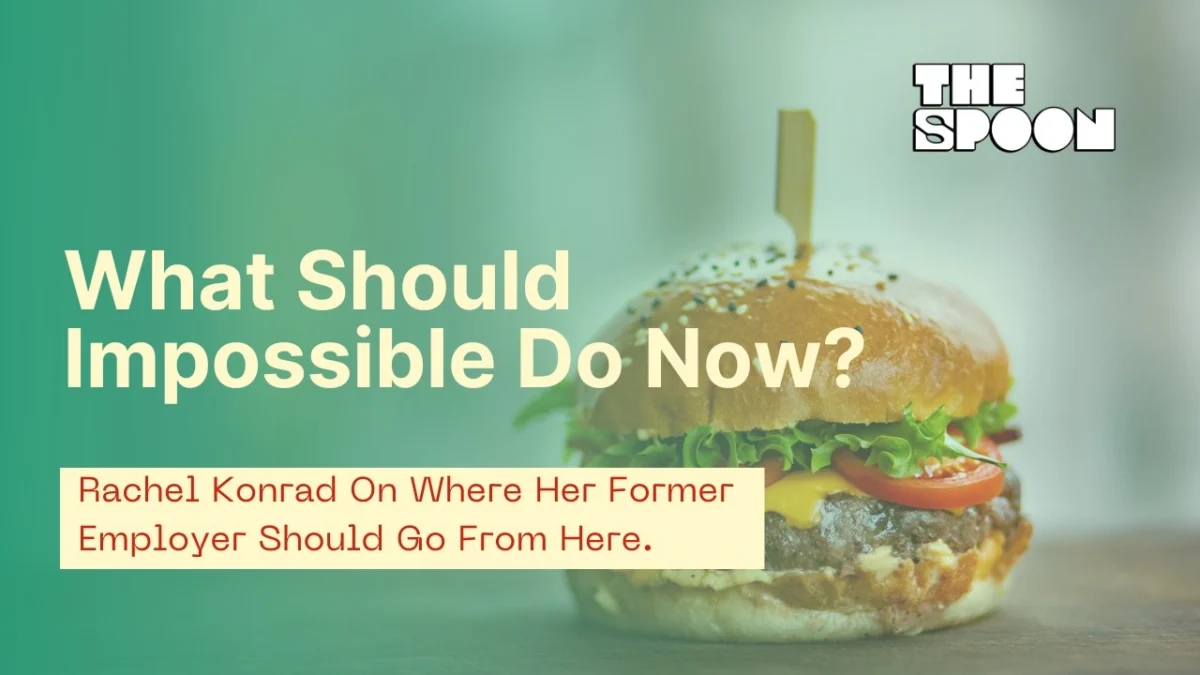

The recent leadership transition at Impossible Foods, marked by the departure of CEO Peter McGuinness after nearly four years at the helm, has ignited a debate about the company’s strategic trajectory. While Impossible Foods characterized the change as a move "from a position of strength," Rachel Konrad, the company’s former head of communications, has offered a critical perspective, suggesting the shift represents the culmination of a "long strategic detour." Konrad, speaking on The Spoon Podcast, articulated her initial vision for Impossible Foods as a "radical, unusual, category-busting biotech juggernaut," a vision she believes has been diluted.
Konrad joined Impossible Foods in 2016, a period when the burgeoning plant-based meat industry was already facing significant headwinds. She recounted an early experience where Impossible’s founder, Pat Brown, forwarded her an email from a "very highly placed in the ag sector" individual, outlining a plan with an "unlimited budget to destroy this silly little company called Impossible Foods, likely funded by the Cattlemen’s Association." This email allegedly detailed a strategy to "Take it down based on propaganda, fear, uncertainty, and doubt." While acknowledging the reality of such external pressures, Konrad posits that internal strategic missteps have been more detrimental to the company’s long-term prospects.
The Startup Dilemma: Navigating Traction and the Incumbent Playbook
According to Konrad, a common pitfall for startups that achieve initial success is the temptation to emulate the strategies of established industry giants. "The biggest mistake startups make is they get a little traction and suddenly decide, ‘Now we’re playing in the big leagues,’" she stated. This often leads to an overhaul of operations and the adoption of what she terms the "incumbent playbook."
This playbook, Konrad explained, typically involves conventional branding, substantial advertising expenditures, and direct competition with legacy corporations. "If you’re a startup, you will never out-advertise Nestlé or Unilever," she emphasized. "Once you adopt the chessboard of the incumbent industry, you’re dead. It might take a year or two, but you’re dead."
Konrad views Impossible Foods’ strategic shift under McGuinness, which positioned the company more explicitly as a "tech-enabled CPG company," as falling directly into this trap. She believes that early, influential investors, such as Vinod Khosla, were drawn to Impossible Foods not as another consumer packaged goods (CPG) brand, but as a company poised to disrupt industries and impact humanity. "Vinod did not invest in a stupid CPG veggie burger company," Konrad asserted. "He invests in things that change the trajectory of humanity."

Redefining Impossible Foods: A Biotech Juggernaut or a CPG Contender?
Konrad’s argument centers on the belief that Impossible Foods’ true differentiator was not its branding or marketing, but its underlying technology. She advocates for a more aggressive Business-to-Business (B2B) strategy, where Impossible Foods would serve as a platform for next-generation meat alternatives, rather than solely focusing on building a direct-to-consumer brand.
"It’s a category-defining biotech company that makes heme," Konrad explained, referring to the key ingredient that gives Impossible Foods’ products their characteristic meaty flavor and color. She questioned why the company did not pursue more aggressively the licensing of its heme technology, explore applications in the supplements market, or establish itself as a major B2B player. This approach, she contends, would have leveraged Impossible’s core innovation and allowed it to exert influence across a broader spectrum of the food industry.
Leadership Dynamics and the "Steve Jobs Moment"
When questioned about the leadership transition itself, and whether McGuinness’s ascent over founder Pat Brown marked a misstep, Konrad drew a parallel to Apple’s history. She suggested that a company often needs a visionary leader willing to challenge conventional wisdom, much like Steve Jobs’ return to Apple. "Apple only became Apple because Steve Jobs came back and said, ‘F**k that – we’re not doing SKU management,’" she remarked, implying that Impossible Foods might require a similar "Steve Jobs moment" to recapture its disruptive spirit.
While acknowledging Brown’s visionary status and his role in overcoming significant obstacles, the article’s author raises a pertinent question: were the broader market headwinds against plant-based proteins simply too formidable for any single leader to navigate successfully? The plant-based meat market, despite its rapid growth in recent years, has encountered increased competition, shifting consumer preferences, and economic pressures. For instance, the global plant-based meat market size was valued at USD 4.3 billion in 2021 and is projected to reach USD 15.7 billion by 2030, growing at a compound annual growth rate (CAGR) of 15.8% from 2022 to 2030, according to Grand View Research. However, recent reports indicate a slowdown in growth for some major players, with consumers citing taste, texture, and price as ongoing concerns.
The Path Forward: A Call for a Return to Vision
Despite her criticisms, Konrad remains hopeful about Impossible Foods’ potential for long-term success. Her optimism is contingent on the company revisiting its foundational vision. "My hope – for the planet, for people, for animals – is that Impossible goes back to that original vision," she concluded. "Without that, it’s going to be very hard to turn this around."
The conversation, as presented on The Spoon Podcast, underscores a critical juncture for Impossible Foods. The company, which burst onto the scene with a bold promise to revolutionize the food system, now faces the challenge of reconciling its innovative origins with the realities of scaling in a competitive and evolving market. Whether it can reignite its "radical, unusual, category-busting" spirit remains to be seen, but as Konrad suggests, a clear return to its core mission may be the most viable path to navigating its current strategic crossroads. The implications of Impossible Foods’ future direction extend beyond the company itself, potentially influencing the broader adoption of alternative proteins and the sustainability of global food production.