
This candid admission from Dr. Gabrielle Fundaro, a highly credentialed expert in human nutrition, underscores a growing paradox within the fitness and wellness community: the struggle even seasoned professionals face in navigating their personal relationship with food, particularly after years of meticulous macro tracking. Despite holding a PhD in Human Nutrition, boasting over a decade of nutrition coaching experience, and having competed in six powerlifting competitions, Dr. Fundaro found herself trapped by the very method she once championed. She confessed that, when truly honest with herself, her confidence around food was far from robust, largely due to her prolonged reliance on macro counting to maintain dietary "control."
The Macro Tracking Paradox: Expertise vs. Personal Struggle
Macro tracking, the practice of monitoring macronutrient intake (proteins, carbohydrates, and fats), has gained immense popularity as a precise method for managing diet, optimizing performance, and achieving specific body composition goals. Its advocates praise its ability to foster nutritional awareness and accountability. For years, it "worked" for Dr. Fundaro, providing a structured framework that aligned with her professional expertise and athletic pursuits. However, this meticulously balanced approach eventually led to exhaustion. The constant vigilance, the inability to spontaneously enjoy a meal without calculating its nutritional impact, and the pervasive fear of compromising her health or physique if she deviated, became an unsustainable burden.
The prospect of abandoning tracking, however, was equally terrifying. The ingrained anxieties surfaced: "What if I don’t eat enough protein, and lose all my muscle?" "What if I overeat and gain fat?" "What if I have no idea how to fuel myself without tracking macros? And what does that say about me as an expert in the field of nutrition?" These questions reveal a deep-seated dependency on external metrics, highlighting a common challenge for many individuals who become reliant on rigid dietary systems. The mental toll of such dependency can be significant, often leading to increased stress, anxiety around food, and a diminished ability to trust one’s internal hunger and fullness cues.
Seeking an Alternative: Beyond Restriction and Pure Intuition
Driven by this internal conflict, Dr. Fundaro began searching for a viable alternative—a method that could support her nutritional objectives while simultaneously fostering a sense of freedom and peace around eating. Traditional calorie counting was immediately dismissed as equally, if not more, restrictive. Intuitive eating, which emphasizes tuning into internal hunger and fullness signals, also presented a challenge. After years of prioritizing external macro targets, Dr. Fundaro felt her internal instincts had been largely overridden, leaving her craving a more structured approach than pure intuition offered. This highlights a critical gap: many individuals transitioning away from highly structured diets find the complete lack of external guidance in intuitive eating overwhelming, requiring a bridge between strict rules and complete freedom.
A pivotal moment arrived not in a nutrition seminar, but in the gym. Dr. Fundaro had begun incorporating the Rate of Perceived Exertion (RPE) scale into her powerlifting training. RPE, a framework for quantifying the subjective intensity of physical activity, allowed her to train both more effectively and safely, adapting her effort based on her body’s real-time feedback rather than arbitrary numbers. She noticed a significant improvement in both strength gains and recovery. This blend of structure and personalized intuition proved remarkably effective. It was then, like an apple falling on Isaac Newton, that a profound realization struck her: If RPE could revolutionize her training, couldn’t a similar framework transform her relationship with food?
The Birth of RPE-Eating: A Structured-Intuitive Approach
This epiphany led to the creation of the RPE-Eating Scale. Dr. Fundaro envisioned a system that would empower individuals to regain confidence and self-trust around food, enhance nutritional awareness, and ultimately liberate themselves from the confines of constant tracking. Her own success with the method confirmed its potential: she finally trusts her eating choices, with no macro tracker in sight.
To understand RPE-Eating, it’s essential to first grasp the original Rate of Perceived Exertion (RPE) scale. Developed by Swedish psychologist Gunnar Borg in the 1960s, RPE is a psychophysical scale used to measure an individual’s perceived level of effort during physical activity. While Borg’s original scale ranged from 6 to 20, modern adaptations, like the one Dr. Fundaro utilized, commonly employ a 0 to 10 range. This scale is widely accepted in sports science and rehabilitation, enabling athletes and patients to self-regulate their training intensity based on how hard they feel they are working, rather than solely relying on external metrics like heart rate or weight lifted.
The RPE Scale in Fitness:
| Rating | Perceived Exertion Level |
|---|---|
| 0 | No exertion, at rest |
| 1 | Very light |
| 2-3 | Light |
| 4-5 | Moderate, somewhat hard |
| 6-7 | High, vigorous |
| 8-9 | Very hard |
| 10 | Maximum effort, highest possible |
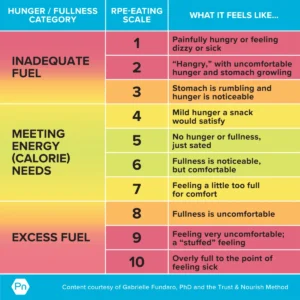
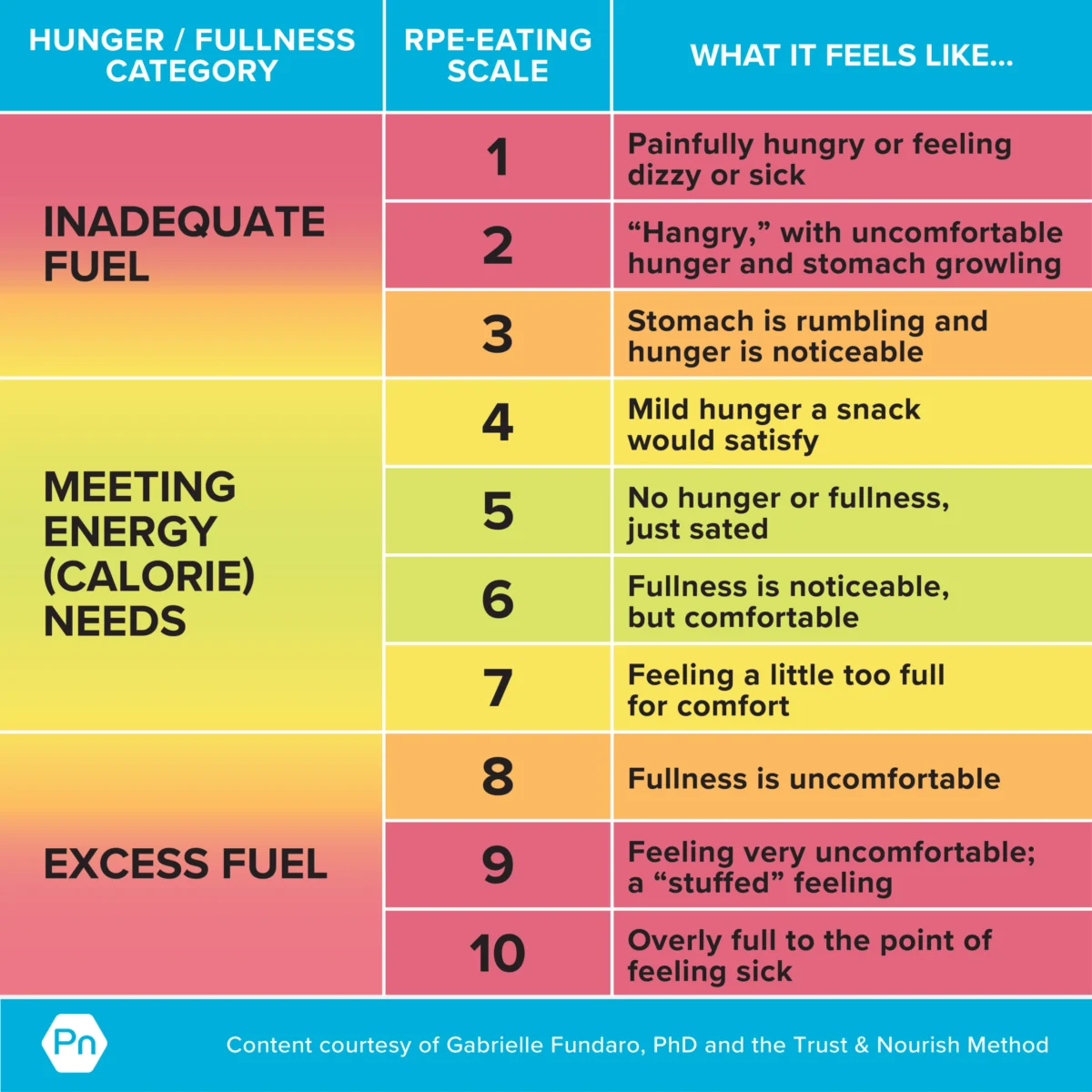
The power of RPE lies in its acknowledgment of human subjectivity. A coach might suggest aiming for a "7/10" effort, but the precise physiological and psychological experience of that "7" is unique to each individual. This autonomy, combined with structured guidance, deeply resonated with Dr. Fundaro. Applying these principles, she adapted the 0-10 scale to the realm of eating, creating a tool that encourages self-assessment of hunger and fullness cues.
The RPE-Eating Scale:
| Rating | Perceived Hunger/Fullness Level |
|---|---|
| 1 | Painfully hungry, dizzy, or sick (Inadequate Fuel) |
| 2 | "Hangry," uncomfortable hunger, stomach growling (Inadequate Fuel) |
| 3 | Hunger noticeable, stomach rumbling (Inadequate Fuel) |
| 4 | Mild hunger, a snack would satisfy (Adequate Fuel) |
| 5 | No hunger or fullness, just sated (Adequate Fuel) |
| 6 | Noticeable fullness, but comfortable (Adequate Fuel) |
| 7 | A little too full for comfort (Adequate Fuel) |
| 8 | Uncomfortable fullness (Excess Fuel) |
| 9 | Very uncomfortable or "stuffed" (Excess Fuel) |
| 10 | Overly full to the point of feeling sick (Excess Fuel) |
The overarching goal of RPE-Eating mirrors its fitness counterpart: to cultivate the skill of determining what constitutes sufficient nourishment for your body, without external apps, trackers, or rigid rules. It’s a journey towards re-establishing an intuitive connection with one’s physiological signals, guided by a structured framework.
Practicing RPE-Eating: A Four-Step Framework
Implementing RPE-Eating requires patience and consistent practice, especially for those accustomed to ignoring internal cues. Dr. Fundaro outlines a four-step process:
-
Get Clear on Your Goals: RPE-Eating is fundamentally different from a traditional diet. Dr. Fundaro emphasizes that its primary aim is not to change your body, gain more control over your diet, or achieve an "optimal" diet. Instead, it’s about developing the capacity to sense and respond to your body’s needs, fostering inner trust and confidence. While it can be adapted for body composition goals (like muscle gain or fat loss), it’s not the most efficient tool for extreme modifications. The core intention is to build self-trust, accepting that changes in body composition may occur as a natural consequence of this renewed relationship with food. This shift in mindset, from external control to internal trust, is perhaps the most challenging yet crucial aspect of the process.
-
Practice Identifying Your Hunger Cues: This step involves differentiating between genuine physical hunger and appetite, which is often driven by desire or external stimuli. Hunger manifests through physical signals like stomach rumbling, emptiness, or lightheadedness, indicating a need for energy. Appetite, conversely, is the desire to eat, which can persist even after physical hunger is satisfied, often triggered by appealing food. The RPE-Eating scale helps individuals reconnect with these true physical hunger cues.
To practice, one identifies their hunger level using the scale before a meal. During the meal, eating mindfully and without distraction, a check-in occurs halfway through, and again upon completion. This iterative process of rating and reflecting helps "download" the feeling of satiety into the body’s awareness, recalibrating the internal compass that may have been disrupted by years of external tracking. Consistency, even if imperfect, is key to enhancing interoceptive awareness—the skill of sensing internal bodily states.
-
Get to Know Your Non-Hunger Triggers: Life is rarely lived perfectly mindfully. Stress, emotions, and environmental cues often trigger eating beyond physical hunger. Dr. Fundaro advocates for developing awareness of these "non-hunger triggers." This involves a "notice and name" approach: observing when compulsive eating occurs and identifying the underlying emotions (anxiety, sadness) or situations (stressful email, argument) that preceded it. Once identified, the next crucial step is to explore what one might truly be needing. Eating for comfort is a normal human behavior, but when it becomes the sole coping mechanism, it can be counterproductive. Expanding one’s repertoire of self-soothing methods—a short walk, deep breathing, connecting with a friend—provides alternatives to using food as the primary emotional regulator. This holistic approach acknowledges the complex interplay between physical and emotional well-being in eating behavior.
-
Eat for Satiety AND Satisfaction: RPE-Eating posits that adequate nourishment involves both physical satiety and emotional satisfaction. Satiety refers to the physical sensation of fullness, where caloric and fuel needs are met. Satisfaction, however, encompasses a more holistic sense of being nourished, where the meal is not only physically adequate but also pleasurable. If an individual only eats to satiety but restricts desired foods, physical hunger might be quelled, but a feeling of deprivation or incompleteness can persist, potentially leading to compensatory overeating later. The "restrict-binge" cycle is a common consequence of such an approach.
Therefore, Dr. Fundaro encourages incorporating genuinely enjoyable foods, even those previously deemed "off-limits," into the RPE-Eating practice. By using the scale with a variety of meals, individuals learn to adequately fuel themselves while also honoring the pleasure and social aspects of eating. This integration of enjoyment into the eating process is vital for long-term adherence and a healthy relationship with food.
Who Benefits from RPE-Eating?
RPE-Eating is not a universal solution but offers a valuable alternative for specific individuals. It is particularly well-suited for those who:
- Feel overly dependent on food tracking but wish to break free.
- Experience anxiety or a sense of lost control when attempting to stop tracking, leading them back to restrictive patterns.
- Desire to transition away from tracking but still require a structured system or guidance.
- Are currently tracking or considering it, but have elevated risk factors for developing disordered eating (e.g., high body dissatisfaction, history of yo-yo dieting, participation in weight-class sports).
For nutrition coaches, RPE-Eating provides a flexible tool to guide clients towards greater autonomy. However, it is crucial to remember that for individuals struggling with clinical eating disorders, this tool is not a substitute for professional help from a therapist, doctor, or registered dietitian specializing in eating disorders.
RPE-Eating for Weight Management: A Cautious Approach
Dr. Fundaro primarily advocates for using RPE-Eating in a weight-neutral context, emphasizing self-trust and awareness over specific body composition targets. She clarifies that while she is not "anti-weight modification," she is "pro-safe weight modification," comparing it to contact sports where inherent risks can be mitigated through best practices. RPE-Eating, by removing macro-tracking (which can elevate disordered eating risk) and relying on biofeedback and non-hunger triggers, provides a safety net often absent in rigid tracking methods.
For those who do wish to adapt RPE-Eating for intentional weight change, Dr. Fundaro suggests aiming for specific ranges on the scale. For weight gain, consistently eating within the 7 to 8 range (noticeable fullness, a little too full) would be the target. For weight loss, aiming for the 4 to 5 range (mild hunger satisfied, no hunger or fullness but sated) would be appropriate for most meals. It’s critical to understand that RPE-Eating is unsuitable for extreme weight modification, such as preparation for a bodybuilding competition, where precise, aggressive caloric manipulation is often required. It’s designed for sustainable, mindful changes, not extreme, short-term interventions.
Addressing Skepticism: Feelings Over Facts?
The concept of "RPE-Eating" might initially provoke skepticism, particularly among those accustomed to data-driven approaches, who might dismiss it as merely "eating based on feelings." However, this overlooks the scientific foundation of RPE itself. The original RPE scale was initially met with similar doubt by some lifters, yet it is now widely accepted and scientifically validated as an accurate and convenient method for autoregulating training intensity. It facilitates interoceptive awareness—the ability to perceive and interpret internal sensations from the body—a crucial skill for self-regulation in both physical activity and eating.
Just as a slowing barbell indicates proximity to failure in lifting, the absence of hunger at the end of a meal signals satiety. RPE-Eating trains individuals to interpret these internal physiological cues, which often correlate with objective measures like blood sugar levels, in a far more accessible way than continuous glucose monitoring or detailed food logging. While not perfect, and prone to initial misjudgments, consistent practice builds proficiency in these core skills, leading to more informed and autonomous eating decisions.
Considerations and Limitations
Despite its benefits, RPE-Eating is a tool with specific applications and limitations. It demands a significant investment of attention and reflection, requiring individuals to tune into their physical and emotional states. This can be challenging in fast-paced modern life, especially for parents with young children or those with demanding work schedules that necessitate eating on the go.
For these individuals, RPE-Eating can be adapted. It might be practiced during quieter meals or specific steps can be isolated, such as focusing solely on developing hunger and fullness awareness without attempting to implement the entire framework.
Ultimately, RPE-Eating serves as a vital "off-ramp" for those seeking to transition away from rigid macro tracking. Tracking, while initially educational, is rarely a sustainable long-term solution for most people. The fear of stopping, of losing control, is a common barrier. RPE-Eating provides a structured yet flexible bridge, offering language and a system to navigate this transition with less fear and greater confidence. It helps shift reliance from external metrics (like macro targets or "cleaning your plate") to internal wisdom.
As Dr. Fundaro aptly summarizes, "The goal is to know that you’re nourishing yourself—and you don’t need a food tracker to do that." This philosophy marks a significant step towards a more empowered, intuitive, and ultimately healthier relationship with food.
References
Click here to view the information sources referenced in this article.