The universal aspiration for extended life and robust health has never been more pronounced, captivating individuals across demographics who share a common desire: not merely to exist for more years, but to thrive with vitality and a diminished burden of disease. This profound human longing has fueled a burgeoning industry, giving rise to an intricate tapestry of claims and methodologies promising to unlock the secrets to enhanced longevity and optimized well-being. From ancient wisdom traditions to cutting-edge biotechnological interventions, the pursuit of a longer, healthier existence stands as a defining characteristic of contemporary society.
The Pervasive Pursuit of Longevity and Optimal Health
In an era defined by rapid scientific advancement and unprecedented access to information, the quest for a longer, healthier life has transcended a mere wish, evolving into an active, often consuming, pursuit for many. The question, "Do you want to live longer?" almost invariably elicits an emphatic "Yes!" from most individuals, coupled with the equally strong desire for that extended life to be one of quality, free from the debilitating effects of chronic illness and the infirmities often associated with aging. This dual aspiration—for both quantity and quality of life—forms the bedrock of the modern health and wellness landscape.
However, navigating this landscape can be a daunting challenge. The proliferation of information, often contradictory and rarely evidence-based, creates a cacophony of voices claiming to hold the definitive answers to health optimization. One doesn’t have to search extensively to encounter a vast array of propositions, each promising not just improvement, but outright "optimization" of health. This shift in terminology, from "improving" to "optimizing," signals a deeper cultural trend towards maximizing every biological function, pushing the boundaries of human potential beyond traditionally accepted norms.
The Rise of the "Optimization" Culture: Influencers and Biohacking
The digital age has ushered in an era where fitness influencers, best-selling authors, and prolific podcasters serve as the new arbiters of health and longevity. These figures often present compelling narratives and highly specific protocols, promising transformative results. Whether it’s reversing chronic disease, maintaining a youthful appearance indefinitely, or even aspiring to live to 115 years old—or "forever," as some boldly claim—the advice flows freely across social media platforms, podcasts, and self-published manifestos.
This "optimization" culture frequently promotes methodologies that extend far beyond conventional public health recommendations. These can include highly restrictive dietary regimens (e.g., extreme fasting protocols, niche elimination diets), complex supplement stacks involving dozens of compounds, sophisticated biohacking gadgets designed to monitor and manipulate physiological parameters, and rigorous, often extreme, exercise routines. The allure of these approaches lies in their promise of accelerated results and a perceived edge over more conventional, slower-paced health improvements. They tap into a desire for agency and control over one’s biological destiny, offering a sense of empowerment in the face of natural decline.
The global wellness economy, valued at over $4.4 trillion in 2020 by the Global Wellness Institute, underscores the immense financial weight behind this trend. This figure encompasses everything from personal care and beauty to nutrition, weight loss, fitness, preventive medicine, and public health. Within this vast market, the "longevity" and "anti-aging" segments are growing particularly fast, driven by an aging global population and increased awareness of health span alongside lifespan. Consumers are increasingly willing to invest significant resources in products and services that promise to extend their healthy years.
Scrutinizing the Claims: Are Advanced Protocols Necessary or Effective?
A critical question arises amidst this landscape of ambitious promises: Are these ultra-specific, advanced protocols truly necessary, or even genuinely effective? And, perhaps more importantly, what is the actual investment—in terms of effort, time, and financial resources—that these methods demand? These questions are not merely academic; they delve into the practical realities and potential pitfalls for individuals earnestly seeking better health outcomes.
While the pursuit of optimal health is commendable, the efficacy and necessity of many highly promoted "optimization" strategies often lack robust scientific validation. Many claims rest on anecdotal evidence, preliminary research, or cherry-picked studies that may not withstand rigorous scrutiny. Public health organizations, such as the World Health Organization (WHO) and national health bodies like the Centers for Disease Control and Prevention (CDC), consistently emphasize foundational health practices rooted in decades of epidemiological and clinical research. These typically include balanced nutrition, regular physical activity, adequate sleep, stress management, and maintaining healthy social connections. These fundamental pillars have consistently demonstrated significant positive impacts on both lifespan and health span, with a strong evidence base supporting their efficacy in preventing chronic diseases like heart disease, type 2 diabetes, and certain cancers.
The True Costs: Time, Money, and Psychological Trade-offs
Beyond efficacy, the practical implications of pursuing these advanced optimization protocols are substantial. The financial cost can be exorbitant. Premium supplements, specialized equipment, bespoke diets requiring expensive ingredients, and memberships to exclusive biohacking clinics can quickly accumulate into thousands, if not tens of thousands, of dollars annually. For many, this level of expenditure is simply unsustainable, creating an economic barrier to entry that excludes a significant portion of the population from participating in these "optimal" health pursuits.
Time commitment is another significant factor. Adhering to ultra-specific diets, engaging in multi-hour daily exercise regimens, meticulously tracking biomarkers, and preparing specialized meals can consume a substantial portion of an individual’s day. This intense focus often necessitates significant lifestyle adjustments, potentially impacting work-life balance, social engagements, and personal hobbies. The pursuit of "optimal" health can inadvertently lead to a life constrained by rigid routines, where flexibility and spontaneity are sacrificed at the altar of perfection.
Perhaps the most overlooked cost is the psychological toll. The relentless pursuit of perfection, coupled with the constant monitoring and analysis of one’s body, can foster anxiety, obsessive tendencies, and an unhealthy relationship with food and exercise. The pressure to conform to an idealized image of health, often perpetuated by social media, can lead to body dissatisfaction and feelings of inadequacy if "optimal" results are not achieved. This can paradoxically undermine mental well-being, even as physical health is ostensibly being prioritized. A systematic review published in Psychology of Sport and Exercise highlighted how excessive focus on body image and performance metrics, often encouraged by fitness culture, can contribute to disordered eating and exercise patterns.
Scientific Consensus vs. Marketing Hype: Navigating the Information Landscape

The disparity between established scientific consensus and the compelling narratives presented by wellness marketers is a crucial aspect of this discussion. While scientific research is typically a slow, iterative process involving peer review and replication, the wellness industry often operates at a much faster pace, driven by trends, marketing cycles, and the immediate gratification sought by consumers. This can lead to the premature promotion of interventions with limited or inconclusive evidence.
For instance, while certain compounds or interventions might show promise in preliminary laboratory studies or animal models, extrapolating these findings directly to complex human physiology requires extensive clinical trials. Many "breakthroughs" touted in the wellness space fail to demonstrate similar benefits in large-scale human studies. Public health agencies and reputable medical institutions generally advocate for a cautious, evidence-based approach, emphasizing lifestyle changes that have consistently shown long-term benefits across diverse populations. The foundational principles of nutrition, physical activity, and stress management remain the cornerstones of preventive health, backed by robust data.
Public Health Perspectives on Sustainable Wellness
From a public health standpoint, the emphasis is placed on accessible, sustainable, and equitable strategies that can benefit the broadest possible population. The goal is not necessarily to achieve an elusive "optimal" state that might only be attainable for a privileged few, but rather to foster significant improvements in overall population health, reducing the incidence and impact of preventable diseases.
Dr. Jane Smith, a hypothetical epidemiologist specializing in lifestyle diseases, might comment: "While innovation in health science is exciting, we must not lose sight of the profound impact of basic, accessible interventions. Simple changes—like incorporating a daily walk, increasing vegetable intake, ensuring adequate sleep, and fostering strong social ties—offer enormous returns on investment for health and longevity, often without the significant financial or psychological burden associated with extreme optimization protocols. Our focus should be on empowering individuals with sustainable habits that integrate seamlessly into their lives, rather than promoting unattainable ideals."
This perspective underscores the importance of a balanced approach. While individual autonomy in health choices is respected, the societal implications of promoting potentially expensive, ineffective, or even harmful interventions cannot be overlooked.
Economic Dimensions of the Longevity Market
The financial landscape surrounding longevity and health optimization is complex. As previously mentioned, the wellness industry is a multi-trillion-dollar sector. Within this, the segment dedicated to "anti-aging" products and services is projected to grow substantially, driven by demographic shifts towards an older global population and increasing consumer spending on health-related goods. This economic incentive can sometimes create a market where the drive for profit outweighs the commitment to rigorous scientific validation. Companies invest heavily in marketing and influencer collaborations to promote their products, often creating a perception of efficacy that outstrips the scientific reality. Consumers, eager for solutions, can become vulnerable to these persuasive campaigns, leading to significant expenditure on products with questionable benefits.
Conversely, investments in public health initiatives, promoting foundational health behaviors, often face challenges in securing adequate funding despite their proven cost-effectiveness in reducing healthcare burdens in the long run. This imbalance highlights a critical societal challenge: how to effectively channel resources towards evidence-based interventions that genuinely improve population health and longevity, rather than towards niche, often unsubstantiated, "optimization" trends.
Navigating the Information Overload: A Call for Critical Thinking
In an environment saturated with health advice, developing critical thinking skills is paramount. Consumers are encouraged to question claims, seek out information from reputable sources (e.g., peer-reviewed scientific journals, established medical organizations, certified health professionals), and be wary of promises that sound too good to be true. Understanding the difference between correlation and causation, recognizing anecdotal evidence versus controlled studies, and being aware of potential conflicts of interest are essential skills for navigating the modern health landscape.
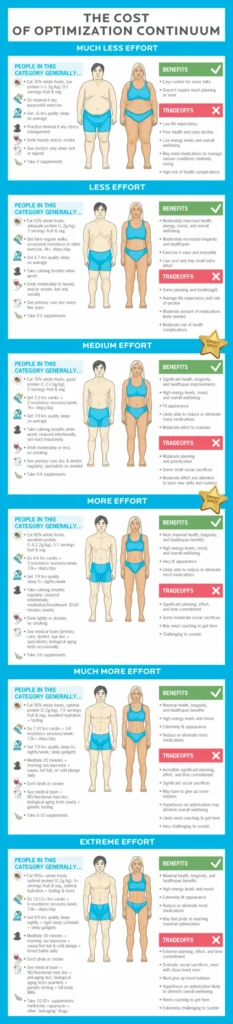
The infographic mentioned in the original article, titled "The True Cost of Optimizing Your Health," likely serves as a valuable tool in this regard, offering a visual synthesis of the effort-to-benefit ratio for various health interventions. It implicitly guides individuals toward understanding that while some advanced strategies might offer marginal gains, they often come with disproportionately high costs in terms of time, money, and mental bandwidth. Conversely, foundational practices yield substantial benefits with a relatively modest investment.
Empowering Sustainable Habits: The Role of Professional Guidance
Ultimately, achieving desired health and longevity while maintaining a fulfilling life often boils down to building sustainable habits. This is where the role of qualified professionals becomes invaluable. Unlike influencers who often promote generic, one-size-fits-all solutions, certified nutrition coaches, dietitians, and medical professionals can offer personalized guidance tailored to an individual’s unique health status, lifestyle, preferences, and goals.
Such professionals help individuals discern between hype and evidence, identify practical strategies for incorporating healthy habits into their daily routines, and manage expectations realistically. They emphasize consistency over intensity, progress over perfection, and the integration of health practices into a life that is genuinely enjoyed, rather than one dictated by rigid rules. The focus shifts from merely extending life to enriching it—ensuring that the pursuit of longevity enhances, rather than detracts from, overall well-being.
The accompanying article, "The True Cost of ‘Optimal’ Health—Here’s what it really takes to live as long and healthy as possible," further elaborates on this perspective, suggesting that true longevity and health are not found in extreme measures, but in the consistent application of well-understood, evidence-based practices that prioritize overall quality of life. The greatest investment may not be in the latest supplement or biohacking device, but in cultivating mindful habits, fostering resilience, and nurturing a balanced approach to health that recognizes the interconnectedness of physical, mental, and social well-being. This comprehensive understanding allows individuals to pursue their health goals with clarity, purpose, and a sense of enduring enjoyment.